


Quick Answer:
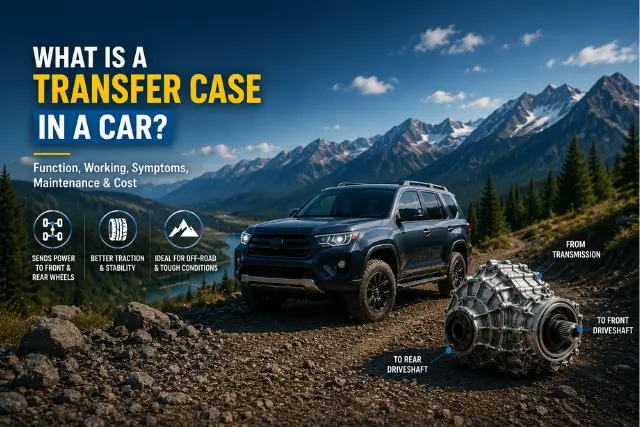
The transfer case in a car is one part of the driveline of 4WD and AWD vehicles. It transfers power from the transmission to the front and rear axles and enables four-wheel drive. When all four wheels have drive power, the transfer case is much better than in an RWD vehicle for traction, stability, and off-road conditions like snow, mud, gravel, and rough terrain.
What is a Transfer Case in a Car?
Ever wanted to know what a transfer case on a car is? A transfer case is a drivetrain component located between the transmission and the driveshafts in AWD and 4WD vehicles.
The transfer case receives power from the transmission and distributes it to the front and rear driveshafts. Without a transfer case, a vehicle would not be able to power all four wheels. Understanding how power reaches different drivetrain components is easier when you know how a drive axle works on a truck.
Transfer cases are usually found on:
- Pickup trucks
- SUVs
- Off-road vehicles
- AWD crossovers
- 4×4 vehicles
What Does a Transfer Case Do?
The primary job of a transfer case is to transmit engine power to more than one axle.
A transfer case can help with:
- On-road traction on low-traction roads
- Drive power to the front and rear wheels in a 4WD car
- On-road and off-road capabilities
- Switching between 2WD and 4WD depending on the car’s requirements
- Stability when tackling uneven terrain
If you are looking for the answer to ‘What does a transfer case do in a car?’, then the basic answer is it sends power to the front and rear wheels when more traction is required.
How Does a Transfer Case Work?
The transfer case is attached to the transmission.
The process works like this:
- The engine creates power.
- The transmission adjusts power delivery.
- The transfer case receives power from the transmission.
- The transfer case sends power to the front and rear driveshafts.
- Power reaches the wheels through the differentials.
Depending on the system, power may be distributed equally or automatically adjusted between axles.
Types of Transfer Cases
Part-Time Transfer Case
Part-time transfer cases allow drivers to manually engage 4WD when conditions require extra traction.
Common in:
- Jeep Wrangler
- Toyota Tacoma
- Ford Bronco
Full-Time Transfer Case
Full-time transfer cases continuously send power to all four wheels and automatically adjust torque distribution.
Common in:
- AWD SUVs
- Luxury crossovers
- Modern all-wheel-drive vehicles
Electronic Transfer Case
Many modern vehicles use electronic transfer cases that can switch drive modes through a dashboard control.
Transfer Case vs Transmission
Many drivers confuse the transmission and transfer case.
| Feature | Transfer Case | Transmission |
|---|---|---|
| Purpose | Distributes power to axles | Changes gear ratios |
| Found In | AWD & 4WD vehicles | All vehicles |
| Connected To | Driveshafts | Engine |
| Controls | Power distribution | Speed & torque |
| Maintenance | Fluid service required | Fluid service required |
| Replacement Cost | $1,500–$4,000+ | $3,000–$8,000+ |
The transfer case works with the transmission but is a completely separate component.
Where Is the Transfer Case Located?
Normally, the transfer case is bolted directly behind the transmission.
On most trucks and SUVs, the transfer case is located underneath the vehicle, just behind the transmission at the center point of the drivetrain.
Can You Drive Without a Transfer Case?
No. AWD and 4WD vehicles rely on the transfer case to distribute power between the front and rear axles. If the transfer case fails, the vehicle may lose power to one or more wheels and become unsafe to drive.
Common Transfer Case Problems
A failing transfer case may cause:
- Grinding noises
- Whining sounds
- Fluid leaks
- Difficulty shifting into 4WD
- Vehicle vibration, especially if other drivetrain components have been damaged. In severe cases, drivers may eventually need to sell a car for parts if major drivetrain repairs become uneconomical.
- Poor power delivery
Ignoring transfer case issues can lead to expensive drivetrain repairs.
What are the Symptoms of a Bad Transfer Case?
Typical symptoms are:
- Noises – These can be grating, grinding, or humming. These could be the cause of internal wear of bearings, gears, or splines inside the transfer case itself.
- Inability to change drive modes – if the AWD system feels like it’s “stuck” in one particular mode. This is generally an issue with the transfer case itself.
- Fluid leaks – there are special oils that are used in a transfer case; if the case is not leaking, it will eventually start to run dry on its lubricants, causing serious damage to the internal workings of the transfer case.
- Warning lights – this can also be indicated on your dashboard by the ‘AWD’ light or ‘Service 4WD’ warning light. Similar dashboard alerts can occur when other systems trigger a check engine light while driving.
- Sudden jerky or slipping feeling while driving/accelerating. This indicates the clutches or chains within the transfer case might be worn out.
What Is Transfer Case Fluid?
The fluid within the transfer case is responsible for the internal mechanisms such as gears and bearings, as well as everything else inside it. Over time, this fluid can break down and become less effective. Just like coolant maintenance, vehicle owners should understand how to add radiator fluid to a car as part of regular vehicle care.
Almost all manufacturers recommend transfer case fluid inspections according to the maintenance schedule outlined in the owner’s manual. Vehicle owners can also review drivetrain maintenance recommendations from the National Highway Traffic Safety Administration (NHTSA).
Can a Bad Transfer Case Cause Transmission Problems?
Yes. A failing transfer case can cause added stress to the drivetrain components and can cause many similar symptoms to transmission issues. But the transmission and the transfer case are separate units, and each must be diagnosed individually.
How Often Should a Transfer Case Be Serviced?
Transfer case fluid needs to be checked or serviced every 30,000-50,000 miles for most Mazdas with i-Activ AWD, although this varies greatly depending on conditions. Severe conditions include driving in inclement weather for extended periods of time or towing large loads, as well as driving off-road on dirt or gravel roads.
During a transfer case service, technicians will:
- Look at the transfer case for any signs of leaks or damage.
- Empty old fluid and look for any shavings.
- Refill with the recommended Mazda-approved transfer case fluid.
- Check the operation of the system. The AWD should engage when the vehicle is put in this mode.
This prevents wear on the gears, chain, and bearings in the system. Also protects from the heat and friction that would result.
Why is transfer case maintenance so important?
Now that we have the transfer case described, the importance of it being properly maintained can be better understood. In the transfer case, the fluid has many important tasks because of the amount of heat and pressure it experiences. It is a key part of protecting components within the transfer case and will eventually start to degrade, become contaminated, or even leak out of the transfer case. Failure of internal components can occur due to inadequate lubrication. The Car Care Council also recommends following manufacturer maintenance schedules to avoid expensive drivetrain repairs.
A failed transfer case can cause:
- Loss of power to one or more wheels.
- Difficulty maintaining traction in poor conditions.
- Grinding noises or vibration while driving.
- Damage to connected drivetrain components like the driveshaft or transmission.
A replacement transfer case is expensive to buy, but cheap to maintain. It’s one of the easiest ways to prolong vehicle life, and its ability to perform – without breaking your bank account – is the service of its fluids.
How Much Does a Transfer Case Replacement Cost?
Transfer case repair costs vary by vehicle. Consumers can compare average repair estimates using resources from Kelley Blue Book Repair Guide.
Typical ranges:
- Fluid service: $100–$250
- Minor repairs: $300–$1,000
- Rebuild: $1,000–$2,500
- Full replacement: $1,500–$4,000+
Luxury and heavy-duty trucks often cost more.
Conclusion
The transfer case is one of the most important drivetrain components in AWD and 4WD vehicles. It transfers power from the transmission to the front and rear axles, helping improve traction, stability, and off-road capability. Regular transfer case fluid changes and inspections can prevent costly repairs and ensure your four-wheel-drive system continues to operate smoothly for years to come.
Frequently Asked Questions (FAQs)
Can the transfer case only be on a 4WD vehicle?
No. AWD vehicles often use transfer cases in addition to 4WD vehicles for power transfer.
What does a transfer case do?
A transfer case distributes power to the front and rear wheels from the transmission.
What happens if a transfer case fails?
Expect to deal with fluid leaks, odd noises, shift difficulties, vibration, or no four-wheel drive.
Is the transfer case a part of the transmission?
No. It is part of the drivetrain and works separately from the transmission.
What is a transfer case on a truck?
Transfer cases on trucks are responsible for channeling the power that comes from the transmission and sending it to the front and rear axles in order for you to drive your truck in 4×4 mode and obtain full traction.
How do I know if my transfer case needs repair?
Common warning signs include grinding noises, fluid leaks, difficulty engaging 4WD, vibrations, and dashboard AWD warnings.
Can I drive with a bad transfer case?
In some cases, yes, but continued driving can cause damage to the transmission, driveshafts, and differentials. Inspection should be scheduled as soon as possible.
Does every AWD vehicle have a transfer case?
Most AWD vehicles use a transfer case or a similar power-transfer unit to distribute power between the front and rear wheels.
What fluid goes in a transfer case?
The correct fluid varies by manufacturer and vehicle model. Always use the fluid specified in the owner’s manual.
Is transfer case maintenance expensive?
No. Fluid service usually costs between $100 and $250, making it much cheaper than repairing or replacing a damaged transfer case.
Reviewed by Automotive Research Team
This article was reviewed for accuracy using vehicle manufacturer documentation, drivetrain system references, automotive repair resources, and publicly available information related to transfer cases, AWD and 4WD systems, drivetrain maintenance, and vehicle repair procedures available at the time of writing.