


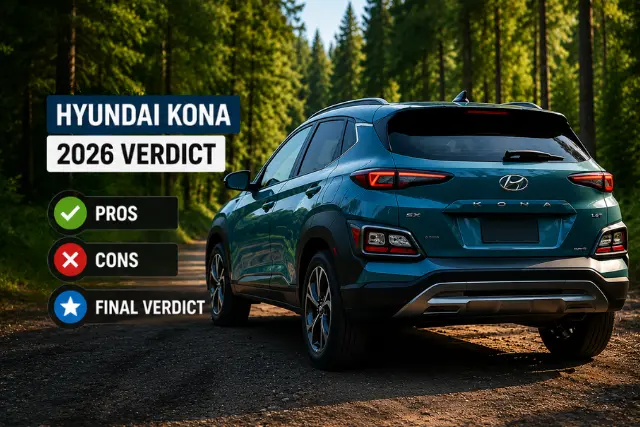
Written by the AutoMagToday Content Team | Reviewed by Nitish Ranjan, Automotive Review Expert, automagtoday.com | Last updated: July 2026
Quick Answer:
So, is the 2026 Hyundai Kona a good car? The verdict is yes. The Kona has a predicted 84/100 reliability rating from the U.S. News and a 7.9/10 score from Edmunds.
Additionally, it’s been honored as the KBB Best Buy Subcompact SUV of 2026. Other attributes that work in its favor include:EPA-estimated 31 MPG combined (FWD); 25.5 cu ft of cargo space;available AWD on every trim; a 10-year/100,000-mile powertrain warranty (unmatched industrywide);best trim – SEL Premium, for its turbo engine, and negative factors include,a base engine that feels a bit weak on the freeway;and a somewhat rigid suspension on less-than-smooth pavement.
It keeps showing up on best-of lists. It won KBB’s Subcompact SUV Best Buy Award. It comes with one of the best factory warranties in the industry. And yet — if you Google ‘is the Hyundai Kona a good car’, you will find plenty of mixed opinions alongside the glowing ones. So what is the real story?
The honest answer is yes — the Hyundai Kona is a genuinely good car in 2026. But it is not the right car for everyone, and some trims are significantly better buys than others. This guide breaks down exactly what makes the Kona worth considering — and what to watch out for — so you can make a properly informed decision. If you’re researching multiple compact SUVs before buying, it’s also worth comparing whether the Kia Soul is a good car and how it stacks up against other practical crossovers.
Quick Overview:
| Category | Rating |
| Reliability | 8.5/10 |
| Fuel Economy | 8/10 |
| Comfort | 7.5/10 |
| Safety | 9/10 |
| Technology | 8.5/10 |
| Value | 9/10 |
| Overall | 8.5/10 |
What is the Hyundai Kona?
The Hyundai Kona is a subcompact SUV; in a currently fierce part of the car market that includes strong competitors from Nissan, Honda, Toyota and Mazda. In its second generation now with a full design over the current car for 2024, the 2026 Kona has expanded somewhat and offers unique external design, and enhanced internal qualities compared with the more cramped first generation.
Hyundai Kona trim lines of the SE, SEL Sport, SEL Premium and Limited are each sold at MSRP with each of our two Kona engine options. Standard on all versions will now be front wheel-drive along with all wheel drive for an additional cost of $1,500; both are available across all trim packages.
The all new Kona Electric will be reported in an additional story.
| Specification | 2026 Hyundai Kona Detail |
| Class | Subcompact SUV (5-door, 5-seat) |
| Base Engine | 2.0L 4-cylinder, 147 hp (SE, SEL Sport) |
| Turbo Engine | 1.6L turbocharged, 190 hp, 195 lb-ft of torque (SEL Premium, Limited) |
| Transmission | CVT (base) / 8-speed automatic (turbo trims) |
| Drive Options | Front-wheel drive standard; AWD +$1,500 on all trims |
| Fuel Economy (FWD 2.0L) | EPA estimated 31 MPG combined (28/35 city/highway) |
| Fuel Economy (AWD turbo) | 28 MPG combined city/highway |
| Cargo Space (rear seats up) | 25.5 cubic feet |
| Cargo Space (rear seats folded) | 63.7 cubic feet |
| Starting MSRP | $25,350 (SE) — $32,650 (Limited) |
| Predicted Reliability Score | 84/100 — ‘Great’ (U.S. News, 2026) |
| Warranty | 5-year/60,000-mile bumper-to-bumper; 10-year/100,000-mile powertrain |
| IIHS Safety | Top Safety Pick (multiple categories rated Good) |
| KBB Award | Best Buy Subcompact SUV 2026 |
Is the Hyundai Kona Reliable? The 2026 Data
Reliability is where the Hyundai Kona has made its biggest strides — especially with the second-generation redesign launched for 2024. You can also review the official safety ratings and crash-test information on the Insurance Institute for Highway Safety (IIHS) website.
Here is what the key sources say:
| Source | Rating / Finding |
| U.S. News Predicted Reliability (2026) | 84/100 — rated ‘Great’ (81–90 range) |
| Edmunds Consumer Rating | 4 out of 5 stars (based on 31 reviews) |
| KBB Overall Rating | Top-ranked subcompact SUV for 2026 |
| Consumer Reports (2026) | Road Test Score: 28/100 — notes firm ride; reliability improving |
| Hyundai Warranty | Best in class: 5yr/60k bumper-to-bumper + 10yr/100k powertrain |
| Owner Satisfaction (KBB) | Strong — multiple reviewers noting significant improvement over 2021–2023 models |
Great, so that is 84/100 for the 2026 Kona; there are few, if any, other vehicles at this trim that reach ‘Great’ reliability (especially compared to their peers at the ‘Best’ tier). One owner mentioned this on KBB: “2026 Kona is a thousand percent better than my 2021. The handling is better, it’s smooth on the suspension, and is nicer in the interior.”
Worth noting: the first-generation Kona (2018–2023) had some reliability concerns, particularly around engine performance and stiffness complaints. The redesigned second-gen model has resolved most of these. If buying used, the 2024–2026 models are the safer pick. Before purchasing any used vehicle, it’s also a good idea to check the vehicle’s history report to verify ownership records, accidents, and maintenance history.
Hyundai Kona Fuel Economy – How Good is the MPG in 2026?
The Kona offers two very different fuel economy profiles depending on which engine you choose — and the difference matters if running costs are a priority:
| Engine / Drive | City MPG | Highway MPG | Combined MPG | Best For |
| 2.0L FWD (SE, SEL Sport) | 28 | 35 | EPA estimated 31 MPG combined | Budget buyers — maximum fuel savings |
| 2.0L AWD (SE, SEL Sport) | 26 | 32 | 28 MPG combined city/highway | All-weather + economy balance |
| 1.6T FWD (SEL Premium, Limited) | 25 | 28 | 26–27 MPG combined | Performance buyers — turbo punch |
| 1.6T AWD (SEL Premium, Limited) | 24 | 28 | 26 MPG combined city/highway | Performance + AWD — best of both |
- The base 2.0L with front-wheel drive achieving an EPA estimated 31 MPG combined is the efficiency champion of the lineup — and one of the better numbers in the small SUVs segment.
- In real-world driving, Edmunds averaged 27.6 MPG on their test route with the AWD turbo model, which tracks with EPA estimates.
- One KBB reviewer reported 35 MPG in real use with the base engine in sport mode — above the EPA figure.
- As a comparison, the Toyota Corolla Cross earns 31 MPG on combined driving with its FWD engine – that’s comparable to the entry Kona’s rating.
- The Honda HR-V boasts 28 MPG combined. Fuel economy is excellent with the base Kona SE model compared with this class.
Official fuel economy estimates can also be verified using the U.S. Environmental Protection Agency Fuel Economy database.
Hyundai Kona Pros and Cons — The Honest List
Every vehicle has strengths and weaknesses, and the Hyundai Kona is no exception. Understanding where it excels—and where it falls short—can help you decide whether it’s the right SUV for your driving needs and budget.
What’s Great About the Hyundai Kona
- Best warranty in the segment: The 10-year/100,000-mile powertrain warranty is industry-leading — no other mainstream subcompact SUV comes close. This alone is a compelling reason to choose the Kona over a rival. If you’re comparing long-term ownership costs across different brands, it’s also helpful to check whether Ford Mustangs are reliable to understand how reliability varies between manufacturers and vehicle types.
- AWD available on every trim: Unlike many competitors that gate AWD to upper trims only, the Hyundai Kona offers AWD for a flat $1,500 on SE through Limited. That is a significant advantage for buyers in snow-heavy states.
- Strong fuel economy on base engine: The EPA estimated 31 MPG combined on the FWD 2.0L is excellent value for daily commuting costs.
- Comprehensive standard safety tech: Hyundai’s SmartSense ADAS suite comes standard on all trims — including blind spot warning, rear cross traffic alert, lane keeping assistance, and forward collision avoidance. Safety is not gated behind expensive packages.
- Roomy interior for the class: The second-gen Kona grew larger and the interior shows it. Rear seat legroom at 38.2 inches is genuinely good for a subcompact SUV. Three adults across the back is possible — not comfortable for long trips, but workable.
- Plenty of cargo space: 25.5 cubic feet in back with the seats up – 63.7 cubic feet with them down – easily beats most compacts.
- Turbo engine: Go with the 1.6L with 190 hp and 195 lb-ft and the Kona is a completely different animal; 60 mph jumps ahead much more quickly and it merges on the highway a breeze.
- Standard wireless Apple CarPlay and Android Auto: Standard on all trims — no cables, no hassle.Wireless Apple CarPlay and Android Auto still isn’t ubiquitous in the segment.
- IIHS Top Safety Pick: The Kona achieved Good scores in all major IIHS crash categories – enough for Top Safety Pick designation – so you know you’ll be riding in an extra safe ride.
What’s Not So Great
- The base engine feels sluggish at highway pace: 147 hp in the 2.0L cylinder engine is fine for city driving and light commuting. But merging onto fast highways or overtaking trucks can feel laboured. If you drive motorways regularly, budget for the turbo trim.
- Firm ride on rough roads: Consumer Reports flagged this consistently — the Kona’s suspension, while improved from Gen 1, still transmits bumps and potholes into the cabin more than the Honda HR-V or Toyota Corolla Cross.
- Road noise at speed: The cabin is not the quietest in the segment. Highway cruising above 65 mph brings noticeable wind and road noise — particularly on non-limited trims.
- Turbo power delivery is abrupt: The 1.6L turbo is powerful, but Consumer Reports notes it is not always smooth or predictable. The transition from low-end pull to full turbo boost can feel unrefined.
- Hyundai reduced some features on 2026 Limited: The Limited trim no longer includes a powered passenger seat or garage door opener — something Edmunds reviewers specifically called out as a step backwards for the top trim.
2026 Hyundai Kona Trim Guide — Which One Should You Buy?
The Kona offers four trim levels in 2026. Here is a clear breakdown to help you pick the right one without overpaying:
| Trim | MSRP | Engine | Key Features | Best For |
| SE | $25,350 | 2.0L 147hp | SmartSense safety suite, 8-inch touchscreen, wireless Apple CarPlay and Android Auto, cloth seats, 16-inch alloys | Budget buyers who want full safety tech at lowest price |
| SEL Sport | $26,675 | 2.0L 147hp | Adds: 18-inch black alloys, blind spot warning active, gloss black mirrors, rear spoiler | Buyers wanting style upgrades over SE without the turbo price jump |
| SEL Premium | $28,550 | 1.6T 190hp | Adds: turbo engine, 8-speed auto, 10.25-inch touchscreen, heated front seats, wireless charging | Best value pick — turbo punch + most wanted features |
| Limited | $32,650 | 1.6T 190hp | Adds: 19-inch wheels, HDA, parking sensors, ventilated seats, Bose audio, sunroof | Buyers wanting near-luxury feel in a subcompact SUV |
Our Pick: The SEL Premium at $28,550 is the sweet spot of the 2026 Kona lineup. It steps up to the 1.6L turbo producing 190 hp and 195 lb-ft of torque, gains the 10.25-inch touchscreen and wireless charging, and adds heated front seats — all for $1,875 over the SEL Sport. That is exceptional value for the upgrade received.
Hyundai Kona Years to Avoid — Used Buyer Guide 2026
If you are considering used, model year matters significantly with the Hyundai Kona. The first generation (2018–2023) and second generation (2024+) are very different cars:
| Year Range | Verdict | Key Notes for 2026 Used Buyers |
| 2018–2019 (Gen 1) | Acceptable used buy | Original design. Cramped cabin vs Gen 2. Reliable enough. Good as a budget used option only. |
| 2020–2023 (Gen 1 late) | Use caution | Some reliability complaints around engine performance and ride stiffness. Not recommended over Gen 2 unless price is very low. |
| 2024–2025 (Gen 2) | Best used buy ✓ | Full redesign. Larger, roomier, improved reliability. Target these if buying used. May have remaining warranty. |
| 2026 (Gen 2 current) | Buy new ✓ | Best version yet. Predicted reliability 84/100. Full warranty coverage. SEL Premium is the value pick. |
Is the Hyundai Kona Worth Buying in 2026?
Is the Hyundai Kona a Good Car for Seniors?
Yes — with caveats. The Hyundai Kona sits at a comfortable height for getting in and out. The standard SmartSense suite with blind spot warning, rear cross traffic alert, and lane keeping assistance actively supports older drivers on familiar and unfamiliar roads. The firm ride on poor surfaces may be uncomfortable for those with back or joint issues — in which case the Honda HR-V’s softer suspension may be a better fit.
Is the Hyundai Kona Electric a Good Car?
The Hyundai Kona Electric is reviewed as a separate model. Multiple KBB reviewers advise against it at current lease pricing — one owner explicitly noted ‘Don’t overpay or buy the EV version.’ The gasoline Kona currently offers significantly better value for most buyers in 2026 unless you have reliable home charging. If you’re also comparing other electric SUVs, you may want to explore the Tesla Model 3 price in the USA before making a decision.
Is the Hyundai Kona Hybrid a Good Car?
There is no traditional hybrid powertrain in the US-market Hyundai Kona lineup for 2026 — just the gasoline and electric versions. If you want a hybrid in this segment, the Toyota Corolla Cross Hybrid (around 42 MPG combined) is a strong alternative.
Is the Hyundai Kona N Line a Good Car?
The N Line styling package is available on the Kona SEL Sport trim, adding sportier exterior detailing. It uses the same 2.0L base engine — so it looks sportier than it drives. If you want genuine performance, step up to the SEL Premium for the 1.6L turbo and 195 lb-ft of torque rather than paying for N Line aesthetics on the base engine.
Hyundai Kona vs Rivals — How Does it Compare in 2026?
The small SUVs segment is arguably the most competitive in the US market right now. Here is how the Kona lines up against its closest alternatives:
| Car | Starting Price | MPG Combined | AWD? | Reliability | Key Advantage vs Kona |
| Hyundai Kona | $25,350 | 31 MPG (FWD) | Yes — all trims | 84/100 Predicted | Best warranty; AWD on all trims; turbo option |
| Toyota Corolla Cross | $23,700 | 31–42 MPG | Yes (optional) | Very high | Better resale value; Hybrid option (42 MPG) |
| Honda HR-V | $25,200 | 28 MPG | Yes (optional) | High | Softer ride; better NVH; classier interior |
| Nissan Kicks | $20,400 | 31 MPG | No AWD option | Average | Cheapest entry; no AWD available anywhere |
| Mazda CX-30 | $26,000 | 28–30 MPG | Yes (optional) | High | Premium interior feel; better driving dynamics |
| Kia Seltos | $25,000 | 29–32 MPG | Yes (optional) | Good | More power on turbo; similar warranty to Kona |
| Chevrolet Trax | $19,995 | 28 MPG | No AWD option | Below avg | Lowest price; no AWD; weaker reliability |
The Toyota Corolla Cross is the Kona’s sharpest rival in 2026 — particularly the Hybrid variant. If maximum fuel economy matters above all and you do not need the turbo’s punch, the Corolla Cross Hybrid at 42 MPG combined is hard to argue against. But the Kona counters with a better warranty, AWD on every trim, and a stronger turbo engine option that the Corolla Cross cannot match. The Toyota Corolla Cross is the Kona’s sharpest rival in 2026, but buyers looking for a larger family SUV may also find it useful to compare the Toyota Sequoia and Ford Expedition before making a final purchase decision.
The Kona beats the HR-V on cargo space and 25.5 cubic feet vs HR-V’s 24.4 cubic feet, and adds an AWD turbo that the HR-V does not offer. The trade-off is a firmer, noisier ride where the HR-V is smoother.
Final Verdict
Yes — the Hyundai Kona is a good car in 2026. KBB agrees. U.S. News agrees. And 2026 owners are reporting it as a significant step up from even the recent prior generations.
What you get is a well-rounded subcompact SUV with exceptional safety coverage, AWD across the full lineup, a turbo option that gives it real performance credentials, wireless Apple CarPlay and Android Auto standard, and the best powertrain warranty in the industry. The fuel economy on the base FWD model — EPA estimated 31 MPG combined — is competitive with anything in the segment.
The things to be clear-eyed about: the base cylinder engine is adequate but uninspiring, the ride is firmer than the HR-V, and road noise at highway speed is noticeable. If a plush, whisper-quiet cabin is your priority, the Honda HR-V edges ahead. If you want AWD availability, a turbo option, and a warranty that rivals cannot touch — the Hyundai Kona makes a compelling case.
Frequently Asked Questions
Is the Hyundai Kona a good car in 2026?
Yes. The 2026 Hyundai Kona is one of the best small SUVs in its class — earning KBB’s Best Buy Award, a predicted reliability score of 84/100, and near-universal praise for its features-per-dollar value. The main caveats are a firm ride and a base engine that struggles at highway pace.
Is the 2026 Hyundai Kona a good car to buy new?
Yes — the 2026 model is the current version and the best-equipped Kona yet. The SEL Premium at $28,550 is the strongest buy, adding the 1.6L turbo producing 190 hp and 195 lb-ft of torque, 10.25-inch touchscreen, and heated seats at a fair step up from the base price.
Is the 2025 Hyundai Kona a good car?
Yes — the 2025 Kona is essentially the same vehicle as the 2026 with minimal changes. If you find a certified pre-owned 2025, it is an excellent buy with significant remaining warranty coverage and the same core quality as the 2026 model.
Is the 2023 Hyundai Kona a good car?
The 2023 Kona is first-generation — before the 2024 redesign. It is a fundamentally different, smaller, and less refined car. Consumer Reports noted a stiff ride and cramped cabin on first-gen models. It is acceptable at a very low price point used, but the Gen 2 (2024+) is significantly better.
Is the Hyundai Kona a good car for seniors?
Mostly yes. Comfortable seating height, standard blind spot monitoring, rear cross traffic alert, and lane keeping assistance make the Kona well-suited for older drivers. The firm ride on rough roads may be uncomfortable for those with back sensitivity — in that case, the Honda HR-V may be more comfortable.
Is the Hyundai Kona a good first car?
Yes — the Hyundai Kona makes an excellent first car. It is easy to park, has great all-round visibility, and comes loaded with safety tech at the base trim. The 10-year powertrain warranty provides unusually strong peace of mind for a first-time buyer. Budget for the SE or SEL Sport to keep costs manageable.
Is the Hyundai Kona a good car for a family?
For a small family — yes. The Kona seats five, offers 25.5 cubic feet of cargo space (63.7 folded), and includes a comprehensive safety suite. It is not the choice for families regularly carrying three adults in the back or needing maximum luggage room — a Hyundai Tucson would be more appropriate. But for one-child families and couples, the Kona works well.
Is the Hyundai Kona SEL a good car?
The SEL designation applies to both the SEL Sport (2.0L base engine) and SEL Premium (1.6L turbo). If you mean the SEL Sport, it is a solid mid-spec option — good looks, full safety kit, but the base engine. If your budget stretches to the SEL Premium, that is where the Kona really comes into its own with the turbo engine and 195 lb-ft of torque.