


Quick Answer:
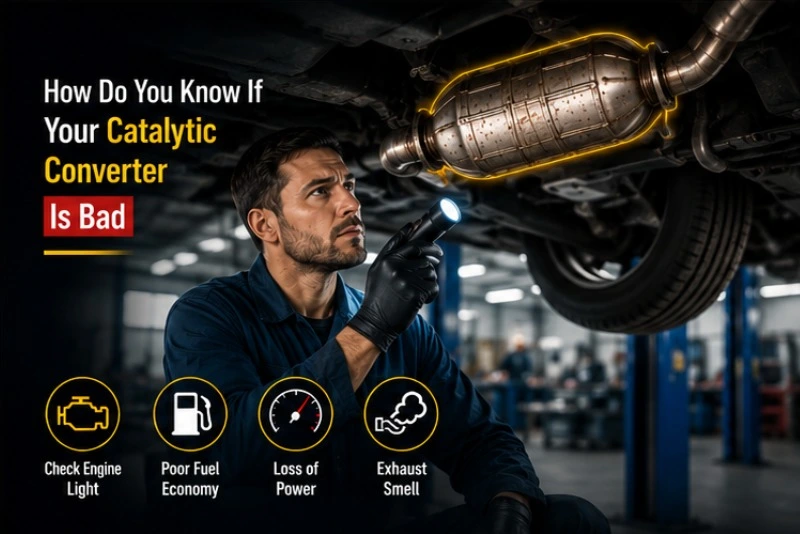
Are you questioning, “How do you know if your catalytic converter is bad?” Then here are 6 signs to look for:
- Your check engine light turns on
- Poor acceleration and loss of engine power
- Decreased fuel economy
- Smell of rotten eggs/sulfur in exhaust
- Rough idle or misfires in the engine
- Rattles coming from underneath the vehicle
If you find any one or several of these symptoms in your vehicle, then you absolutely need to get it into the shop before you do more damage to the inside of the engine/exhaust system.
To you, I would ask the question: how would you know your catalytic converter is bad? Your car usually makes obvious warning signals of a bad catalytic converter, such as the Check Engine Light on, poor acceleration of the car, bad fuel efficiency, an engine misfire, odor in the exhaust, and rattling sounds from under your car.
Unfortunately, most owners tend to confuse bad catalytic converter symptoms for another type of engine problem and do not take it in for repair until the problem is major and costly to repair. The nice part is that there are typically several warning signals your car gives off before a complete catalytic converter failure. By diagnosing these symptoms promptly, you will save yourself thousands of dollars in repairs, your car will have better fuel efficiency, and overall perform better.
If your check engine light is already on, it’s a good idea to understand what it means before replacing expensive components. We will discuss the most common catalytic converter symptoms, their causes, repair, and replacement.
What Does a Bad Catalytic Converter Do?
Before identifying the symptoms, it’s helpful to understand what a catalytic converter does and why it’s important.
A catalytic converter is a pollution control device in your vehicle that is situated within your exhaust system. It holds the precious metals platinum, palladium, and rhodium to convert noxious gases, which occur during burning, to an output of gases that is less damaging to the atmosphere before release.
Without a functioning catalytic converter, your vehicle may:
- Produce excessive emissions
- Fail emissions inspections
- Experience reduced engine performance
- Consume more fuel
- Trigger dashboard warning lights
Due to its operation at such high temperatures, the catalytic converter will be prone to wearing out.
How Do You Know If Your Catalytic Converter Is Bad? 6 Warning Signs
Some of the most common and early signs of a faulty catalytic converter are:
1. Your Check Engine Light Comes On
On almost all newer vehicles, there are two O2 sensors placed around the catalytic converter that monitor exhaust emissions as they exit the system. If either one of the O2 sensors finds that the catalytic converter is not functioning properly, it will report to the ECM in a way that will set off codes. Both the P0420 code and the P0430 code relate to the catalytic converter having an issue. The check engine light is not a guarantee that the problem lies in the exhaust/emissions system, but it is typically the first thing that shows up.
While it isn’t definitive, the check engine light is one of the first indicators that your car is having issues within the exhaust/emissions system.
2. Reduced acceleration and power
Has your car seemed ‘under-powered’ of late?
If your catalytic converter is blocked, the gases cannot exit the engine easily.
This means there is backpressure in the exhaust system, which reduces engine power and the overall responsiveness of the vehicle. Some signs include:
- Reduced acceleration
- Trouble climbing hills
- Decreased power at highway speeds
- Sluggish throttle response
It will likely feel as if the car isn’t getting enough air.
3. Decreased Fuel Economy
Another common issue seen with bad catalytic converters is that they reduce the fuel economy of the vehicle. If the gases aren’t leaving efficiently, the engine is forced to overcompensate and is burning more fuel than it should be in order to expel the exhaust.
- More frequent fuel-ups
- Lower miles per gallon
- Increased fueling costs
In a case like that, you may want to have a look at your catalytic converter.
4. Rotten Egg Smell
It’s the smell that most gives a bad catalytic converter away. As combustion takes place in an engine, sulfur is created, and the catalytic converter is designed to filter it out of the exhaust system. If your converter is failing, the sulfur can leak out and smell similar to sulfur or eggs.
If your car repeatedly has a sulfur smell to it, then you should make sure that it is checked promptly.
5. Engine Misfires or Rough Idling
If your catalytic converter is damaged, it can cause other issues to arise with your engine’s normal operation. It may start to misfire, have a rough idle, or even a very hard start-up. Performance is diminished, and you may eventually find yourself having trouble getting the vehicle to turn over. If this is left for too long, repeated misfires can further damage the converter.
6. Rattling noises underneath the vehicle
One of the most obvious and recognizable symptoms that your catalytic converter is failing is the rattling coming from underneath the car, particularly when you first start the car up and then when you put your foot down on the throttle. Inside the converter, there is a ceramic honeycomb that becomes red hot under normal operating conditions, and in the case of a failed converter, the ceramic itself breaks up, and small pieces fall off into the case, causing the rattling.
What Causes a Catalytic Converter to Fail?
Several issues can contribute to catalytic converter failure:
| Symptom | Possible Cause | Should You Repair Immediately? |
|---|---|---|
| Check Engine Light | Sensor or converter issue | Yes |
| Rotten Egg Smell | Sulfur buildup | Yes |
| Loss of Power | Exhaust restriction | Yes |
| Poor Fuel Economy | Blocked converter | Yes |
| Rattling Noise | Broken honeycomb | Yes |
| Rough Idle | Engine misfire | Yes |
- Engine misfires
- Oil leaks are entering the combustion chamber
- Coolant contamination
- Running excessively rich fuel mixtures
- Physical damage from road debris
- Age and normal wear
Addressing underlying engine problems can often help prevent premature catalytic converter failure.
Can You Drive With a Bad Catalytic Converter?
Your car might still be driving, but it is not suggested to drive with a failed catalytic converter since it could cause:
- Reduced engine performance
- Poor fuel economy
- Increased emissions
- Failed emissions testing
- Expensive engine repairs
The longer the issue goes unresolved, the greater the risk of additional damage. Since a faulty catalytic converter can increase harmful vehicle emissions, it’s important to understand how emissions systems protect air quality. The U.S. Environmental Protection Agency (EPA) provides detailed information about vehicle emissions and emission control systems.
How to Diagnose a Bad Catalytic Converter
If you suspect your catalytic converter is failing, several diagnostic methods can help confirm the problem before replacing the part.
Use an OBD-II Scanner
Scan your vehicle for diagnostic trouble codes. Codes such as P0420 and P0430 are among the most common indicators of catalytic converter efficiency problems.
Check for P0420 or P0430 Codes
These codes usually indicate that the catalytic converter is no longer cleaning exhaust gases efficiently. However, they can also be triggered by faulty oxygen sensors, so additional testing may be needed.
Perform an Exhaust Backpressure Test
A mechanic can measure exhaust backpressure to determine whether the catalytic converter is clogged and restricting exhaust flow.
Measure Exhaust Temperature
Using an infrared thermometer, technicians compare the inlet and outlet temperatures of the catalytic converter. An abnormal temperature difference may indicate internal failure.
Inspect the Oxygen Sensors
Faulty oxygen sensors can mimic catalytic converter problems. Testing the sensors helps determine whether the issue is with the converter itself or another part of the emissions system. You can also learn more about vehicle safety and maintenance recommendations from the National Highway Traffic Safety Administration (NHTSA).
Listen for Rattling Sounds
If you hear a metallic rattling noise underneath the vehicle, the ceramic honeycomb inside the catalytic converter may have broken apart, indicating that replacement is likely needed.
How Much Does Catalytic Converter Replacement Cost?
Catalytic converter replacement costs vary depending on:
- Vehicle make and model, previous maintenance history, and repair records all influence replacement costs.
- OEM or aftermarket parts
- Labor rates
- Emissions requirements
Most replacements cost between $500 and $2,500+, though luxury and performance vehicles may cost significantly more. Following a regular maintenance schedule can help identify exhaust system issues early and reduce the risk of expensive repairs. The Car Care Council offers practical vehicle maintenance tips for drivers and car owners.
How Long Can You Drive With a Bad Catalytic Converter?
While your vehicle may still be drivable with a failing catalytic converter, it’s best to have it inspected and repaired as soon as possible. Continuing to drive can worsen the problem and lead to more expensive repairs. Here’s what you should keep in mind:
Short trips only
If you must drive, limit it to short trips and avoid unnecessary travel until the issue is fixed.
Avoid long-distance driving
Extended driving with a clogged or damaged catalytic converter can increase exhaust backpressure and put extra strain on the engine.
Risk of engine overheating
A restricted catalytic converter can trap exhaust gases, causing higher engine temperatures and potentially leading to overheating.
Risk of damaging O2 sensors
A failing catalytic converter can affect oxygen sensor readings, which may trigger additional fault codes and increase repair costs.
Higher repair costs if ignored
Delaying repairs can damage other exhaust and engine components, making the final repair bill much more expensive than replacing the catalytic converter early.
Final Thoughts
So you’ve been asking, “How can you tell if my catalytic converter is bad?” Well, for most cases, it simply has to do with learning the main warning signs that something is wrong with this specific part of your car. Warning lights such as the check engine light are some of the first major signs of a problem, as are a slow accelerator, poor fuel economy, a smell of sulfur, engine misfires, and any rattling.
Learning the symptoms early can help you avoid expensive repairs and keep your vehicle running efficiently with proper preventive maintenance.
Frequently Asked Questions (FAQs)
What are some indicators of a faulty catalytic converter?
A faulty catalytic converter can be signaled by an engine check light, diminished acceleration, diminished fuel efficiency, engine misfires, and a sulfurous odor (like rotten eggs) being released from the tailpipe.
What are early indicators of a failing catalytic converter?
When a catalytic converter begins to fail, the symptoms are often the presence of an engine check light, a drop in engine performance, and some unique smells.
Can a damaged catalytic converter cause a power reduction?
Absolutely; since it limits the exhaust gases being released from the engine, you can expect to have more trouble with a failing catalytic converter when you try to accelerate from your engine, therefore lowering your vehicle’s power.
How do you identify the smell of a bad catalytic converter?
If you smell a sulfur or rotten egg-like smell emanating from your car’s tailpipe, it is quite often a failing catalytic converter.
If I have a bad catalytic converter, will my engine check light come on?
Yes, often fault codes P0420 and P0430 are logged by your vehicle when your catalytic converter isn’t performing to specifications.
Is it advisable to drive a car with a bad catalytic converter?
It is, however, the reduced efficiency that may end up causing more damage or expense down the road.
What causes a catalytic converter to malfunction?
Common things that will wear out or break down your catalytic converter include oil leaks, coolant leaks, overheating, misfires, and simple wear.
Will fuel efficiency be impacted by a damaged catalytic converter?
Yes, when your catalytic converter goes bad, the engine will have to work much harder, which can have a significant impact on fuel economy.
What can I expect to pay for the replacement of a catalytic converter?
A replacement catalytic converter is usually in the $500 – $2,500 range, depending on your make and model of car.
How long will a catalytic converter normally last?
Most catalytic converters last about 10 years, but the actual duration is subject to change.
Reviewed by Automotive Research Team
Reviewed by automotive researchers and vehicle maintenance experts for technical accuracy, reliability, and current industry best practices.