


Written by the AutoMagToday Content Team | Reviewed by Anand Raj, Automotive Review Expert, AutoMagToday | Last updated: August 2026
Quick Answer:
The number of ignition coils in a car depends on the ignition system type:
Distributor system (older cars): 1 ignition coil for the entire engine
Coil pack system: 1 coil per pair of cylinders (2 for a 4-cyl, 3 for a 6-cyl, 4 for a V8)
Coil-on-plug (COP) system: 1 coil per cylinder (4, 6, 8, or more)
So a modern 4-cylinder car will typically have 4 ignition coils. A V8 could have anywhere from 4 to 8 depending on its generation and setup.
This is one of those questions which appear easier to answer than they truly are once you start peeking behind the curtain. One moment your car is running as smoothly as usual, then presto, the check engine light comes on, the mechanic is quoted on new coils and next thing you know, you are wondering: how many ignition coils does my car actually have?
Here’s everything you need to know to determine how many ignition coils your vehicle has and why the answer depends on its ignition system. If your check engine light is already on because of a suspected ignition problem, you may also want to read can you drive a car with the check engine light on?
What Does an Ignition Coil Do? (Quick Background)
Before we count coils, it helps to understand what they’re doing in the first place.
Your car’s battery produces around 12 volts of electricity. That’s not nearly enough to create a spark strong enough to ignite the air-fuel mixture inside the engine cylinders. An ignition coil is essentially a transformer, it steps up that 12-volt battery voltage to anywhere between 12,000 and 45,000 volts of high voltage electricity. That massive electrical charge then travels to the spark plug, creates a spark, and ignites the air-fuel mixture to produce combustion. If you’d like to understand how combustion differs in diesel engines, check out do diesel engines have spark plugs?
No ignition coil working properly = no spark = engine won’t run. Simple as that.
Think of it this way: The ignition coil is the muscle behind every spark plug. Without it converting low battery voltage into high voltage, your spark plugs would just be expensive metal sticks doing nothing. For a deeper explanation of modern ignition systems and automotive technology, you can also explore Bosch Automotive Technology.
The Three Types of Ignition Systems and How Many Coils Each Has
Here’s the core of it. There are three main ignition system types you’ll encounter, and each uses a different number of coils.
Pre-1980s to early 2000s (some models)
1. Distributor-Based Ignition System – 1 Coil
This is the old-school setup. A single coil sits near the distributor and handles the entire engine. The distributor’s job is to take that high-voltage electrical pulse from the single coil and physically distribute it one at a time to each spark plug via spark plug wires.
So whether you had a 4-cylinder or a V8, the answer was always the same: 1 ignition coil. The coil just had to work harder as the engine got bigger.
Distributors were still being used on many vehicles as late as 2007, so don’t assume an older car is automatically on a newer system.
Late 1980s onward – Distributorless Ignition
2. Coil Pack (DIS) – 1 Coil Per Pair of Cylinders
From around the mid-1980s, engine control modules (ECMs) started taking over ignition timing, and the distributor began to disappear. In its place came the coil pack — a rectangular housing containing multiple coils mounted together.
In this setup, each coil fires two spark plugs simultaneously in what’s called a “wasted spark” system. One plug fires on the compression stroke (doing real work), and the other fires on the exhaust stroke (the “wasted” spark that is harmless but necessary for the paired firing approach).
How many coils in a coil pack?
- 4-cylinder engine: 2 coils (firing plugs in pairs: 1&4, 2&3)
- 6-cylinder engine: 3 coils
- V8 engine: 4 coils
The coil pack itself looks like a single unit, which sometimes confuses people into thinking there’s only one coil. But inside that housing, there are multiple individual coils, one per cylinder pair.
Mid-1990s onward – Now the Standard
3. Coil-on-Plug (COP) System – 1 Coil Per Cylinder
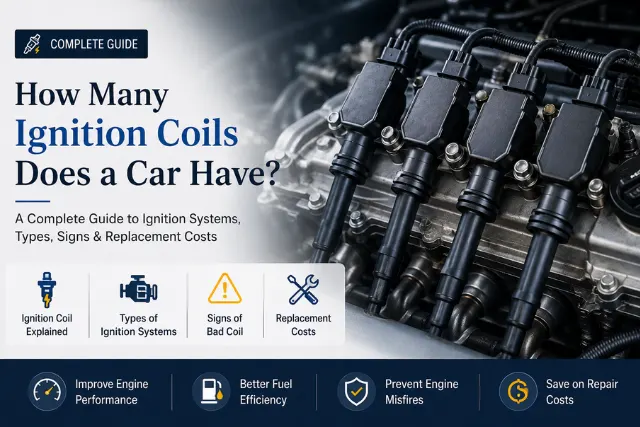
This is the modern standard. In a coil-on-plug system, each cylinder gets its own individual ignition coil sitting directly on top of the spark plug. You’ll recognise these by the pencil-shaped or cylindrical coils plugged directly into the valve cover, one per cylinder.
This is the most precise, most efficient setup because each coil fires independently, controlled by the ECM, with exact timing.
How many coils in a COP system?
- 4-cylinder engine: 4 ignition coils
- 6-cylinder engine: 6 ignition coils
- V8 engine: 8 ignition coils
- V10 engine: 10 ignition coils
This is why some cars can end up with 8 or even 10 individual coils, one for every single cylinder.
How Many Ignition Coils by Engine & System – At a Glance
| Engine Type | Distributor System | Coil Pack (DIS) | Coil-on-Plug (COP) |
| 4-Cylinder | 1 coil | 2 coils | 4 coils |
| 6-Cylinder (V6 / Inline) | 1 coil | 3 coils | 6 coils |
| V8 | 1 coil | 4 coils | 8 coils |
| V10 | 1 coil | 5 coils | 10 coils |
How Many Ignition Coils Does a 4-Cylinder Car Have?
Since this is one of the most searched questions, let’s address it directly.
A 4-cylinder car can have 1, 2, or 4 ignition coils. Here’s how to know which applies to you:
1 coil – If your car has a distributor cap and rotor, and spark plug wires running from a central distributor to each plug, you have a single coil system. Common on older 4-cylinders from the 1980s and earlier.
2 coils – If you have a coil pack (a rectangular plastic housing mounted on the engine with multiple wire connections), you likely have 2 coils in that pack. Very common on 4-cylinders from the late ’80s through the 2000s.
4 coils – If you see individual pencil coils sitting directly on each spark plug with no plug wires at all, you’re on a modern coil-on-plug setup with 4 coils. Most 4-cylinders built from the late 1990s onward use this.
Quick tip: Still not sure? Count the coils you can see on the engine. Or look up your specific make, model, and year. The ignition system type is always listed in your owner’s manual or the service manual.
A Brief History: Why Did Cars Go from 1 Coil to 8+?
It’s pretty helpful to know this whole story, as it helps explain why you have seen such disparate numbers of ignition coils when looking at different cars!
In reality, back in the 1980s, the ignition system really was that simple: ONE coil sent current to the distributor, the distributor sent that to the plug wires, and the wires to the plug – but just one cylinder at a time, electronically triggered in sequence through the distributor cap and rotor.
Then, around 1984, something changed. Engine Control Modules (ECMs) — onboard computers — started managing ignition timing electronically. Sensors like the crankshaft position sensor (tracking piston location), camshaft sensor (tracking valve position), and mass airflow sensor (MAF) began feeding real-time data to the ECM. The ECM could now calculate the optimal spark timing for every firing event, far more precisely than any mechanical distributor could manage.
With the ECM in control, having a single coil and a distributor became a limitation. Multiple coils and eventually one per cylinder let the ECM fire each plug with pinpoint precision, independently. The result: better fuel economy, more power, cleaner emissions, and longer engine life.
By 1996, the OBD2 (On-Board Diagnostics II) standard became mandatory across all cars sold in the US — a standardised diagnostic port so technicians could read fault codes. Around this time, coil packs and early coil-on-plug systems were becoming mainstream. By the mid-2000s, distributors were largely phased out, and the coil-on-plug system became the dominant setup.
The pattern is clear: As engine management systems got smarter, coil counts went up. More coils = more individual control = better combustion efficiency. Today’s engines squeeze every last bit of efficiency from each combustion event and having a dedicated coil per cylinder is a big part of how they do it.
Signs Your Ignition Coil Has Failed
Regardless of how many coils your car has, when one failed ignition coil causes problems, you’ll typically notice some or all of these symptoms:
| Symptom | Possible Cause |
|---|---|
| Check Engine Light | Misfire detected |
| Rough Idle | Weak or failed coil |
| Poor Acceleration | Cylinder misfire |
| Hard Starting | Faulty ignition coil |
| Backfiring | Incomplete combustion |
| Reduced Fuel Economy | Weak spark |
- Check engine light – This is usually the first sign. The ECM detects a misfire and logs a code (typically P0300–P0308 range for misfires, or P0350–P0362 for coil-specific faults). If your vehicle also feels underpowered or is misfiring, here’s how to tell if your catalytic converter is bad, as prolonged misfires can damage it over time.
- Engine misfire or rough idle – The affected cylinder stops contributing to combustion, causing a distinctive rough, lumpy feel, especially at idle or low speeds.
- Loss of power – When you effectively kill a cylinder, you’ll struggle with acceleration, and especially acceleration with weight or with load.
- Loss of fuel economy – That unburned fuel goes through the misfiring cylinder and you burn fuel for no reason – not to mention it will damage your cat over time.
- Difficulty starting – In severe cases, a failed coil can make the engine hard or impossible to start.
- Backfiring – Unburnt fuel igniting in the exhaust can cause occasional backfires.
Do You Need to Replace All Ignition Coils at Once?
This is one of the most common questions when an ignition coil fails, and the answer depends on your situation.
If your car has low mileage and only one coil has failed, replacing just the failed coil is perfectly reasonable. A single coil failure on a young engine is sometimes a manufacturing defect or a one-off issue.
If your car has high mileage (say, 100,000+ km) and one coil has failed, the others have been through the same wear and are likely not far behind. Many mechanics and experienced car owners recommend replacing all coils at once in this scenario. You save significantly on labour costs by doing them all in one visit rather than coming back repeatedly as each one fails.
For coil pack systems, the entire coil pack is typically replaced as a single unit regardless, since the coils inside it aren’t individually serviceable in most cases.
Always replace spark plugs at the same time as ignition coils. Worn or fouled spark plugs put extra electrical stress on coils, which is often what causes coils to fail prematurely in the first place. If you’re already paying for the labour to access the coils, doing the plugs simultaneously saves both time and money. While maintaining your engine, it’s also worth learning how many fuel injectors a car has, since both components play an important role in engine performance.
Ignition Coil Replacement Cost – What to Expect
Costs vary depending on your car, location, and how many coils need replacing. Here are rough ballpark figures to give you a realistic idea:
| Scenario | Parts Cost (Approx.) | Labour Cost (Approx.) | Total (Approx.) |
| Single COP coil (budget brand) | $15–$50 | $50–$100 | $65–$150 |
| Single COP coil (OEM / quality brand) | $40–$120 | $50–$100 | $90–$220 |
| Full set (4-cylinder, COP) | $80–$300 | $80–$150 | $160–$450 |
| Coil pack replacement | $60–$200 | $60–$120 | $120–$320 |
| Full set (V8, COP) + spark plugs | $200–$600 | $150–$300 | $350–$900 |
These are estimates – luxury European vehicles (BMW, Audi, Mercedes) often sit at the higher end or above it due to OEM part costs and labour time. Japanese and Korean vehicles tend to be much more affordable.
Key Takeaways
- Ignition coil count depends on the ignition system.
- Modern cars usually have one coil per cylinder.
- Faulty coils commonly trigger the check engine light.
- Replacing worn spark plugs helps extend coil life.
- Early diagnosis prevents catalytic converter damage.
The Bottom Line
So exactly How Many Ignition Coils Does a Car Have? On the whole the quantity varies between one and ten but relies mostly on vehicle motor dimensions along with the ignition technique. Cars possessing a distributor system contain one coil – cars and trucks possessing a coil load pack contain a 1 for two cylinders motor car including a single for two motor – and people driving Coil on Place vehicles usually possess a one for cylinder.
If you’re trying to figure out your specific car, the fastest route is looking at the engine directly or pulling up your car’s service info online. And if a check engine light is on and misfires are involved, get the coils tested — it’s one of the most common ignition system faults, and catching it early saves you from bigger problems (and a ruined catalytic converter) down the road.
Quick Tips to Extend Ignition Coil Life
- Replace spark plugs at the recommended service interval.
- Fix oil leaks that can contaminate ignition coils.
- Use high-quality replacement coils.
- Avoid driving with an active engine misfire.
- Scan diagnostic trouble codes promptly if the check engine light appears.
Frequently Asked Questions
How many ignition coils does a car have?
Depending on the ignition system your vehicle is equipped with. If it has a distributor system then it has 1 coil. If it is equipped with a coil pack then it has 2 coils per 4cyl, 3 per 6cyl, 4 per V8.Cars that have coils on plug systems each have one per cylinder (4,6,8 or more).Most cars today use the coil on plug system.
How many ignition coils does a 4-cylinder car have?
A 4-cylinder car can have 1, 2, or 4 ignition coils depending on its ignition system. Older distributor-based 4-cylinders have 1. Coil pack systems have 2. Modern coil-on-plug 4-cylinder engines have 4, one per cylinder.
What is a coil pack and how many coils does it have?
A coil pack is a single housing that contains multiple ignition coils. A 4-cylinder coil pack contains 2 coils, a 6-cylinder has 3, and a V8 has 4. Each coil in the pack fires 2 spark plugs simultaneously using a “wasted spark” method.
What’s the difference between a coil pack and coil-on-plug?
A coil pack is a grouped housing of multiple coils mounted remotely, with spark plug wires connecting to the plugs. Coil-on-plug (COP) means each cylinder has its own individual coil sitting directly on the spark plug, no wires needed. COP is the more modern, more precise system.
How do I know how many ignition coils my car has?
The easiest way: look at the engine. If you see one coil near a distributor cap with wires going to each plug — 1 coil. If you see a rectangular plastic pack with multiple wire connections — that’s a coil pack (count the towers). If you see individual pencil-shaped units sitting directly on each spark plug — that’s coil-on-plug, and you have one per cylinder.
How long do ignition coils last?
Generally ignition coils can be rated to 100-160 thousand kilometres. Poor worn sparks, oil seeping on coils, excessive temperatures, or low-quality replacements will prematurely kill coils though! Replacing sparks on time is a great start to a longer life for your coils.
Do you have to replace all ignition coils at once?
Not always, but it’s often recommended on high-mileage vehicles. If one coil has failed from wear at 150,000 km, the others are under the same strain and may fail soon. Replacing all at once saves labour costs. On low-mileage vehicles, replacing just the failed coil is usually fine.