


Written by the AutoMagToday Content Team | Reviewed by Anand Raj, Automotive Review Expert, AutoMagToday | Last updated: October 2026
Quick Answer
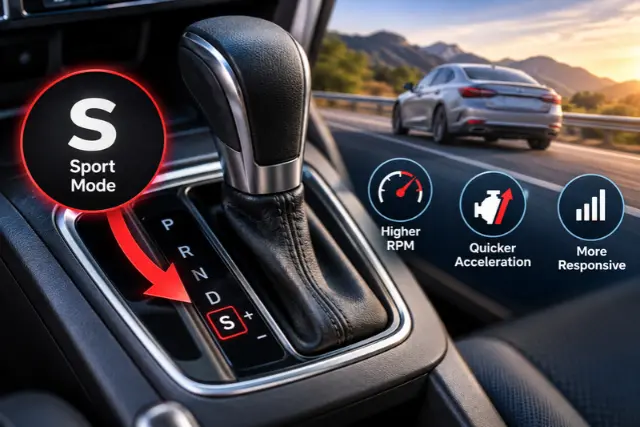
Do you know what does the S mean on a gear shift? The “S” on an automatic gear shift stands for Sport mode. It doesn’t add a gear or unlock hidden power. It swaps the transmission’s shift program: gears are held longer, upshifts happen at higher RPM, downshifts come faster, and throttle response sharpens. That makes the car feel quicker and more alert at the cost of fuel economy and cabin noise. Useful for merging, overtaking, and hilly roads. Not the choice for a long, flat commute.
You nudged the shifter one notch past Drive without meaning to, and now the engine is revving noticeably higher, the car feels twitchier under your foot, and everything sounds louder. Did you just break something?
No. You found Sport mode and it’s one of the more genuinely useful settings on your car once you know what it’s actually doing.
Key Takeaways
- S = Sport mode, a different shift program, not an extra gear
- Holds gears longer and raises engine RPM
- Improves throttle response and overtaking confidence
- Adds no horsepower whatsoever
- Safe to use. it’s a factory-designed mode
- Uses more fuel than Drive
- Different from Low (L) and from Manual (M)
What Does the S Mean on a Gear Shift?
Your gear selector runs the familiar PRNDS sequence such as Park, Reverse, Neutral, Drive, Sport. Some cars label it DS, some show S on its own, and premium brands often call the same idea Dynamic, Sport+, or S+.
Here’s the part most explanations skip: Sport mode is software, not hardware.
Selecting S doesn’t engage a different set of gears. Your transmission has exactly the same ratios it had a second ago. What changes is the logic controlling when it uses them. The transmission control module switches to a more aggressive shift map and on many modern cars, throttle mapping and steering weight shift too.
That’s why the car feels transformed while being mechanically identical.
What Actually Happens When You Shift into S?
Shift into S
↓
Transmission changes shift logic
↓
Upshifts delayed, revs held
↓
Engine stays in its power band
↓
Sharper throttle + faster downshifts
↓
Better acceleration, more engine braking
↓
Lower fuel economy
Concretely, five things change:
Upshifts are delayed: Where Drive might shift at 2,500 rpm to save fuel, Sport may hold to 4,500 or beyond.
Downshifts happen faster and more willingly: Press the accelerator and the transmission drops a gear immediately instead of hesitating.
Throttle response sharpens: The same pedal travel requests more throttle opening, which is a large part of why the car feels faster.
The engine stays in its power band: Most engines make peak torque well above idle. Holding revs keeps you there, ready to go. If you notice an unusual warning light while driving, learn what a flashing engine light means and when it needs immediate attention.
Engine braking increases: Lift off in Sport and the car slows more noticeably, because the transmission holds a lower gear instead of coasting up.
Drive (D) vs Sport (S)
| Feature | Drive (D) | Sport (S) |
| Fuel economy | Best | Lower |
| Engine RPM | Low, efficient | Higher |
| Acceleration feel | Normal | Noticeably quicker |
| Upshift timing | Early | Delayed |
| Downshift response | Slower | Immediate |
| Highway overtaking | Adequate | Better |
| Daily commuting | Ideal | Workable but wasteful |
| Engine braking | Minimal | Moderate |
| Cabin noise | Quiet | Louder |
| Ride character | Smooth | Responsive |
When Should You Use Sport Mode?
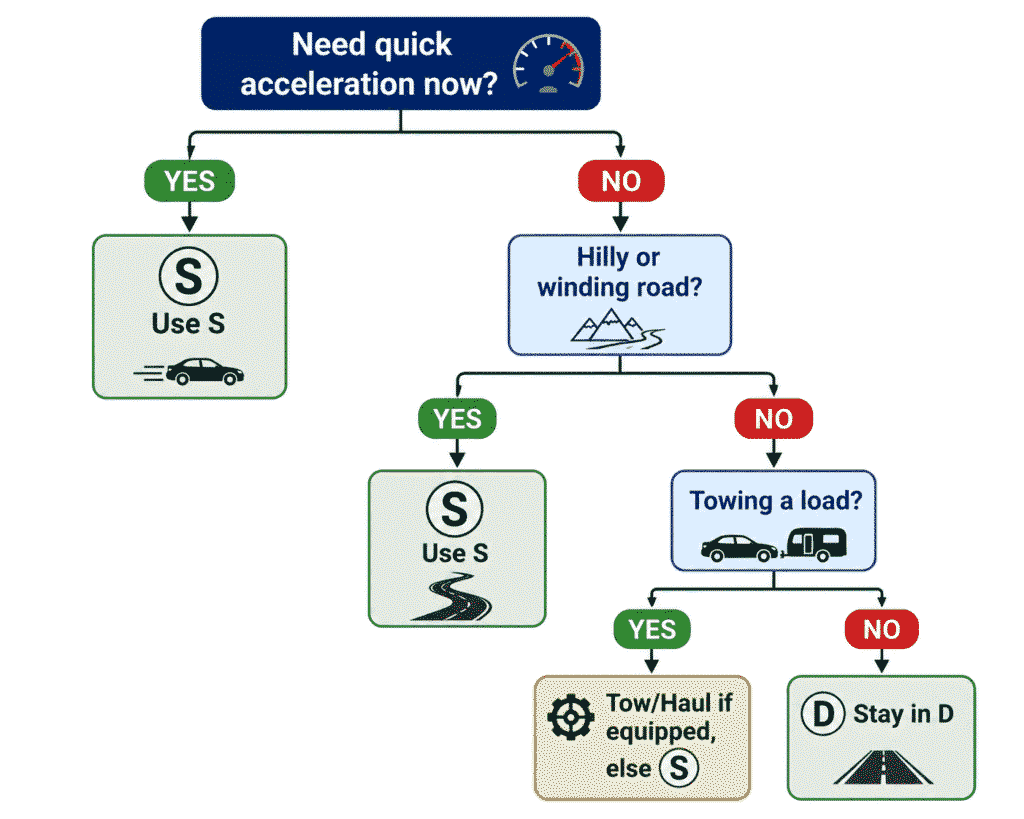
Merging onto a highway: Short on-ramps are where S earns its keep. The transmission is already in the right gear rather than scrambling to find one mid-merge.
Overtaking: Select S before you pull out, not while you’re alongside. The car is ready the instant you commit, which is exactly when you want it.
Mountain and hilly roads: Sport stops the transmission “hunting” up and down between gears on rolling terrain, and the extra engine braking helps on descents.
Winding back roads: Fewer mid-corner gear changes means a more settled, predictable car.
Passing trucks on two-lane roads: Anywhere your window to complete a manoeuvre is limited.
Towing on undulating terrain: Though if your vehicle has Tow/Haul mode, that’s purpose-built and the better choice.
Should You Shift into S? Decision Flow
When You Should Avoid Sport Mode
- Long flat highway cruising – Pure fuel waste with no benefit
- Heavy stop-and-go traffic – Jerky and tiring
- Fuel-conscious trips – S works directly against economy
- Ice and snow – See the caution below
- Everyday commuting – Drive genuinely does this better
A word on winter: Sport mode’s sharper throttle response makes it easier to apply too much torque too suddenly, which on a slippery surface means wheelspin. Some manufacturers explicitly advise against Sport in snow and ice, and many cars offer a Snow mode that does the opposite — softening throttle response and sometimes starting in second gear.
If your car has a Snow or Eco mode, that’s the one for bad weather, not S.
Does Sport Mode Damage Your Engine or Transmission?
No. Sport mode is a manufacturer-engineered setting, tested and warrantied like every other function on the car. The ECU still enforces the rev limiter, still protects the transmission, and still won’t let you do anything mechanically dangerous with the selector.
| Myth | Reality |
| “Sport mode voids your warranty” | It’s a factory feature — using it is normal operation |
| “It over-revs the engine” | The rev limiter is unchanged and still active |
| “It wears out the transmission” | Higher RPM adds heat over time, but it’s within design limits |
| “You must stop before switching” | Not on any modern automatic |
| “It unlocks hidden horsepower” | It changes gearing behaviour, not engine output |
The honest caveat: Driving exclusively in Sport for years will generate more heat cycles in the engine and transmission than a gentler life would. That’s ordinary wear, not damage. But it’s why S is best treated as a tool you reach for rather than a setting you leave on.
Does Sport Mode Use More Fuel?
Yes, and it’s not subtle.
Higher RPM means more combustion cycles per mile. Delayed upshifts keep the engine spinning faster than it needs to. Sharper throttle mapping means the same pedal movement delivers more fuel. Along with understanding driving modes, Honda Civic owners can also learn how to reset oil life on a Honda Civic to keep track of routine maintenance.
| Driving mode | Relative fuel economy |
| Eco mode (if equipped) | Best |
| Drive (D) | Very good |
| Sport (S), driven gently | Lower |
| Sport (S), driven hard | Lowest |
There’s no scenario where Sport mode improves your mileage. If someone tells you otherwise, they’re confusing it with the fact that a car in the right gear feels more efficient than one labouring in the wrong one.
Is Sport Mode Actually Faster?
Yes and no, and the distinction matters.
No, in the sense that your engine produces identical horsepower and torque in S as it does in D. Nothing is unlocked.
Yes, in the sense that the car is far better positioned to use that power. Holding a lower gear keeps the engine in its power band, so when you demand acceleration it’s immediately available rather than a gear-change away.
In practice this can produce marginally quicker real-world acceleration, mostly because you’re eliminating the hesitation of a downshift. The perceived difference is bigger than the measured one. But on a short merge lane, perception and confidence count for something.
Sport Mode vs Manual Mode (M)
| Sport (S) | Manual (M) |
| Transmission still chooses gears | You choose every gear |
| Aggressive automatic shift map | Full driver control via lever or paddles |
| No learning curve | Requires attention |
| Good for daily spirited driving | Better for track or technical roads |
| Auto-upshifts near redline | May hold gear until you shift |
Some cars label this M/S or D/S on one gate — nudging sideways gives you Sport, and tapping forward or back gives you manual control. Same lever, two functions.
Sport Mode (S) vs Low Gear (L)
This is the comparison people get wrong most often, and one your keyword data shows being searched directly.
| Sport (S) | Low (L) |
| Purpose: performance | Purpose: control and engine braking |
| Holds gears longer across the range | Locks the lowest gear or gears |
| Full speed range available | Hard speed ceiling |
| Best for merging, overtaking | Best for steep descents, towing, crawling |
| Moderate engine braking | Strong engine braking |
| Winding roads | Mountain grades, mud, boat ramps |
Simplest way to remember it: S is about going. L is about slowing.
For the full breakdown, see our guide on what the L means on a gear shift.
What About B, D3, and the Numbered Gears?
While we’re here, since these share the same shifter:
| Marking | What it means |
| B | Braking mode – common on hybrids and EVs, increases regenerative braking |
| 1 / 2 / 3 | Locks the transmission to that gear and below |
| D3 | Locks out the top gear on older automatics |
| OD | Overdrive on/off – disabling it prevents the tallest gear |
| M | Manual mode |
| S+ / Sport+ / Dynamic | More aggressive Sport variants on performance and luxury cars |
B is not S. Hybrid drivers see B and sometimes assume it’s a sport setting. It’s the opposite — it exists to slow the car and harvest energy.
Does Every Automatic Have Sport Mode?
Most modern automatics do, though the labelling varies enormously.
Honda, Toyota, Ford, Chevrolet, Nissan, Hyundai, Kia, and Mazda commonly use a plain S on the selector. Volkswagen often uses S or D/S. German luxury brands frequently use Sport, Sport+, or Dynamic, sometimes on a separate drive-mode dial rather than the shifter itself.
Some vehicles put Sport on a button or rotary controller instead. Some CVTs offer an S position that simulates stepped gear behaviour. Some hybrids skip it entirely in favour of B, Eco, and EV modes.
Because implementations differ this much, your owner’s manual is the final word on what S does in your specific vehicle. On one car it’s purely a shift map; on another it also stiffens the suspension and weights the steering.
Can You Shift Between D and S While Driving?
Yes. You don’t need to stop, brake, or lift off.
On virtually every modern automatic, moving between D and S at speed is completely normal — the transmission control module handles the transition and won’t allow anything harmful. You may feel a small shift as the transmission drops a gear to match the new program.
The practical technique: Select S before you need the performance. Shifting into Sport halfway through an overtake wastes the moment you were trying to seize.
Common Mistakes Drivers Make
- Leaving it in S permanently – you’ll pay for it at every fill-up
- Expecting more horsepower – you’re getting better gearing, not more power
- Forgetting to shift back to D after a merge or overtake
- Believing S improves fuel economy – it never does
- Confusing S with L – very different jobs
- Using S on ice or snow – sharper throttle response is the last thing you want
- Shifting into S mid-manoeuvre rather than beforehand
Expert Driving Tips
- Select S before overtaking, never during, preparation beats reaction.
- Shift back to D once you’re settled at cruising speed.
- Use S on descents for the extra engine braking; use L if the grade is genuinely steep.
- Read your manual. Sport mode is tuned differently by every manufacturer.
- Skip S in bad weather. If your car has Snow or Eco mode, that’s the correct tool.
- Pair it with decent tyres. Sharper response only helps if you have grip to use. Learn how to check tyre air pressure to help maintain tyre grip and vehicle control.
The Bottom Line
Now you have the answer for what does the S mean on a gear shift? The S on your gear shift is Sport mode, a different transmission program, not a secret power boost. It holds gears longer, sharpens throttle response, and makes the car feel considerably more eager, which is genuinely valuable when you’re merging into fast traffic or working a winding road.
Use it deliberately: Before an overtake, on a hilly stretch, when you want the car awake. Then shift back to Drive and let the transmission do what it’s optimised for.
Leave it in S all the time and all you’ll really notice is the fuel bill.
Sources:
- NHTSA
- SAE International
- ASE (National Institute for Automotive Service Excellence)
- Owner’s manuals from Toyota, Honda, Ford, GM, Mazda, Volkswagen, Hyundai, and Nissan
Frequently Asked Questions
What does S stand for on a gear shift?
Sport mode. It changes the transmission’s shift pattern to hold gears longer and improve throttle response.
Can I drive in S mode every day?
You can, it won’t harm the car. But you’ll use noticeably more fuel and get a louder, busier ride. Drive is better for commuting.
Does Sport mode hurt the transmission?
No. It’s a factory-designed mode with full ECU protection. Constant use adds heat cycles over years, but that’s normal wear, not damage.
Is S mode faster than Drive?
It feels faster and can be marginally quicker in real-world acceleration, because the car is already in the right gear. Engine output is unchanged.
Does Sport mode save fuel?
No. It always uses more than Drive.
Can I switch between D and S while driving?
Yes, at any normal speed. No need to stop or lift off.
Is Sport mode good for hills?
Yes, it prevents gear hunting on climbs and adds engine braking on descents. For very steep grades, Low (L) is better.
Does S mode increase horsepower?
No. Your engine makes exactly the same power. Sport changes how the transmission uses it.
Is Sport mode the same as manual mode?
No. Sport still shifts automatically. Manual (M) puts every gear change in your hands.
Should I use Sport mode in snow?
Generally no. Sharper throttle response encourages wheelspin. Use Snow or Eco mode if available.
Is S mode better for towing?
It helps on hilly terrain by reducing gear hunting, but Tow/Haul mode is purpose-built and preferable if your vehicle has it.
Why does my engine rev higher in Sport mode?
Because the transmission deliberately delays upshifts to keep the engine in its power band.
What’s the difference between S and B on my shifter?
S is Sport, performance-oriented. B is Braking, found on hybrids and EVs to increase regenerative braking. Opposite purposes.
What does D/S mean?
A combined gate: Drive in one position, Sport when nudged sideways. Common on Volkswagen, Audi, and several Japanese brands.
Disclaimer
This article is for informational purposes only and provides general guidance on automatic transmission Sport mode. The functions and operating recommendations of Sport mode can vary by vehicle make, model, and transmission type. Always refer to your vehicle’s owner’s manual and follow the manufacturer’s instructions for safe driving.