


Written by the AutoMagToday Content Team | Reviewed by Anand Raj, Automotive Review Expert, AutoMagToday | Last updated: September 2026
Quick Answer
What does a flashing engine light means? It usually means the vehicle has detected a serious engine fault, with a severe misfire being a common cause. Unburned fuel from a misfire can increase the risk of catalytic-converter damage. Reduce speed, avoid heavy acceleration, and safely stop as soon as possible. Have the vehicle diagnosed with an OBD-II scanner or by a qualified mechanic.
You’re merging onto the highway, the engine stumbles, and the check engine light suddenly starts pulsing on and off. It’s not glowing steadily. It’s flashing.
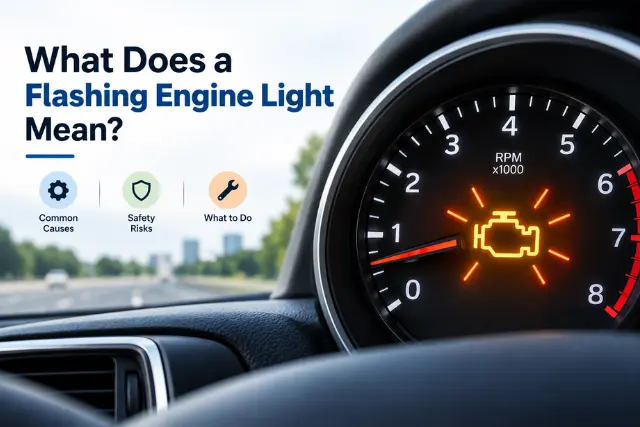
If you’re wondering what does it mean when the engine light blinks, that distinction matters. A steady check engine light can indicate a fault that needs attention, while a flashing light can signal a more urgent problem, such as a severe misfire that may damage the catalytic converter.
What Does a Flashing Engine Light Mean?
Your engine control unit continuously monitors combustion and misfire activity. When it detects a misfire severe enough to threaten emissions equipment, the malfunction indicator light (MIL) may begin flashing instead of remaining steadily illuminated.
| Warning | Meaning |
| Solid check engine light | Minor or moderate engine/emissions issue |
| Flashing check engine light | Severe engine misfire requiring immediate attention |
A flashing malfunction indicator light generally signals a more urgent emissions-related fault than a steady light. In OBD systems, flashing can be used when engine misfire is severe enough to pose an imminent risk to the catalytic converter.
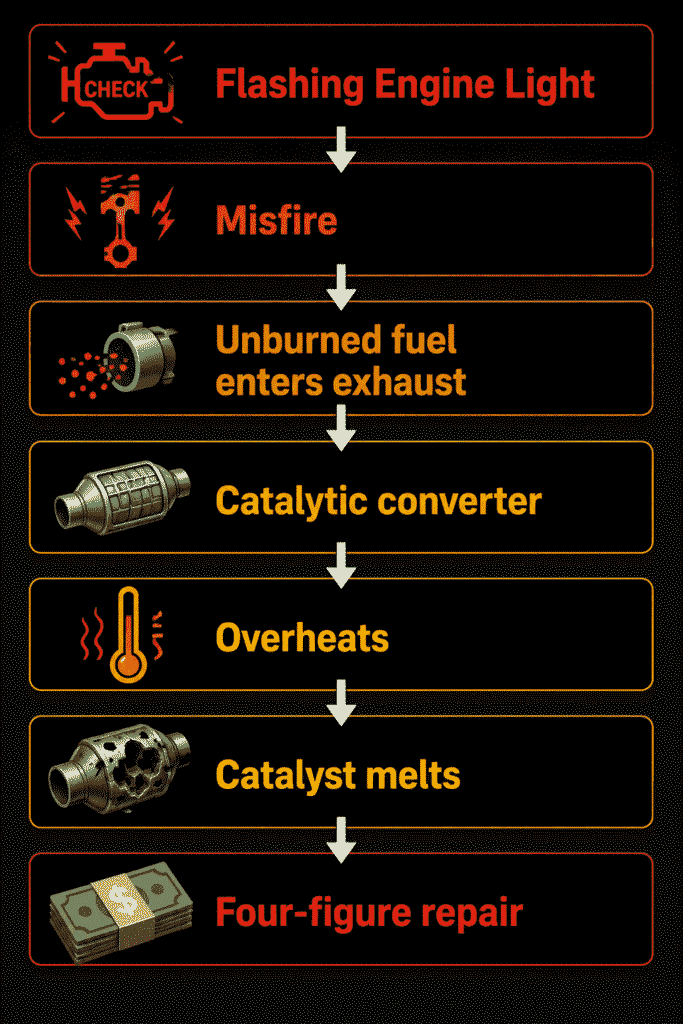
Here’s the chain reaction it’s warning you about:
A Real-World Scenario
You accelerate onto the freeway and the engine light begins flashing. The engine is also running roughly, but the car is still moving, so you decide to continue driving.
The vehicle may continue running even while an active misfire sends unburned fuel into the exhaust. That can raise catalytic-converter temperatures and increase the risk of expensive damage.
The important point is that a car can remain driveable while the underlying problem is getting worse. A flashing engine light should therefore be treated as a warning to reduce load and arrange for diagnosis as soon as possible.
What Happens If You Keep Driving?
| Time driving | What’s happening |
| Immediately | Engine misfires; unburned fuel begins entering the exhaust |
| 5–10 minutes | Fuel accumulates in the catalytic converter |
| 10–20 minutes | Converter temperature climbs well beyond its normal range |
| Extended driving | Internal catalyst substrate can melt or fracture |
| Continued driving | Possible cylinder wall washing, valve or piston damage |
These are indicative rather than exact — the pace depends heavily on load. Highway speeds, hills, and towing accelerate everything. Gentle low-speed driving buys you more time, though never unlimited time.
How Far Can You Drive With a Flashing Engine Light?
The honest answer: as short a distance as you can manage. But circumstances differ, so:
| Situation | Recommendation |
| Flashing + engine shaking | Stop immediately and tow |
| Flashing + loss of power | Drive only a very short distance to the nearest shop, if safe |
| Flashing + smoke or burning smell | Stop immediately, tow |
| Flashing + knocking noises | Stop immediately, tow |
| Flashing only, engine smooth | move only, gentle drive to a shop is usually acceptable |
| Flashed briefly, now solid | Diagnose the same day; avoid unnecessary driving |
If you must move the car: keep speeds low and steady, switch off the A/C to reduce engine load, avoid highways and hills, and don’t tow anything. If the shop is more than a few miles out, a tow costs far less than a catalytic converter. For a broader look at when driving with a check engine warning may be possible, see our guide on can you drive a car with check engine light on.
Repair Decision Matrix
| Symptom combination | Safe to drive? | Tow? |
| Flashing only | No | Recommended |
| Flashing + shaking | Never | Yes |
| Flashing + smoke | Stop immediately | Yes |
| Flashing + power loss | Very short distance only | Preferably |
| Flashing then solid | Diagnose today | Usually no tow |
Is It Safe to Drive? Decision Flow
Flashing Engine Light
│
▼
Is the engine shaking?
│
┌─────┴─────┐
YES NO
│ │
▼ ▼
Stop safely Loss of power?
│ │
▼ ┌─────┴─────┐
Tow truck YES NO
│ │
▼ ▼
Nearest garage Scan OBD-II
(low speed) codes today
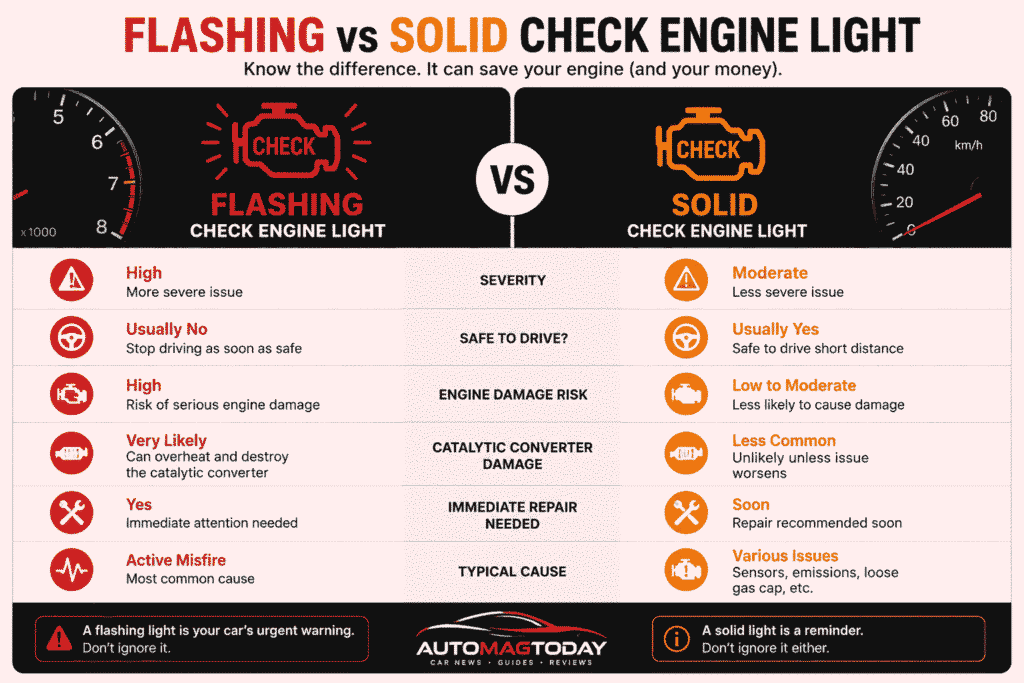
Flashing vs Solid Check Engine Light
| Feature | Flashing | Solid |
| Severity | High | Moderate |
| Safe to drive? | Usually no | Usually yes, short distance |
| Engine damage risk | High | Low to moderate |
| Catalytic converter damage | Very likely | Less common |
| Immediate repair needed | Yes | Soon |
| Typical cause | Active misfire | Sensor, emissions, gas cap |
A solid light might be a loose gas cap or an ageing oxygen sensor. A flashing one is almost never that minor. For the full dashboard picture, see dashboard warning lights explained.
Common OBD-II Codes
Plug in a scanner and you’ll almost certainly see one of these:
| Code | Meaning |
| P0300 | Random or multiple cylinder misfire |
| P0301 | Cylinder 1 misfire |
| P0302 | Cylinder 2 misfire |
| P0303 | Cylinder 3 misfire |
| P0304 | Cylinder 4 misfire |
| P0305–P0308 | Cylinders 5–8 misfire |
| P0171 / P0174 | System too lean (Bank 1 / Bank 2) |
| P0200 | Injector circuit malfunction |
| P0420 / P0430 | Catalyst efficiency below threshold |
The cylinder-specific codes are the useful ones — they point straight at the problem cylinder and cut diagnostic time considerably. A P0420 appearing alongside a misfire code often means converter damage has already begun.
Top Causes of a Flashing Engine Light
Engine misfire (the overwhelming majority)
Everything below is really a variation of this. See engine misfire symptoms for the fuller picture.
Worn or fouled spark plugs
One common cause, especially past 60,000–100,000 miles. See bad spark plug symptoms.
Failing ignition coils
A failing ignition coil can cause a cylinder-specific misfire and may trigger a flashing engine light. If a coil is diagnosed as the problem, our guide to ignition coil replacement cost explains the typical repair expenses and factors that affect the price.
Fuel injector problems
A clogged or failing injector starves one cylinder of fuel.
Low fuel pressure
A weak pump or restricted filter can cause misfires across several cylinders at once.
Vacuum leak
A cracked hose or failed intake gasket lets unmetered air in, throwing off the mixture.
Damaged catalytic converter
Sometimes the cause rather than the casualty — a clogged converter creates backpressure that disrupts combustion.
Faulty oxygen sensor
Rarely the direct cause, but bad readings can push fuel trims far enough to trigger misfires.
Timing problems
A stretched chain or slipped belt throws valve timing off. Rarer, but serious.
ECU faults (rare)
Occasionally the computer itself. This is a last-resort diagnosis, not a first guess.
| Cause | Severity | DIY? | Typical cost |
| Spark plugs | Medium | Yes | $ |
| Ignition coil | High | Sometimes | $$ |
| Vacuum leak | Medium | Sometimes | $$ |
| Fuel injector | High | No | $$$ |
| Fuel pump | High | No | $$$ |
| Catalytic converter | Very high | No | $$$$ |
| ECU | Rare | No | $$$$ |
Common Misdiagnoses (And What It Usually Actually Is)
This is where people waste money. Shops — and DIYers throwing parts at the problem — frequently replace:
| Commonly replaced | When the real fault is often |
| Oxygen sensor | Ignition coil or spark plug |
| Mass airflow (MAF) sensor | Vacuum leak |
| Catalytic converter | The misfire that damaged it |
| Fuel pump | Clogged injector |
| ECU | Wiring or connector fault |
The pattern is consistent: downstream components get blamed for upstream problems. An oxygen sensor code does not necessarily mean the sensor itself has failed. A misfire or mixture problem can affect the readings, so the underlying cause should be diagnosed before replacing the sensor.
The rule worth remembering: if a shop proposes replacing the catalytic converter without identifying why it failed, get a second opinion. A new converter fitted behind an unresolved misfire will fail too. See catalytic converter replacement cost before authorising that job.
Repair Costs (2026 Estimates)
| Repair | Estimated cost (US) |
| Spark plug replacement | $100–$300 |
| Ignition coil | $150–$500 |
| Vacuum hose or gasket | $150–$400 |
| Oxygen sensor | $150–$450 |
| Fuel injector | $250–$900 |
| Fuel pump | $400–$1,200 |
| Catalytic converter | $900–$2,800 |
These are broad averages. Real cost swings hard on make, model, engine layout, and local labour rates — a coil on an accessible four-cylinder is a very different job from one buried under a V6 intake manifold.
What Should You Do Immediately?
- Stay calm and reduce engine load as soon as it is safe to do so.
- Ease off the accelerator. Reduce load rather than braking hard.
- Avoid hard acceleration and steep climbs.
- Turn off the A/C and heavy electrical draws.
- Find a safe place to pull over.
- Check for anything obvious — a disconnected hose or loose connector. Don’t touch anything hot.
- Scan the OBD-II codes if you have a reader.
- Call a mechanic or roadside assistance.
How Mechanics Diagnose It
- Pull OBD-II codes and freeze-frame data
- Review live data while the engine runs
- Inspect spark plugs and ignition components
- Swap coils between cylinders to see if the misfire follows
- Compression test to rule out mechanical damage
- Fuel pressure test
- Injector testing — electrical and flow
- Smoke test for vacuum leaks
Diagnostic codes can help identify the system or cylinder involved, but they don’t always identify the failed component. If you’re trying to understand the possible reasons behind a check engine warning, see our guide on why is my check engine light on.
Can You Fix It Yourself?
Reasonable DIY:
- Replacing spark plugs on an accessible engine
- Replacing an ignition coil when the affected component has been properly identified
- Changing the air filter
- Checking and reseating obvious vacuum hoses
Leave to a professional:
- Full misfire diagnosis when the cause isn’t obvious
- Fuel injector work
- Catalytic converter replacement
- Anything involving engine timing
- ECU faults
An OBD-II scanner can retrieve diagnostic trouble codes that may identify a misfiring cylinder, although further testing may be needed to identify the failed component. That narrows the job considerably and makes you a much harder customer to upsell. It doesn’t replace a proper diagnosis when the cause isn’t obvious.
Flashing Engine Light by Vehicle
The underlying meaning is identical across every OBD-II vehicle sold since 1996 — a flashing malfunction indicator lamp signals a misfire severe enough to threaten emissions equipment. What varies is labelling and which components tend to wear first.
Honda Civic / Accord – Standard flashing MIL behaviour. Coil-on-plug ignition means a failed coil typically produces a clean cylinder-specific code.
Ford F-150 – Flashing MIL on misfire. On V6 and V8 configurations, note which bank the code refers to before ordering parts.
Toyota Camry – Standard behaviour. Coil-on-plug design makes cylinder identification straightforward via scan.
Chevrolet Silverado – Flashing MIL; some GM models display “Service Engine Soon” instead of “Check Engine.” Same lamp, same urgency.
RAM 1500 – Standard flashing MIL on misfire detection.
Jeep Wrangler – Standard behaviour; worth checking connectors after off-road use or water crossings.
Hyundai Elantra / Kia Forte – Standard flashing MIL. Shared platforms mean similar diagnostic paths.
Nissan Altima – Often labelled “Service Engine Soon” rather than “Check Engine.” Identical meaning.
Whatever the badge, the response is the same: reduce load, stop safely, scan the codes. Vehicle-specific instructions can differ, so drivers should also consult the owner’s manual and relevant NHTSA vehicle documentation when interpreting dashboard warning behavior.
Common Mistakes Drivers Make
- Continuing on the highway. The worst possible condition for a misfiring engine.
- Clearing the code before diagnosis. This wipes the data a mechanic needs and fixes nothing. See how to reset a check engine light for when it’s appropriate — after the repair.
- Ignoring engine vibration because the car “still drives.”
- Replacing random parts hoping to get lucky.
- Waiting several days to book it in.
- Using low-quality fuel after repeated misfires.
Prevention: Maintenance Schedule
| Mileage | Service |
| ~30,000 miles | Air filter replacement |
| ~60,000 miles | Spark plug replacement (check your manual) |
| ~100,000 miles | Ignition system inspection, coils checked |
| ~120,000 miles | Fuel system service, injector cleaning |
Intervals vary by manufacturer — your owner’s manual overrides this table. Our car maintenance checklist covers the full routine.
- Replace spark plugs at the manufacturer’s interval
- Use fuel from reputable stations at the specified octane
- Follow the full maintenance schedule, not just oil changes
- Scan warning lights early rather than waiting for a flash
- Fix small misfires immediately — they escalate
- Change air and fuel filters on schedule
- Service ignition components as a set on high-mileage engines
Expert Tips
- Don’t confuse a flashing check engine light with a maintenance reminder. Different systems entirely.
- A sustained flashing warning under heavy load can increase the risk of rapid catalytic-converter damage.
- Cheap aftermarket ignition parts cause repeat failures. One area where reputable brands genuinely pay for themselves.
- Some misfires only appear under acceleration and vanish at idle — “it seems fine now” isn’t proof of a fix.
- If the engine is shaking noticeably, tow it. No exceptions worth the gamble.
Key Takeaways
- A flashing check engine light usually signals a severe engine misfire
- Continuing to drive can destroy the catalytic converter
- Reduce speed immediately and avoid hard acceleration
- Scan the OBD-II codes to identify the affected cylinder
- Repair the fault before resetting the light
The Bottom Line
A flashing engine light is the one dashboard warning that genuinely rewards acting within minutes rather than days. It nearly always means an active misfire, and every mile driven on it risks turning an affordable repair into an expensive one.
Slow down, get off the road, scan the codes if you can, and get it diagnosed the same day. Fix the fault before clearing the light. Most of the time you’re looking at plugs or a coil — a few hundred dollars and an afternoon. The four-figure bills almost always belong to people who kept driving.
Methodology: This guide was prepared with reference to EPA OBD-II standards, SAE repair practices, manufacturer service documentation, and ASE diagnostic recommendations. Cost ranges are US averages compiled from typical independent-shop pricing and vary significantly by vehicle, region, and labour rate.
Sources: U.S. Environmental Protection Agency (OBD-II standards) · NHTSA · SAE International · ASE (National Institute for Automotive Service Excellence) · Manufacturer owner’s manuals
Frequently Asked Questions
What does a flashing engine light mean?
It signals a severe engine misfire that risks damaging your catalytic converter. Stop driving as soon as it’s safe and get it diagnosed.
Can I drive with a flashing check engine light?
Ideally no. If unavoidable, drive gently at low speed for a short distance only — no highways, no hard acceleration.
How far can I drive?
As little as possible. If the engine is shaking or losing power, don’t drive at all — tow it.
Will a flashing engine light go away on its own?
It may go solid if the misfire eases under lighter load. The fault is still stored and will return.
How much does it cost to fix?
Roughly $100 for plugs up to $2,800 or more if the converter is destroyed. Acting early keeps you at the low end.
Does low oil cause a flashing engine light?
Not usually — low oil triggers its own warning. Severe oil starvation can eventually cause misfires, so if both are happening, stop driving.
Can bad spark plugs cause it?
Yes — the most common single cause.
Can low-quality fuel trigger it?
It can contribute, particularly contaminated or water-affected fuel, though it’s rarely the sole cause.
Which OBD-II codes are associated with it?
Most commonly P0300 and P0301–P0308. P0171 and P0420 often appear alongside.
Is a flashing engine light always a misfire?
Not literally always, but a common cause are. A scan confirms it in under a minute.
Should I tow my vehicle?
Yes if it’s shaking, stalling, smoking, losing power, or the shop is more than a few miles away.
Why is my check engine light flashing and the car shaking?
The shaking is the misfire, felt through the chassis. They almost always occur together.
Can a flashing engine light damage the catalytic converter?
Yes — that’s precisely what the warning exists to prevent.
My light flashed right after an oil change — is that related?
Possibly coincidence, but a disturbed connector or sensor is worth checking. See check engine light after an oil change.
Disclaimer: This article is for general informational purposes only and does not replace professional automotive advice, diagnosis, or repair. A blinking engine light can indicate a serious vehicle problem, and the exact cause varies by vehicle. If your engine light is flashing, reduce engine load and have the vehicle inspected by a qualified mechanic as soon as possible. Repair costs and recommendations may vary based on the vehicle, location, parts, and labor.