


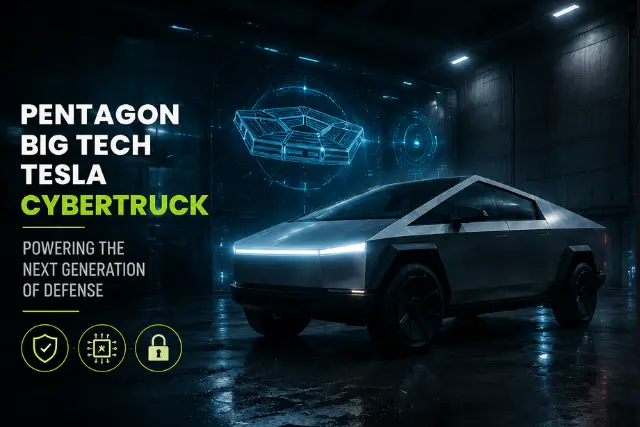
The phrase “Pentagon Big Tech Tesla Cybertruck” may sound like an internet meme, but it reflects a real shift happening inside the U.S. defense industry: the growing relationship between Silicon Valley and the Pentagon.
The growing connection between EV manufacturers, software companies, and government agencies is also changing how modern vehicles are viewed beyond traditional consumer transportation. Even consumer-focused EV discussions, like whether the Hyundai Palisade comes in a Hybrid, now reflect how rapidly vehicle technology is evolving beyond standard commuting needs.
What is the Pentagon Big Tech Tesla Cybertruck Story?
The “Pentagon Big Tech Tesla Cybertruck” discussion refers to the growing relationship between major technology companies, electric vehicle manufacturers, and the U.S. Department of Defense. The topic gained attention after reports revealed the U.S. Air Force planned to purchase Tesla Cybertrucks for missile target testing, while companies like Google, Microsoft, OpenAI, and SpaceX simultaneously expanded defense-related AI and cloud contracts with the Pentagon.
How the Pentagon–Big Tech relationship actually started
For most of its history, the U.S. military bought hardware from a tight club of specialized contractors – Lockheed Martin, Boeing, Northrop Grumman, Raytheon. Silicon Valley was a completely different universe. That changed permanently around 2018.
2018 – Project Maven: This $500m contract from the Pentagon gives Google use of artificial intelligence to analyze surveillance drone imagery. It sparked employee protests inside Google — but the door was now open.
2019 – JEDI Cloud Contract: The DoD launched a $10 billion cloud computing contract, drawing Amazon and Microsoft into direct defense competition.
2022 – JWCC Contract: The Joint Warfighting Cloud Capability contract — worth up to $9 billion was split between Microsoft, AWS, Google, and Oracle.
2025 – AI Wave: Google, OpenAI, Anthropic, and Elon Musk’s xAI each received $200 million DoD contracts to develop advanced AI tools for national security applications
The Department of Defense remains one of the largest buyers of private-sector technology and defense services in the United States, making up more than half of all government contracts, with over $445 billion out of the $755 billion obligated to the government in FY2024, according to U.S. Government Accountability Office (GAO) reports.
Tesla Cybertruck & U.S. Air Force – The real story
In mid-2025, the U.S. Air Force revealed its intention to buy Tesla Cybertrucks – not for driving around base, but for missile targets in live-fire training exercises. And it was this information that launched the “Pentagon Big Tech Tesla Cybertruck” story into popularity.
Why the Cybertruck specifically?
A unique stainless-steel body: A February 2025 Pentagon market study singled out the Cybertruck’s unpainted stainless steel body, angular geometry, and 48-volt electrical system.
Military simulation training for modern battlefield scenarios: SOCOM’s Standoff Precision Guided Munitions (SOPGM) program utilizes civilian vehicles to represent insurgent forces in military simulations. Military planners viewed the Cybertruck as a realistic stand-in for the kind of modern civilian vehicle that could appear in future battlefield environments.
“No engine or systems need to function”: The tender clearly states that the required condition of the Cybertrucks is: intact body, intact glass, intact mirrors, and intact wheels. They are intended as mobile and static missile targets.
Durable stainless-steel construction: Tesla had demonstrated the durability of its stainless steel construction in front of pistol fire, which increased interest in how unconventional vehicle materials perform under stress testing. Questions around vehicle protection and damage resistance are also common in consumer vehicle ownership, especially when discussing whether car wraps can damage paint over time.
The 400 million dollar armored Tesla scandal
If the missile-target story was astonishing, the following one was explosive.
- In December 2024, during Trump’s transition period, a 400 million line item showed up in the US State Department’s 2025 procurement forecast with a planned purchase of “Armored Tesla (Production Units)”.
- It was the largest proposed vehicle-related purchase listed anywhere in the five-year procurement forecast.
- The forecast document did not indicate what model “armored Tesla” was.
- As one could expect, congressional critics quickly raised questions of conflict of interest due to Elon Musk’s active participation in the administration at the time.
- A State Department official was quick to state: “The State Department has not issued or awarded any government contract to Tesla, or any other automobile manufacturer, for the production of armored electric vehicles.” Musk himself claimed he would never allow Tesla to get the contract.
Big Tech at the Pentagon: who’s getting what
| Company | Contract / Role | Value |
| SpaceX (Musk) | Launch services + Starlink satellite communications | ~$22 billion |
| Palantir | 10-year U.S. Army software deal (TITAN program) | $10 billion |
| Microsoft / AWS / Google / Oracle | JWCC cloud computing contract | Up to $9 billion |
| OpenAI | AI capabilities for warfighting + enterprise security | $200 million |
| Google / Anthropic / xAI | Advanced national security AI tools | $200M each |
| Tesla | Cybertruck target vehicles (Air Force SOPGM) | Not disclosed |
The DOGE factor: where it gets uncomfortable
The Department of Government Efficiency, the informal advisory body led by Elon Musk from early 2026, was tasked with identifying and cutting federal spending across all agencies, including the Department of Defense.
- SpaceX (Musk’s company) already held billions in DoD contracts while Musk simultaneously directed federal efficiency recommendations.
- Tesla was being considered for government fleet and armored vehicle purchases during the same period.
- DOGE was in a position to influence which competing vendors faced cuts and how federal procurement priorities were reshaped.
- Amazon, Microsoft, and Google, recipients of the $9 billion JWCC contract, were watching closely to see whether DOGE recommendations would affect their own Pentagon relationships.
The Future: Electric Vehicles and Pentagon Modernization
Regardless of whether the Cybertruck ever deploys to a war theater, it is a harbinger of an ongoing, broader transformation.
How EVs may actually integrate into the military:
Base Electrification: For vehicles operating on domestic military bases, a shift toward electricity and fuel cost savings is a relatively low-risk, high-probability next step. Similar conversations are already happening in the consumer market around EV ownership costs, charging practicality, and long-term vehicle financing trends covered in this guide on electric vehicle finance options.
Disaster Recovery: If military units must respond to natural disasters such as wildfires and hurricanes, having the capability of deploying a silent EV that could serve as a remote battery backup would be a tactical plus.
Thermal Signature: Electric vehicles generally produce less heat than traditional internal combustion vehicles, which could offer advantages during reconnaissance or stealth-focused operations.
Energy Security: The Pentagon has repeatedly described energy security and fuel supply resilience as long-term national security priorities. Electrifying vehicle fleets can reduce the vulnerability of fueling infrastructure.
Technology transfer: The military rarely deploys commercial technologies directly. It first evaluates reliability, durability, and operational performance before adapting similar concepts into specialized systems. That process is somewhat comparable to how civilian vehicle inspections and verification systems work, including tools used to check vehicle VIN number history before purchase.
Conclusion
The Pentagon Big Tech Tesla Cybertruck story is bigger than a single vehicle purchase. It reflects a larger transformation happening across defense, artificial intelligence, cloud computing, and electric vehicle technology.
While the Cybertruck itself may never become an operational military vehicle, the attention surrounding it highlights how closely Silicon Valley and national defense priorities are becoming connected.
As AI systems, autonomous technologies, satellite communications, and EV infrastructure continue evolving, partnerships between private tech companies and the Pentagon will likely become even more influential over the next decade.
Frequently Asked Questions (FAQs)
Why did the Pentagon buy Tesla Cybertrucks?
The U.S. Air Force reportedly explored using Tesla Cybertrucks as missile target vehicles because of their stainless-steel body design and unusual exterior shape for battlefield simulation testing.
Does Tesla have military contracts?
Tesla itself has very limited confirmed defense involvement, but Elon Musk’s SpaceX holds major U.S. defense contracts related to rocket launches, satellite communications, and national security operations.
Is the Tesla Cybertruck being used by the U.S. Military?
No. As of 2026, the Tesla Cybertruck is not an operational U.S. military vehicle. The U.S. Air Force reportedly acquired some Cybertrucks for missile target testing under the SOPGM program rather than active military deployment.
Does the Pentagon Big Tech Tesla Cybertruck story imply Tesla has a large defense contract?
No. Tesla itself does not have a major confirmed Pentagon vehicle contract tied to the Cybertruck. Most large defense-related contracts connected to Elon Musk involve SpaceX, including launch services and Starlink communications.
Which Big Tech companies work with the Pentagon?
Companies including Microsoft, Amazon, Google, Oracle, OpenAI, Anthropic, Palantir, and SpaceX all work with the Pentagon through cloud computing, AI, software, satellite, or defense technology contracts.
Is the Cybertruck bulletproof?
No. Tesla claims the Cybertruck’s stainless-steel body offers limited resistance to small projectiles, but the vehicle is not military-grade armored and has not passed MIL-SPEC protection standards.
What is the SOPGM program?
SOPGM stands for Standoff Precision Guided Munitions, a U.S. Special Operations Command program focused on testing precision-guided missiles. Civilian-style vehicles are sometimes used as target platforms during training exercises and weapons testing.
Reviewed by Automotive Research Team
Updated with the latest 2026 Pentagon AI contract developments, Tesla Cybertruck military testing reports, DoD procurement updates, EV defense modernization trends, and Big Tech–Pentagon partnership analysis.