


Written by the AutoMagToday Content Team | Reviewed by Nitish Ranjan, Automotive Review Expert, automagtoday.com | Last updated: November 2026
Quick Answer
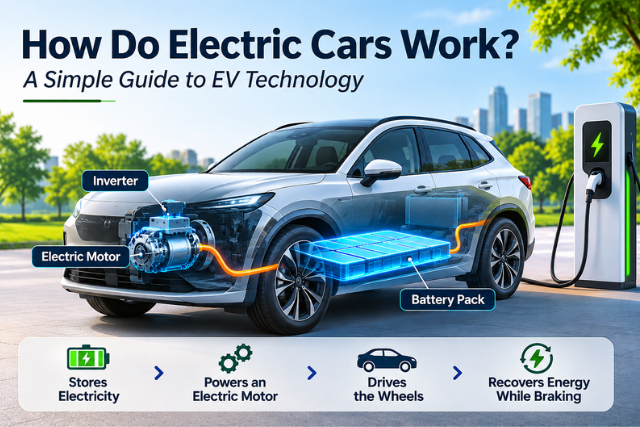
If you’ve ever wondered how do electric cars work, the process is simpler than you might think. An electric car uses energy stored in a rechargeable battery to power an electric motor, which turns the wheels and moves the vehicle. Regenerative braking also helps recover some energy when the car slows down and sends it back to the battery.
So, how do electric cars work? A big battery feeds a motor, and the motor turns the wheels. That’s really it. No fuel tank, no exhaust, no oil to change.
The details are where it gets interesting, because they explain why EVs feel so quick, why they’re cheap to run, and why the way you charge matters more than most new owners expect.
What Is an Electric Car and How Does It Work?
An electric car runs on electricity stored in a rechargeable battery instead of burning fuel. The industry calls these battery-electric vehicles, or BEVs.
People mix up the types all the time, so here’s the quick sort. A hybrid has a fuel engine that gets some help from a small battery. A plug-in hybrid has a bigger battery you can charge, plus an engine as backup. A full EV has no engine at all.
So when someone asks “do electric cars have engines?”, the answer is no. They have motors. It sounds like a small difference, but it changes everything about how the car feels and what it needs to stay healthy.
How Do Electric Cars Work? Step-by-Step Explanation
Here’s what happens every time you pull away from a red light.
1. The battery releases power – The pack sits flat under the floor and stores energy as direct current.
2. The inverter converts it – Most EV motors run on alternating current, so the inverter switches the type and controls how much power goes through.
3. The motor spins – Electricity creates a rotating magnetic field that turns a shaft.
4. A simple gear delivers the power – Most EVs use a single-speed reduction gear. You never feel a gear change because there isn’t one.
The wheels move. Torque shows up almost instantly, which is why even an ordinary family EV feels punchy off the line.
A petrol engine has hundreds of moving parts that have to work together perfectly. An electric motor has one main moving part. Fewer parts means fewer things that wear out.
Main Components That Explain How Electric Cars Work
Understanding the main components makes it easier to see how do electric cars work. Each part has a specific job, from storing electrical energy to converting it into the mechanical power needed to move the vehicle. The U.S. Department of Energy’s explanation of how all-electric cars work provides additional details about these components.
The Battery Pack
This is the heart of the car and the most expensive part. Its size is measured in kilowatt-hours, or kWh. Think of it as the size of your fuel tank. Bigger number, more range, generally.
Most carmakers back the battery with a long warranty, often around 8 years or 100,000 miles in the US. Check the exact terms for the car you’re looking at, because they differ.
How Do Electric Car Motors Work?
The motor does the job an engine would do, just with far less fuss. Power goes in, magnetic fields push the rotor around, and you get full pushing force from a standstill. That’s why acceleration feels smooth instead of building up gradually.
Some EVs have one motor. Others have two, one for each axle, which gives you all-wheel drive without a heavy driveshaft.
The Inverter and the Onboard Charger
These two do opposite jobs. The inverter sends battery power to the motor. The onboard charger takes AC electricity from your wall or a public charger and turns it into DC so the battery can store it.
You’ll almost never think about either one. When they work properly, you only notice a smooth drive and a car that charges overnight.
The Battery Cooling and Heating System
Batteries are a bit like people. They perform best when they’re not too hot or too cold. A liquid loop keeps the pack in a comfortable range. This is also why winter range drops. The car is spending energy on keeping the battery and the cabin warm, not just moving you down the road.
What Is Regenerative Braking?
Regenerative braking is an important part of how do electric cars work. It allows the electric motor to act as a generator when the vehicle slows down, converting some of its movement energy into electricity and sending it back to the battery.
In a normal car, braking turns your forward motion into heat and wastes it. An EV catches a share of that energy and stores it. Plenty of cars let you drive with one pedal. Lift your foot and the car slows down on its own. It feels strange for a day or two, then you won’t want to go back.
There’s a bonus too. Because the motor does a lot of the slowing, the brake pads wear much more slowly.
How Are Electric Cars Powered and Charged?
Electric cars run on grid electricity, and that power comes from a mix of sources like gas, nuclear, hydro, wind and solar. How green your EV is depends partly on where you live.
There are three main ways to charge.
| Charging Type | Where You Plug In | Rough Speed (estimate) | Best For |
| Level 1 | Regular 120V wall outlet | 3 to 5 miles of range per hour | Light daily use |
| Level 2 | 240V home or public charger | 20 to 30 miles per hour | Everyday home charging |
| DC Fast Charging | Public high-power station | 10% to 80% in about 20 to 40 minutes | Road trips |
Treat those numbers as ballpark figures. Real speed depends on the car, the charger, the battery temperature and how full the battery already is.
One tip that surprises people. Fast charging slows down a lot after about 80%. On a road trip, it’s usually quicker to unplug at 80% and drive on than to wait for the last 20%.
Electric Car vs Gas Car vs Hybrid
| Feature | Electric Car | Gas Car | Hybrid |
| Energy source | Battery | Gasoline | Gasoline plus small battery |
| Tailpipe emissions | None | Yes | Lower |
| Routine servicing | Light | Heavy | Medium |
| Refueling | Plug in | Gas station | Gas station |
| Efficiency | Very high | Low | Moderate |
The U.S. Department of Energy says EVs turn a much bigger share of their energy into actual movement than gasoline vehicles do. A petrol car loses most of its energy as heat. That gap is the main reason EVs usually cost less per mile.
The Good and the Bad
What’s good
- Lower fuel cost per mile in most places
- No oil changes, spark plugs or timing belts
- Quiet and quick
- Zero tailpipe emissions
- Charging at home while you sleep
What’s not so good
- Many models cost more up front
- Public charging can be patchy depending on your area
- Long trips need more planning
- Range drops in cold weather and at high speeds
- Replacing a battery outside warranty can be expensive
How Much Do Electric Cars Cost?
It depends a lot on size and brand. Some small EVs start in the low to mid $30,000s, while premium models go well past $60,000. For example, you can explore the Tesla Model 3 price in the USA to understand the pricing of a popular electric car.
A heads up for US buyers: the federal EV tax credit ended on September 30, 2025. Some states, cities and power companies still run their own rebates, so check with your state energy office and your electricity provider before you sign anything.
Where EVs really win is running cost. Charging at home is normally cheaper than fuel for the same distance, though your local electricity rate decides how much. Public fast charging costs more and can come close to petrol prices per mile.
Is an Electric Car Worth Buying?
It depends on how you live. An EV works well if you can charge at home or at work, do mostly local or regional driving, and want lower running costs. You can also read our Hyundai Kona review when comparing practical vehicle options.
It’s harder to justify if you rent an apartment with no charging, tow heavy loads often, or regularly drive long rural routes with few chargers. In those cases a plug-in hybrid can be a sensible middle road.
Tips for New EV Owners
- Charge to around 80% for everyday use. It’s gentler on the battery over time, unless your maker says otherwise.
- Warm up or cool down the cabin while the car is still plugged in.
- Ease off the speed on highways. It hurts range more than you’d think.
- Check charger availability in an app before a long drive.
- Read the manual. Battery advice varies between brands. Rivian owners can also refer to this guide on how to reset the Rivian R1T for vehicle-specific guidance.
Mistakes People Make
- Trusting the advertised range without thinking about their own roads and weather.
- Not setting up home charging and relying only on public chargers.
- Leaving the car at 100% for days.
- Forgetting about tires. EVs are heavy and quick, so tires can wear faster.
- Skipping insurance quotes before buying.
What Maintenance Does an EV Need?
Less than a petrol car, but not zero. You’ll still deal with tire rotations, cabin air filters, brake fluid, battery coolant and software updates. Brake pads tend to last longer. The battery usually loses capacity slowly over many years instead of failing suddenly.
Where Electric Cars Are Headed
Expect faster charging, better cold weather performance and more cars using the North American Charging Standard plug. Solid-state batteries are being tested, but nobody can say for sure when they’ll reach everyday cars. Treat any date you read as a guess.
Key Takeaways
- An EV has far fewer moving parts than a petrol or diesel car.
- The core parts are the battery, inverter, motor, onboard charger and a cooling system for the battery.
- Regenerative braking wins back energy a normal car throws away as heat.
- Charging at home is usually the cheapest way to run an EV.
- Range changes with weather, speed and how you drive.
The Bottom Line
So, how do electric cars work? A battery feeds an inverter, the inverter powers a motor, and the motor drives the wheels, while regenerative braking gives a bit back. It’s simpler than most people expect. If you can charge at home and your driving fits, an EV is a practical, efficient choice. Understand how the system works, match the car to your life, and the decision gets a lot easier.
Frequently Asked Questions (FAQs)
How do electric cars work in simple words?
Electric cars work by using electricity stored in a battery to power an electric motor. The motor turns the wheels, while an inverter manages the electricity supply. Regenerative braking also helps recover some energy when the car slows down.
Do electric cars have engines?
No. They use electric motors. These have far fewer moving parts and deliver power instantly.
How are electric cars powered?
By electricity from the grid, stored in a lithium-ion battery. You recharge through a home outlet, a Level 2 charger or a DC fast charger.
How far can an electric car go on one charge?
Many current models are rated somewhere between 220 and 350 miles, and some go further. Weather, speed and load change the real number. Check the EPA rating for the exact model.
How long does it take to charge an EV?
Several hours on a home Level 2 charger, or about 20 to 40 minutes at a fast charger for 10% to 80%. It varies by car and conditions.
Can I charge an electric car at home?
Yes. A regular outlet works but is slow. A 240V Level 2 charger is much faster, and a licensed electrician can tell you whether your home can handle it.
Which is best, an electric car or a hybrid?
Neither is best for everyone. EVs suit people with easy charging. Hybrids and plug-in hybrids suit people who want flexibility on long trips. Learn more about how a hybrid vehicle works before deciding which option suits your needs.
How much does it cost to own an electric car?
The purchase price is often higher, but fuel and servicing usually cost less. The purchase price is often higher, but fuel and servicing usually cost less. Buyers considering a premium electric vehicle can also explore Lexus electric vehicle financing options to understand available financing choices. Compare your local power rates, insurance and any state incentives.
Why does cold weather reduce EV range?
Cold slows the chemistry inside the battery, and the car uses extra energy for heating. Preconditioning while plugged in helps.
When should I replace an EV battery?
Usually not for many years. Most are covered by long warranties, and plenty of owners never replace one.
Disclaimer
This article is intended for general informational and educational purposes only. Electric vehicle features, battery performance, charging times, driving range, and maintenance requirements may vary depending on the manufacturer, model, and driving conditions. Always refer to the vehicle manufacturer’s guidelines before making purchasing or maintenance decisions.