


Written by the AutoMagToday Content Team | Reviewed by Nitish Ranjan, Automotive Review Expert, automagtoday.com | Last updated: October 2026
Quick Answer
A car that vibrates when braking usually has warped brake rotors, worn brake pads, sticking brake calipers, damaged wheel bearings, suspension issues, or tire problems. The location of the vibration – steering wheel, brake pedal, or the entire vehicle — helps identify the cause. If the shaking is severe or braking performance drops, have the vehicle inspected immediately.
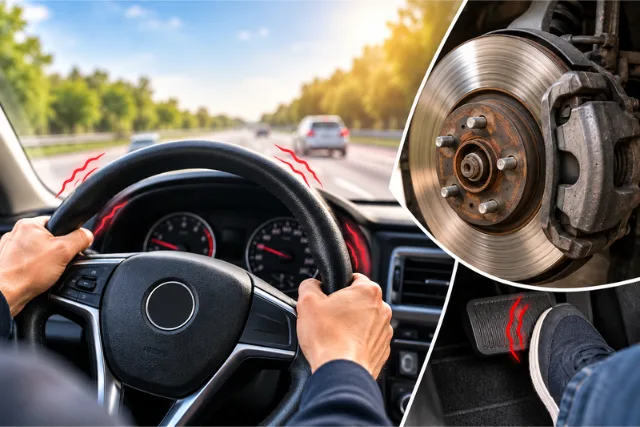
If you’ve ever pressed the brake pedal and felt the whole car shudder, a wobble in the steering wheel, or a pulse under your foot, you already know how unsettling it is. So why does my car vibrate when I brake? In most cases it’s something in the braking or wheel system that’s no longer perfectly even — usually warped rotors, worn pads, or a wheel that’s out of balance. The good news is that brake vibration is one of the more diagnosable car problems, and catching it early usually keeps a small fix from becoming an expensive one.
Let’s walk through what’s actually happening, how to pin down the cause yourself, what repairs cost in 2026, and when you shouldn’t wait another day to get it checked.
Why Your Car Shakes or Vibrates During Braking
When you press the pedal, the brake pads clamp onto the rotors — the smooth metal discs that spin with your wheels — and friction slows you down. For that to feel smooth, everything has to be flat and even. The moment a rotor develops high and low spots, a pad wears unevenly, or a wheel spins slightly off-balance, the pads grab inconsistently. You feel that inconsistency as vibration, brake judder, or a wobble in the wheel.
A little feedback under hard braking can be normal. But a clear, repeatable shake that shows up every time you slow down is your car telling you something needs attention. This applies across cars, SUVs, pickup trucks, crossovers, hybrids, and EVs alike — though the underlying cause can vary by vehicle and brake design.
Common Reasons Your Car Vibrates When Braking
Warped Brake Rotors (the usual suspect)
This is the number one reason a car shudders when you hit the brakes. Rotors “warp” – really, they develop uneven thickness – from heat. Riding the brakes down a long hill, repeated hard stops in traffic, or spraying cold water onto hot brakes at a car wash all contribute. The telltale sign: a brake pedal pulsation or steering wheel vibration that gets stronger as you go faster. If you need it, here’s our brake rotor replacement guide.
Worn or Unevenly Worn Brake Pads
Pads wear down over time, and when they wear unevenly they can’t grip the rotor smoothly. Old, glazed, or cracked pads cause vibration under braking and often a squeal or grind as they thin out. See the signs your brake pads need replacement. AAA also explains the warning signs that your brakes may need replacement, helping drivers recognise when professional inspection is necessary.
Sticking Brake Calipers
The caliper squeezes the pad against the rotor. When one sticks, it keeps partial pressure on the rotor even when you’re off the pedal. That drags, overheats the rotor, and creates both front brake vibration and a pull to one side. More in our brake caliper guide.
Worn Wheel Bearings
A failing wheel bearing lets the wheel wobble slightly on its hub. That play shows up as vibration, often with a humming or growling noise that changes with speed.
Suspension and Steering Problems
Worn tie rods, ball joints, control arms, or bushings let parts move when they shouldn’t. Under braking, weight shifts forward and loads the front suspension — so a loose component announces itself as a front-end shake right when you slow down. See common car suspension problems.
Unbalanced or Damaged Wheels
A wheel that’s out of balance, bent, or fitted with a bad tire vibrates on its own, and braking makes it more noticeable. This is why the same shaking sometimes appears at highway speed even when you’re not braking. Understanding how long a tire alignment takes can also help you plan a professional wheel inspection. Our wheel alignment vs wheel balancing explainer covers the difference.
ABS Kicking In (this one’s normal)
If you brake hard on a slippery surface and feel the pedal pulse rapidly, that’s the anti-lock braking system (ABS) doing its job, pumping the brakes faster than you ever could. Working alongside Electronic Stability Control (ESC), that pulsing during an emergency stop is expected not a fault. If a light stays on afterward, check our ABS warning light meaning.
Where Do You Feel the Vibration?
Location is your best clue. Notice exactly where the shake lives before you spend a dollar.
| What you feel | Most likely cause |
| Steering wheel shakes when braking | Front rotors, wheel balance, or front suspension |
| Brake pedal pulsates | Warped rotors (or ABS in an emergency stop) |
| Whole vehicle vibrates | Rear brakes, tires, or wheel bearings |
| Seat/rear shudder | Rear brakes or rear suspension |
Symptoms by Speed: When the Vibration Happens
When the shaking appears is just as telling as where.
| When vibration happens | Likely cause |
| Only at high speeds when braking | Warped rotors |
| Only when braking | Brake system (pads, rotors, calipers) |
| At all speeds, braking or not | Tire or wheel balance issue |
| After hitting bumps | Suspension |
| Only during hard, emergency braking | ABS (normal) |
How Serious Is It? Severity at a Glance
| Problem | Safe to drive? |
| Warped rotors | Drive only to the repair shop |
| Worn brake pads | Repair soon |
| ABS activation | Normal |
| Loose or damaged wheel | Stop immediately |
| Soft/sinking brake pedal | Do not drive |
Stop Driving Immediately If:
- The brake warning light stays on
- You smell burning from the brakes
- You hear metal grinding when braking
- The brake pedal sinks toward the floor
- The car pulls sharply to one side while braking
- There’s severe steering wheel vibration you can’t control
These affect your ability to stop safely. Treat braking faults as urgent — this is the system that keeps you from hitting something.
Is It Safe to Drive If Your Car Vibrates When You Brake?
A mild, occasional vibration usually means you can drive carefully to a shop soon — but not ignore it indefinitely. Severe shaking, grinding, pulling, or a soft pedal means you should stop and get it inspected. When in doubt, don’t gamble on brakes. You should also understand other vehicle safety issues, such as whether a car can pass inspection with a cracked windshield, before deciding whether a vehicle is safe to drive.
What Happens If You Ignore Brake Vibration?
Putting it off rarely stays cheap. As the problem worsens, you can expect:
- Longer stopping distances as braking performance drops — a real safety risk.
- Uneven, accelerated pad wear that ruins pads faster than normal.
- Damaged rotors that were resurfaceable becoming replace-only.
- Ruined calipers and wheel bearings from the extra heat and stress.
- Higher repair bills as one worn part drags others down with it.
A vibration that starts as a $250 pad-and-rotor job can snowball into caliper and suspension work costing several times more. Early action almost always saves money.
How to Diagnose Brake Vibration at Home
You don’t need a lift to narrow it down. Work through this checklist:
- Road test: Note the speed it starts, whether it’s in the pedal or the wheel, and whether braking makes it worse.
- Look at the rotors: Through the wheel spokes, check for deep grooves, blue heat spots, or a rough surface.
- Check the pads: If visible, thin pads (roughly under ¼ inch) are due for replacement.
- Inspect the tires: Look for uneven wear, cupping, bulges, or low pressure. You can also learn how to check tyre air pressure to rule out pressure-related issues.
- Wiggle test: With the car safely raised and supported, grab the tire at 12 and 6 o’clock and push-pull. Play here suggests wheel bearings or suspension.
- Lug nuts: Confirm they’re torqued to spec — loose lugs cause vibration too.
- Brake fluid: Low or old fluid affects braking feel; here’s how to check brake fluid.
Brake Vibration Diagnosis Flowchart
Car vibrates while braking →
- Steering wheel shakes? → Yes → Front brakes, wheel balance, or front suspension
- No → Brake pedal pulsates? → Yes → Warped rotors (or ABS in an emergency stop)
- No → Whole vehicle shakes? → Inspect rear brakes, tires, and wheel bearings
How to Fix Brake Vibration
- Replace brake pads when worn, glazed, or uneven — always in axle pairs. See brake pad replacement.
- Resurface or replace rotors. Slightly warped rotors can sometimes be machined flat; thin or badly damaged ones need replacing. Most shops fit fresh rotors with new pads. A manufacturer service bulletin available through NHTSA outlines diagnostic steps for vibration while braking, including checking the rotors, wheels, and hub surfaces.
- Replace a sticking caliper if it’s seized or dragging.
- Balance the wheels to correct uneven weight distribution.
- Repair the suspension – tie rods, ball joints, control arms, or bushings as needed.
- Replace bad tires with cupping, flat spots, or internal damage.
Brake Vibration Repair Costs (U.S., 2026)
Typical ranges. Actual pricing depends on your vehicle, parts quality, and local labor rates.
| Repair | Estimated cost (per axle unless noted) |
| Brake pads | $150–$300 |
| Brake rotors | $300–$600 |
| Brake caliper | $300–$800 |
| Wheel balancing | $15–$50 per wheel |
| Wheel bearing | $250–$550 each |
| Suspension repair | $200–$1,000+ |
Estimated Repair Time
Knowing how long a job takes helps you plan and sanity-check a shop’s quote.
| Repair | Typical time |
| Brake pads | 1–2 hours |
| Rotors | ~2 hours |
| Wheel balancing | ~30 minutes |
| Wheel bearing | 2–4 hours |
| Suspension | 2–6 hours |
Can You Fix It Yourself?
Reasonable DIY if you’re handy: inspecting pads and rotors, checking tire pressure and condition, and confirming lug nut torque. Many confident owners also replace pads and rotors themselves.
Leave to a professional: caliper replacement, brake bleeding, wheel bearing jobs, and suspension repair. These affect safety directly and need proper tools and torque specs. When unsure, an ASE-certified technician is worth it — the braking system isn’t the place to guess.
Why Brake Vibration Differs by Vehicle Type
- Why SUVs vibrate when braking: More weight means more heat and stress on rotors, so warping and uneven pad wear are common — especially with towing or loaded cargo.
- Why pickup trucks vibrate when braking: Heavy loads and larger brake components make trucks prone to rotor warping and front-end shudder under hard stops.
- Why electric cars (EVs) vibrate when braking: EVs and hybrids rely heavily on regenerative braking, so friction pads and rotors are used less and can develop surface rust or uneven wear that shows up as vibration when the physical brakes finally engage.
The core causes are the same, but the way they appear can differ with each vehicle’s brake design.
How to Prevent Brake Vibration?
- Have brakes inspected every 10,000–15,000 miles, or per your owner’s manual.
- Replace brake fluid at the manufacturer-recommended interval (typically every 2–3 years for many vehicles — check your OEM schedule).
- Replace pads before they go metal-on-metal, and rotors when needed.
- Rotate tires regularly and keep wheels balanced and aligned.
- Have alignment and suspension checked periodically.
- Avoid overheating brakes — use engine braking (a lower gear) downhill instead of riding the pedal.
- Choose quality OEM or reputable parts; bargain pads and rotors often warp faster.
Common Mistakes Drivers Make
- Ignoring early, mild vibration until it becomes a big repair.
- Replacing pads but reusing worn rotors.
- Buying the cheapest brake parts to save money.
- Skipping brake fluid changes.
- Overlooking suspension and tire issues that mimic brake problems.
Key Takeaways
- Warped brake rotors are the most common reason a car vibrates when braking.
- Where and when you feel the shake — wheel vs pedal, high speed vs all speeds — is your fastest diagnostic clue.
- Mild vibration can wait briefly; grinding, pulling, or a soft pedal cannot.
- Ignoring it lengthens stopping distances and turns cheap fixes into expensive ones.
- Routine inspections every 10k–15k miles, quality parts, and balanced wheels prevent most brake vibration.
Final Thoughts
So, why does your car vibrate when you brake? Nine times out of ten it’s warped rotors, worn pads, or a wheel that needs balancing — all fixable, and all cheaper to handle sooner than later. Pay attention to where and when the vibration shows up, watch for the serious warning signs, and don’t put off a brake inspection. Your brakes are the one system you never want to gamble on.
Frequently Asked Questions
Why does my steering wheel shake when I brake?
Something that often causes steering-wheel shake while braking is warped front rotors, unbalanced front wheels, worn front suspension parts. Problems tend to be noticed in the front end more than anything else because the front brakes do most of the work.
What makes my brake pedal shiver when I hit the brake?
A pulsing pedal is the sure sign of warped or uneven rotors. The exception is ABS during a hard emergency stop – that quick pulse is normal and means the ABS is keeping you from locking up.
Why does my steering wheel shake only when braking downhill?
Braking downhill causes a quick build-up of heat, causing any rotor warpage to become more pronounced. Cranking the pedal down on a long hill makes an uneven rotor surface even more obvious and the vibration may not be apparent until the long grade.
Can low tire pressure cause vibration while braking?
Absolutely. A low or badly worn tire alters the way the tire meets the road & this may induce a pulsing that brake operation intensifies. Always check tire pressure before blaming a brake!
Can a bad wheel alignment cause brake vibration?
Straightness alone doesn’t warp rotors; it is imprecise tire wear resulting from incorrect alignment that causes vibration. Often at its most noticeable when decelerating, check for and eliminate it before overcoming your balance.
Why does my new brake rotor vibrate?
A new vibrating rotor almost always indicates that the pads haven’t been correctly bedded-in, the rotor had not been perfectly seated on the hub (rust or dirt in between), or a lug/caliper wasn’t torqued properly. Have the installer check their work.
Should I replace brake pads and rotors together?
It depends… In most situations, yes. New pads on damaged or unbalanced rotors will usually bring the pulses back. New pads and new rotors will give you a nicer braking experience and longer pad life.
Can bad tires cause vibration when braking?
Yes – worn out tread, cupping, flat spots or an unbalanced wheel might be responsible for the shaking and braking causes it to seem worse. Always get the tires checked out first.
Do warped rotors always need to be replaced?
Not necessarily. Thin rotors can often be resurfaced, but if the rotor is too thin, or too damaged replacement is the way to go.
Can suspension problems cause brake vibration?
Yes. If the tie rods, ball joints or bushings are worn then the components will allow some movement under braking weight transfer, causing a vibration that could be mistaken for a brake-related problem.
How much does it cost to fix brake vibration?
Most brake-related fixes run roughly $150–$600 per axle for pads and rotors. Caliper, wheel bearing, or suspension repairs cost more. Early diagnosis keeps you at the lower end.
Disclaimer
This article is for informational purposes only and provides general guidance on why a car may vibrate when braking, including possible causes, symptoms, repair options, and estimated costs. The actual cause and repair requirements vary by vehicle, brake system, and driving conditions. Repair cost estimates are approximate and may vary by location, parts, and labor rates. Brake and suspension issues can affect vehicle safety. If you experience severe vibration, grinding noises, reduced braking performance, or a soft brake pedal, stop driving when safe and seek professional inspection. Always consult a qualified automotive technician for diagnosis and repairs.