


Written by the AutoMagToday Content Team | Reviewed by Anand Raj, Automotive Review Expert, AutoMagToday | Last updated: October 2026
Quick Answer
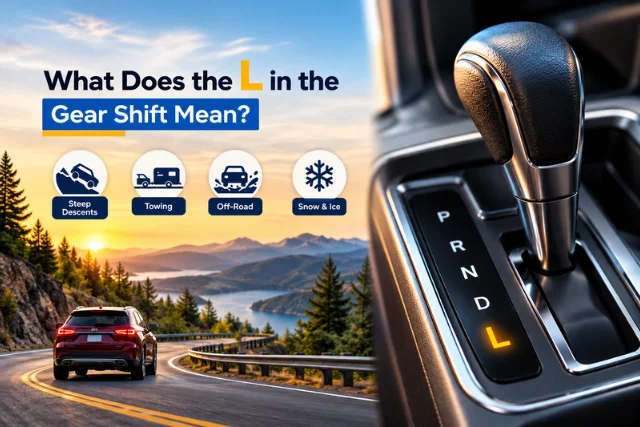
You might be looking for what does the L in the gear shift mean? The “L” on an automatic gear shift stands for Low Gear. It locks the transmission into its lowest gear or gears instead of shifting up, which raises engine RPM, multiplies torque at the wheels, and creates strong engine braking. Use it for steep descents, towing, crawling in mud or gravel, and any slow-speed situation where you need control rather than speed. Don’t use it for normal highway driving.
You’re partway down a long mountain grade, your brakes are starting to feel soft, and you notice that “L” sitting below the D on your shifter. You’ve driven this car for three years and never touched it. Should you now?
Yes and that moment is exactly what it’s there for.
Key Takeaways
- L = Low Gear, not “Load” or “Limit”
- Its main job is engine braking, not extra power
- Excellent on steep descents — saves your brakes
- Useful for towing and off-road crawling
- Doesn’t damage a healthy transmission
- Wrong choice for highways and daily commuting
- Not the same as Sport (S) or Manual (M)
What Does the L on the Gear Shift Mean?
Every automatic gear selector runs through the same basic sequence, usually called PRNDL:
| Position | Meaning | Typical use |
| P | Park | Parked, locks the driveline |
| R | Reverse | Backing up |
| N | Neutral | Temporary disengagement |
| D | Drive | Everyday driving |
| L | Low Gear | Hills, towing, engine braking |
In Drive, your transmission decides everything — it upshifts as you gain speed and downshifts when you need power, all automatically. In Low, you take that decision away. The transmission stays in its lowest gear (or lowest couple of gears) and refuses to climb higher no matter how fast you’re going.
That single change does three useful things at once.
How Low Gear Actually Works
- It raises engine RPM at any given speed – At 25 mph in Drive your engine might be loafing at 1,200 rpm. In Low, that same 25 mph could have it spinning at 3,000. Same speed, very different engine behaviour.
- It multiplies torque at the wheels – A lower gear ratio means more turning force reaching the tyres — the same reason a cyclist drops to a small chainring on a climb.
- It creates engine braking – This is the big one. When you lift off the accelerator in a low gear, the engine’s internal resistance fights the drivetrain and actively slows the car. No brake pedal required.
Here’s the point most drivers miss: Low gear does not give you more horsepower. Your engine makes exactly the same power it always did. What changes is how that power is geared — more force, less speed. Confusing the two is the most common misunderstanding about the L position.
Engine braking is also studied in automotive engineering because transmission gear selection affects how a vehicle slows down on a descent. A technical paper published by SAE International on engine braking and transmission control examines engine braking performance under different operating conditions.
When Should You Use Low Gear?
Descending steep hills
The headline use. On a long grade, riding your brakes builds heat until they start to fade — the pedal goes soft and stopping distances stretch alarmingly. Low gear lets the engine hold the car back so your brakes stay cool and effective for when you actually need them.
Truck drivers have used this principle forever. The rule of thumb: descend in the same gear you’d need to climb the hill. Vehicle-specific instructions are important because the correct gear and shifting procedure can vary between models. For example, the Toyota owner’s manual guidance on downhill driving and engine braking explains why drivers should slow down before descending steep grades and avoid sudden downshifts.
Climbing steep grades
Going up, Low stops the transmission from hunting between gears — that irritating shift-up-shift-down cycle on a long climb. It holds the ratio, keeps the engine in its torque band, and reduces heat build-up in the transmission.
Towing heavy loads
Trailers add weight and momentum, both of which punish brakes. Low gear helps you control a loaded descent and prevents constant gear-hunting on rolling terrain. If your vehicle has Tow/Haul mode, use that first — more on the difference below.
Mud, sand, and loose gravel
Slow, deliberate torque delivery is what you want in soft ground. Low gear gives you fine throttle control at crawling speeds without the transmission trying to shift up underneath you.
Off-road crawling
Rock crawling, steep trails, and boat ramps all call for the same thing: maximum control at minimum speed.
Snow and ice — with an important caveat
This is where most articles oversimplify. Low gear is genuinely useful for descending a slippery grade, because engine braking slows you more smoothly than stabbing at the brake pedal, which can lock wheels.
But for pulling away from a stop on snow, extra torque is often the last thing you want — it spins the wheels. That’s precisely why many cars include a Snow mode that starts in second gear instead of first, deliberately reducing torque to help the tyres grip.
So: L for controlled descents, not necessarily for getting moving.
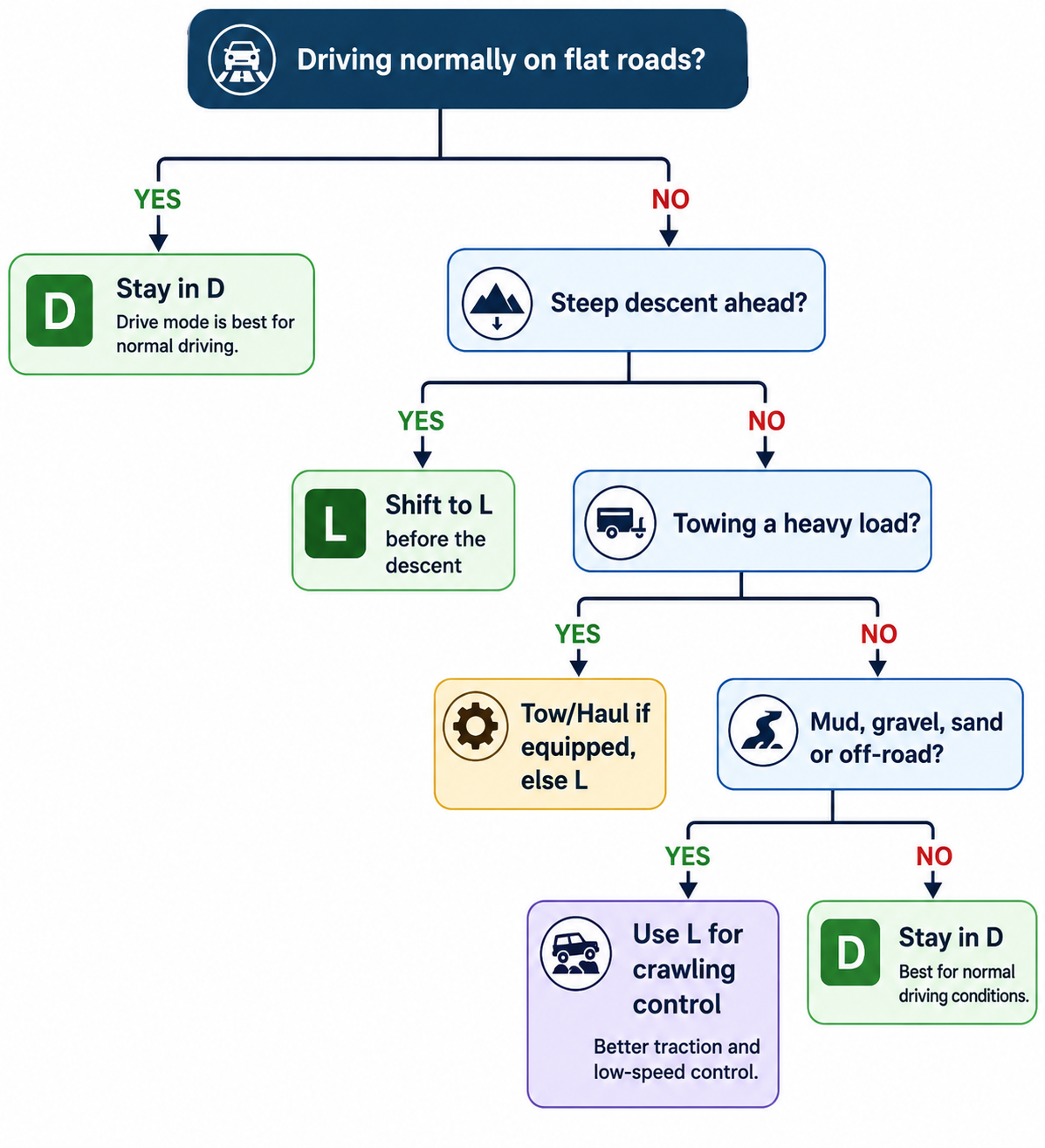
Decision Flow: Should You Shift into L?
When You Should NOT Use Low Gear
- Highway and freeway driving. The engine will scream, fuel economy tanks, and you gain nothing.
- Normal city commuting. Drive handles this better than you can.
- With cruise control engaged. The two work against each other.
- On flat roads at speed. No benefit, all downside.
- As a permanent setting. It’s a tool, not a default.
Is It Bad to Drive in Low Gear?
Not inherently but it isn’t designed for continuous use.
Drive in L for a few miles down a mountain and your car will thank you. Drive in L across three states and you’ll get:
- High sustained engine RPM
- Noticeably worse fuel economy
- A loud, unpleasant cabin
- A hard speed ceiling (you physically can’t go fast)
- More heat in the engine and transmission
None of that destroys anything immediately. All of it is unnecessary wear you didn’t need to create.
Can Driving in L Damage Your Transmission?
Under normal use, no. Automatic transmissions are engineered with Low as a legitimate operating mode, and modern ones include electronic safeguards — if you try to select L at a speed that would over-rev the engine, the transmission simply won’t complete the shift until you’ve slowed enough.
Where problems can creep in:
- Sustained high RPM over long distances adds heat and wear
- Extended towing in low gear without a transmission cooler can raise fluid temperature
- Ignoring manufacturer guidance on speed limits for the L position
Your owner’s manual will list a maximum recommended speed for Low. That number exists for a reason.
L vs D: The Difference
| Feature | L (Low) | D (Drive) |
| Gear selection | Locked in lowest gears | Full automatic range |
| Engine RPM | High | Optimised |
| Engine braking | Strong | Weak |
| Fuel economy | Worse | Better |
| Highway use | No | Yes |
| Hill descents | Excellent | Poor |
| Towing control | Good | Fair |
| Daily driving | No | Yes |
L vs 1 vs 2 vs S vs M vs B
Different manufacturers label the same idea differently, which is why this gets confusing.
| Marking | What it does |
| L | Holds the lowest gear or gears available |
| 1 | First gear only – maximum engine braking, lowest speed |
| 2 | Will use first and second, no higher |
| 3 / D3 | Locks out the top gears, common on older automatics |
| S | Sport – holds gears longer for performance, not the same as Low |
| M | Manual mode – you choose each gear via paddles or the lever |
| B | Braking mode, common on hybrids and EVs – increases regenerative braking |
The one people mix up most: L is not Sport mode. Sport keeps revs high for quicker throttle response and spirited driving. Low keeps revs high for control and engine braking. They feel superficially similar and exist for entirely different reasons.
And B is not L: On a Prius or most hybrids, B stands for Braking, and it mainly increases regenerative braking rather than mechanically locking a gear. Same goal — controlled descent — different mechanism.
Does Every Automatic Have an L?
No, and the variation is worth understanding.
Traditional automatics usually have L, or numbered positions like 1 and 2, or both.
CVTs have no fixed gears at all — they use a belt-and-pulley system with infinite ratios. Many still offer an L position, which holds the pulleys at a low ratio to mimic the effect. It works, though it feels different from a stepped automatic.
Hybrids frequently replace L with B, since regenerative braking does most of the slowing.
Dual-clutch transmissions typically skip L entirely in favour of manual paddle control.
Electric vehicles often have no gear selector positions beyond drive and reverse. Instead they offer adjustable regenerative braking or one-pedal driving, which achieves the same downhill control electronically.
Trucks and SUVs may offer Tow/Haul mode, low-range 4WD, or Hill Descent Control alongside or instead of L. However, low gear in an automatic transmission is not the same as low-range four-wheel drive. Understanding what a transfer case does in a car can help explain how a 4WD system provides additional gearing for demanding driving conditions.
L vs Tow/Haul vs Hill Descent Control
Three systems people confuse constantly:
| System | What it does | Best for |
| Low (L) | Locks transmission in lowest gears | Steep grades, crawling |
| Tow/Haul | Alters shift timing, holds gears, adds engine braking automatically | Towing on varied terrain |
| Hill Descent Control | Uses brakes electronically to hold a set crawl speed | Steep off-road descents |
If you’re towing and have Tow/Haul, use it — it’s smarter than L, adapting shift points to the load rather than locking one gear. Hill Descent Control is a different animal entirely: it works the brakes for you, typically off-road at walking pace.
What Happens If You Accidentally Shift into L?
Don’t panic. On any reasonably modern car, the transmission will simply refuse the shift if you’re going too fast, or it’ll wait until your speed drops.
If it does engage at moderate speed, you’ll feel a firm deceleration and hear the engine rev up sharply. It’s startling, not damaging.
What to do: Ease off the accelerator, let the car settle, and shift back to D. No need to stop or pull over. If you feel or hear anything genuinely alarming afterwards — grinding, slipping, a transmission warning light — get it checked.
Does Low Gear Save Your Brakes?
Yes, meaningfully. This is Low gear’s best argument.
Brakes work by converting motion into heat. On a long descent, that heat has nowhere to go, and once pads and fluid get hot enough, braking performance drops — sometimes dramatically. Brake fade is a genuine cause of mountain-road accidents.
Engine braking shifts that work to the drivetrain. Your brakes stay cool and available for the corner you didn’t see coming. On a long grade you’ll also brake far less often, which means less pad wear and less rotor heat cycling.
Does Low Gear Improve Fuel Economy?
In normal driving, no — it makes it worse. Higher RPM at the same speed means more fuel burned.
But there’s a genuine exception worth knowing. Modern fuel-injected engines use deceleration fuel cut-off: when you’re coasting downhill in gear with your foot off the accelerator, the engine typically stops injecting fuel entirely. It’s being turned by the wheels rather than burning anything.
Coast down that same hill in Neutral and the engine has to idle — which does consume fuel.
So engine braking down a long descent isn’t just safer than riding the brakes; it can use less fuel than coasting in Neutral. Which is a good thing, because coasting downhill in Neutral is a genuinely bad idea — you lose engine braking and drivetrain control precisely when you need them.
Can You Shift Between D and L While Driving?
Generally yes, at sensible speeds. You don’t need to stop, and you don’t need to touch the brake.
Do it smoothly: Ease off the accelerator, move the selector, then reapply throttle gently. Shifting at high speed either won’t engage or will produce an unpleasant lurch.
Check your owner’s manual for the maximum speed at which L can be selected. It varies by vehicle, and it’s the one number worth knowing before you need it.
Common Mistakes Drivers Make
- Using L on the freeway — no benefit, plenty of noise and wasted fuel
- Forgetting to shift back to D after a hill
- Assuming L adds horsepower — it adds torque multiplication, not power
- Selecting L for every mild incline — Drive handles ordinary hills fine
- Riding the brakes downhill instead of using engine braking
- Coasting in Neutral on descents
- Never reading the manual’s speed limit for the L position
Expert Driving Tips
- Shift into L before the descent begins, not halfway down when your brakes are already hot.
- Descend in the gear you’d need to climb — the old trucker’s rule still works.
- Don’t hold the engine near redline. If revs climb too high, you’ve picked too low a gear for your speed.
- Use Tow/Haul instead of L if your vehicle has it and you’re towing.
- Practise on a modest hill first so the sound and feel don’t surprise you on a mountain pass.
- Brake in short, firm applications rather than continuous light pressure when you do need them.
The Bottom Line
The L on your gear shift is one of the most useful controls most drivers never touch. It isn’t there for speed or power — it’s there for control.
Use it descending steep grades, towing heavy loads, or crawling through mud and gravel. Shift into it before the hill rather than partway down. Then shift back to Drive once the terrain flattens out, because leaving it in Low on the highway just burns fuel and makes noise.
Learn what it does once, and it stops being a mystery letter on your shifter and becomes the thing that keeps your brakes working on the way down.
Sources: NHTSA · SAE International · ASE (National Institute for Automotive Service Excellence) · Owner’s manuals from Toyota, Honda, Ford, GM, Mazda, Subaru, Hyundai, and Nissan
Frequently Asked Questions
What does L mean on a gear shift?
Low Gear. It holds the transmission in its lowest gear for more torque and stronger engine braking.
Is it okay to drive in L?
Yes, for the situations it’s designed for — hills, towing, low-speed control. Not for normal driving.
Can Low Gear damage the engine or transmission?
Not under normal use. Prolonged high-RPM driving adds wear and heat, but modern transmissions prevent unsafe downshifts.
Can I shift into L while driving?
Usually yes at moderate speeds. Ease off the accelerator first, and check your manual’s maximum speed for L.
Does L increase horsepower?
No. Engine power is unchanged — the gearing multiplies torque at the wheels, which feels like more pull.
Does L improve traction?
Indirectly, by allowing finer throttle control at low speed. But extra torque can also cause wheelspin on ice.
Is Low Gear good in snow?
For controlled descents, yes. For pulling away on a slippery surface, a Snow mode that starts in second gear is often better.
Can I use L while towing?
Yes, particularly on descents. If your vehicle has Tow/Haul mode, use that instead.
Why doesn’t my car have an L?
Many CVTs, hybrids, and EVs use B mode, manual paddles, or adjustable regenerative braking instead.
Is L the same as Sport mode?
No. Sport holds gears for performance and throttle response. Low holds the lowest gear for control and engine braking.
Why does my engine rev higher in L?
Because the transmission won’t upshift. Same road speed, lower gear, higher RPM.
Can I use L in the rain?
You can, though it’s rarely necessary. Reserve it for steep wet descents where brake control matters.
Is L better for mountain driving?
Yes — it’s arguably what the position exists for. Descend in L and save your brakes.
Does Low Gear save brakes?
Meaningfully, yes. Engine braking reduces heat build-up and prevents brake fade on long grades.
Is Low Gear the same as manual mode?
No. Manual mode (M) lets you select any gear. L simply locks the lowest one. Some automatic transmissions also let drivers select gears manually through steering-wheel-mounted paddles. Learn more about Dodge paddle-shift transmissions to understand how manual gear selection works in performance-oriented automatic vehicles.
Disclaimer
This article is for general informational and educational purposes only. The meaning and operation of the L gear position can vary depending on the vehicle’s make, model, transmission type, and year. Always consult your vehicle owner’s manual for the recommended operating procedures, speed limits, and safety precautions before using Low Gear. The information provided here is not a substitute for manufacturer guidance or professional automotive advice.