


Written by the AutoMagToday Content Team | Reviewed by Anand Raj, Automotive Review Expert, AutoMagToday | Last updated: September 2026
Quick Answer
Why is my check engine light on? Your check engine light may be on because the vehicle detected a problem with the engine, emissions system, fuel delivery, ignition system, oxygen sensor, catalytic converter, or another monitored component. A solid light usually requires a diagnostic check soon, while a flashing light may indicate a serious misfire and requires immediate attention.
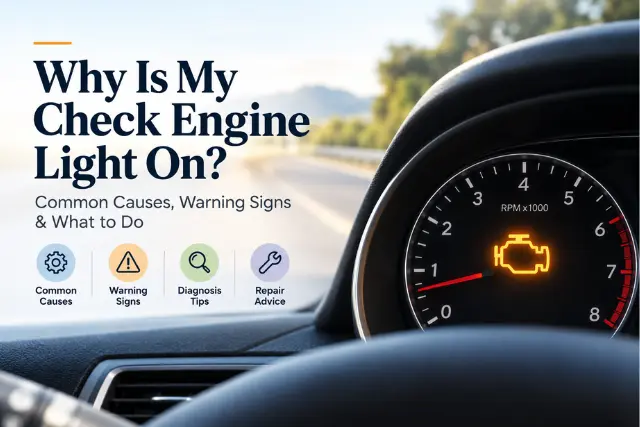
You’re driving along, nothing feels off, and then that little orange engine icon lights up on your dash out of nowhere. Your first thought is probably somewhere between “is my car about to die” and “I really don’t have time for this right now.” Take a breath – in most cases, it’s not the disaster it looks like.
A check engine light comes on because your car’s computer picked up a problem somewhere in the engine, fuel, ignition, or emissions system. Sometimes that means a simple, inexpensive fix. Sometimes it means something you shouldn’t put off. Problems involving ignition coils, for example, can trigger engine misfires and may require further diagnosis. The difference usually comes down to one detail: is the light steady, or is it flashing?
What the Light Actually Means
Your car has a small onboard computer watching dozens of systems at once such as how the engine’s running, how fuel is burning, whether emissions are in range, whether sensors are reporting numbers that make sense. The check engine light is that computer raising its hand and saying “something here isn’t right.” What it doesn’t do is tell you exactly what’s wrong. You need to pull the diagnostic code for that, which we’ll get to shortly.
Solid Light vs. Flashing Light – This Is the Part That Matters Most
A steady check engine light often indicates a fault that requires attention but may not require an immediate stop. If the vehicle is running normally and no other warning signs appear, arrange a diagnostic check as soon as practical. Always follow the vehicle owner’s manual if it gives different instructions.
A flashing check engine light can indicate a serious misfire that may damage the catalytic converter. Reduce speed, avoid hard acceleration, and pull over as soon as it is safe. If the vehicle is shaking, losing power, overheating, producing smoke, or showing additional warning lights, arrange professional assistance rather than continuing to drive.
10 Common Reasons Your Check Engine Light Comes On
1. Loose or faulty gas cap
This is the classic “oh, that’s it?” cause. A cap that isn’t sealed properly throws off the emissions system, and the light can pop on a drive or two after you filled up. Check that it’s tightened, it may take a few drive cycles to clear.
2. Bad oxygen sensor
This measures oxygen in your exhaust so the engine can adjust the fuel mix. When it fails, worse gas mileage is often the first thing you notice.
3. Failing catalytic converter
This component helps reduce harmful exhaust emissions. When it starts failing, you may notice reduced power, poor fuel economy, or unusual exhaust smells. Because catalytic converter repairs can be expensive, it’s worth learning how to recognize signs of a bad catalytic converter before the problem becomes more serious.
4. Faulty mass airflow sensor
Measures incoming air to help the engine figure out how much fuel to add. If it’s off, you’ll likely feel a rough idle or sluggish acceleration.
5. Worn spark plugs or bad ignition coils
These cause misfires, the engine may stumble or shake, especially at idle. This is a common cause behind a flashing light.
6. Vacuum or EVAP leak
Your engine relies on a precise air-to-fuel balance, and a leak in these lines throws that off.
7. Fuel injector problems
Dirty or failing injectors mess with fuel delivery, showing up as rough idling, misfires, or lower fuel economy. If you’re trying to understand the issue more clearly, it may help to learn how many fuel injectors a car has and how they work together.
8. EGR or emissions system issue
These systems control emissions, and a fault here can cause mild rough running without anything dramatic.
9. Weak battery or charging system problem
Low voltage can trip warning lights that seem unrelated to the engine, often alongside other electrical quirks.
10. A more serious engine or transmission issue
Not the most common cause, but occasionally the light does point to something bigger, exactly why getting the code checked beats guessing.
Common Check Engine Light Causes and Symptoms
|
Possible Cause |
Common Symptoms |
Typical Urgency |
|---|---|---|
|
Loose gas cap |
Light appears after refueling, no major driving symptoms |
Low, but inspect soon |
|
Faulty oxygen sensor |
Poor fuel economy, emissions-related warning |
Moderate |
|
Bad catalytic converter |
Reduced power, poor fuel economy, unusual exhaust smell |
High |
|
Faulty mass airflow sensor |
Rough idle, hesitation, sluggish acceleration |
Moderate |
|
Worn spark plugs or ignition coils |
Misfire, shaking, rough idle, flashing light |
High if flashing |
|
Fuel injector problem |
Rough running, hesitation, lower fuel economy |
Moderate to high |
|
EVAP or vacuum leak |
Rough idle or emissions warning |
Moderate |
|
Battery or charging issue |
Multiple warning lights, electrical problems |
Moderate to high |
|
EGR or emissions fault |
Rough running or emissions warning |
Moderate |
|
Engine or transmission problem |
Power loss, unusual noise, poor drivability |
High |
Why is My Check Engine Light On But My Car Runs Fine?
This situation confuses many drivers. If the car feels normal, it is natural to wonder whether the warning can wait. Some problems get flagged by the computer well before you’d notice them while driving. A loose gas cap, an early-stage sensor issue, or a minor emissions fault can all trigger the light without changing how the car feels. “Runs fine” doesn’t mean “nothing to see here,” it just means whatever tripped the light hasn’t gotten bad enough yet to be obvious.
Can I Drive With the Check Engine Light On?
A quick way to think about it:
- Solid light, car feels normal → generally fine to keep driving, but get it scanned soon.
- Solid light, but reduced power or rough running → don’t put it off, get it checked promptly.
- Flashing light with shaking or a misfire you can feel → pull over when safe and arrange help.
- Flashing light with power loss, smoke, overheating, or a strange smell → stop driving and get professional assistance.
When in doubt, treat “flashing” as your car’s version of urgent. For a more detailed explanation, read our guide on whether you can drive a car with the check engine light on.
What Should You Actually Do When It Comes On?
First, check whether it’s solid or flashing, that tells you how urgent this is. Next, notice if anything feels physically different: shaking, power loss, weird smells, smoke, overheating, or new noises. If you recently filled up, check your gas cap. Think back on recent maintenance too, since a loose part after a repair is a common culprit. From there, get the code scanned, and bring it to a mechanic if it points to something you’re not comfortable handling yourself.
How Do You Diagnose It?
Most cars built after 1996 have an OBD2 port, usually tucked under the dashboard near the steering column. Plugging in a scanner — you can buy an inexpensive one, or many auto parts stores will read it for free — pulls a diagnostic trouble code that points toward the system involved.
A diagnostic code points toward a system or component, but it does not always identify the exact failed part. A code for an oxygen sensor doesn’t always mean the sensor itself is bad; sometimes it’s a symptom of something upstream. For anything beyond the obvious stuff like a gas cap, a full inspection from a mechanic using live data and sometimes electrical or pressure testing is worth it.
The EPA’s OBD-II guidance explains how the system detects problems, stores diagnostic trouble codes, and alerts drivers when service may be needed.
How Much Does It Cost to Fix?
There’s no single honest answer, because it depends entirely on what’s wrong. Repair costs vary widely. Tightening a loose gas cap may cost nothing, while replacing an oxygen sensor, spark plugs, or ignition coils may cost anywhere from a modest amount to several hundred dollars, depending on the vehicle and labor rates. Catalytic converter and major engine repairs can cost substantially more.
Can the Light Turn Off By Itself?
Yes, sometimes. If the original issue was minor or intermittent, like that loose gas cap finally sealing, the light can clear after a few drive cycles. But the light going off doesn’t always mean the underlying issue is gone for good. The stored code often stays in the system even after the light disappears, which is worth mentioning to a mechanic if you bring it in later.
Should You Just Reset It Yourself?
You can, but resetting the code without fixing the actual problem just hides the warning. It doesn’t solve anything. If the issue is still there, the light will likely come right back. Diagnose first, fix what’s actually wrong, then reset if needed.
Check Engine Light vs. Other Warning Lights
| Warning Light | What It Generally Means | Urgency |
| Check Engine | Engine, emissions, or related system fault | Depends on solid vs. flashing |
| Oil Pressure | Possible lubrication problem | High |
| Temperature | Engine overheating | High |
| Battery | Charging or electrical issue | Moderate to high |
| Tire Pressure | Low tire pressure or sensor issue | Usually lower |
Warning light colors and meanings can vary slightly by vehicle, so your owner’s manual is the final word for your specific car.
When Should You Stop Driving Right Away?
Pull over as soon as it’s safe if the light is flashing, or if you notice severe shaking, a major loss of power, smoke, a strong unusual smell, overheating, or other warning lights joining in. None of those are things to push through to get home.
The Bottom Line
A check engine light can be as minor as a gas cap that isn’t quite tight, or as serious as an engine problem that needs immediate attention. The difference usually comes down to whether it’s solid or flashing, and whether other symptoms show up alongside it. Don’t just reset it and hope for the best. Get the code checked, understand what it’s actually telling you, and fix the real issue instead of silencing the warning.
Frequently Asked Questions
Why is my check engine light on?
Usually, your car’s computer detected an issue in the engine, fuel, ignition, or emissions system: anything from a loose gas cap to a failing sensor.
Can I drive with my check engine light on?
If it’s solid and the car feels normal, generally yes, but get it scanned soon. If it’s flashing, pull over safely instead of continuing.
Why is my check engine light flashing?
It usually points to something more urgent, like a misfire that could damage your catalytic converter if you keep driving.
Why is my check engine light on but my car runs fine?
Some issues get flagged by the computer before they’re noticeable while driving. It doesn’t mean it’s not worth checking.
Can a loose gas cap cause the check engine light to come on?
Yes, it’s one of the most common and cheapest causes.
How do I diagnose a check engine light?
Plug an OBD2 scanner into the port near your steering column to pull the trouble code, then use that as a starting point for further inspection.
How much does it cost to fix?
It ranges from free (tightening a gas cap) to a few hundred dollars for sensors, and potentially much more for a catalytic converter or engine issue.
Can a check engine light turn off by itself?
Sometimes, especially for minor or intermittent issues, though the underlying code may still be stored.
Can I reset my check engine light myself?
You can, but resetting without fixing the issue just hides the warning temporarily.
How long can I drive with a check engine light on?
There’s no fixed timeline. A solid light with no other symptoms can often wait for a scheduled diagnosis, but don’t let it sit indefinitely.