


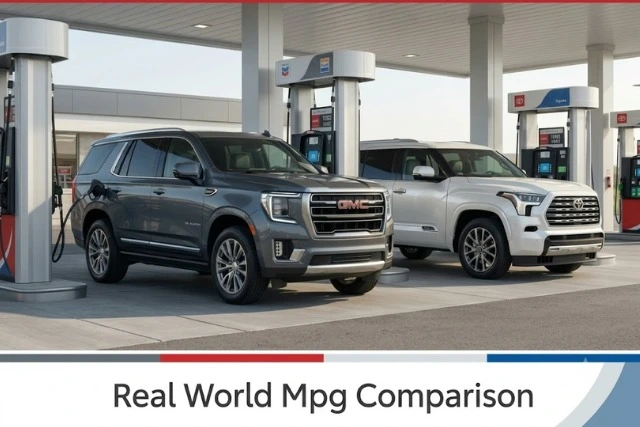
Quick Verdict: GMC Yukon vs Toyota Sequoia
Choose the 2026 GMC Yukon if you need maximum cargo capacity (122.8 cu ft vs 86.9), more engine options, a massive 16.8″ screen, and optional Super Cruise hands-free tech.
Choose the Toyota Sequoia if you want better fuel economy (21/24 MPG hybrid vs 16/20 MPG), higher towing capacity (9,520 lbs vs 8,400 lbs), and Toyota’s long-standing reputation for reliability and strong resale value.
The GMC Yukon vs Toyota Sequoia debate has been a staple of full-size SUV shopping for years — and in 2026, it’s more interesting than ever. One’s a traditional American V8 bruiser with a cabin the size of a studio apartment. The other is a hybrid-powered Japanese import that somehow tows more than its engine size suggests. Two completely different philosophies. One price bracket. Which one wins?
Let’s cut through the spec sheets and actually answer that.
2026 GMC Yukon vs Toyota Sequoia Specs — Side by Side
| Spec | 2026 GMC Yukon | 2026 Toyota Sequoia | Winner |
| Base Price | ~$72,395 | ~$67,220 | Sequoia |
| Engine Options | 5.3L V8 / 6.2L V8 / 3.0L Diesel | 3.4L Twin-Turbo V6 Hybrid (only) | Yukon |
| Horsepower | 355 / 420 / 305 hp | 437 hp (hybrid system) | Sequoia |
| Torque | 383 / 460 / 460 lb-ft | 583 lb-ft | Sequoia |
| Fuel Economy (City/Hwy) | 16 / 20 MPG (V8) | 21 / 24 MPG (hybrid) | Sequoia |
| Towing Capacity (max) | 8,400 lbs | 9,520 lbs | Sequoia |
| Max Cargo Capacity | 122.8 cu ft | 86.9 cu ft | Yukon |
| Behind 3rd Row | 25.5 cu ft | 22.3 cu ft | Yukon |
| Front Legroom | 44+ inches | 41.2 inches | Yukon |
| Infotainment Screen | 16.8 inches | 14 inches | Yukon |
| Hands-Free Driving | Super Cruise (select trims) | Not available | Yukon |
| Seating | 7–9 passengers | 7–8 passengers | Tie |
| Warranty | 3yr/36k basic, 5yr/60k powertrain | 3yr/36k basic, 5yr/60k powertrain | Tie |
GMC Yukon vs Toyota Sequoia: Which SUV Wins Each Category?
| Category | Winner |
| Price | Toyota Sequoia |
| Fuel Economy | Toyota Sequoia |
| Towing Capacity | Toyota Sequoia |
| Horsepower | Toyota Sequoia |
| Cargo Space | GMC Yukon |
| Passenger Space | GMC Yukon |
| Technology | GMC Yukon |
| Engine Choices | GMC Yukon |
| Hands-Free Driving | GMC Yukon |
| Reliability | Toyota Sequoia |
Engine & Performance: Different Philosophies
Advantage: Toyota Sequoia (peak power)
Power Numbers
Just one powertrain in the Toyota Sequoia – a 3.4-liter twin-turbo V6 and electric motor making 437 hp. The impressive thing isn’t that number, but rather 583 lb-ft of torque. Available at a low rpm, it tugs more powerfully than a Yukon’s V8, helping boost the Toyota’s tow rating a sliver.
Under the hood, the 2026 GMC Yukon can be specified with three engine variants, a 5.3L V8 (355 hp / 383 lb-ft), 6.2L V8 (420 hp / 460 lb-ft) and a 3.0L Duramax diesel (305 hp / 460 lb-ft), with the 6.2L V8 the choice if you’re prioritising performance, but in truth, what the Yukon’s more effectively delivered, however, is character. The V8 provides effortlessly confident freeway pull, free from the weight imposed by the hybrid system, while the 10-speed auto will shift imperceptibly under power load.
If you’re towing regularly, the Sequoia’s torque advantage matters at low speeds. For sustained highway towing, the Yukon V8 has the edge in feel. Both are genuinely capable. This one comes down to preference. SUV buyers who compare off-road capability should also understand what a transfer case in a car is and how it impacts 4WD performance.
Fuel Economy
Advantage: Toyota Sequoia (for city driving)
MPG Comparison
The Toyota Sequoia’s hybrid powertrain delivers around 21 city / 24 highway MPG — genuinely impressive for a full-size SUV that weighs over 5,800 lbs. The regenerative braking system recaptures energy that a traditional V8 simply wastes. Over a full year of city driving, that difference is real money.
The GMC Yukon’s 5.3L V8 returns roughly 16 city / 20 highway MPG. Not terrible for the class, but a clear gap versus the Sequoia. The optional Duramax diesel significantly closes the gap — diesel owners report 22–24 MPG on the highway, often matching the Sequoia’s combined efficiency. If you log serious highway miles, the diesel Yukon is worth a serious look. Buyers can compare official fuel economy ratings for different SUV models through the EPA fuel economy database before making a purchase decision.
One additional note: fuel economy advantage aside, the Sequoia requires premium fuel, which runs significantly more per gallon than the regular/recommended Yukon. Factor that into your long-run cost math.
Love full-size SUV debates? AutoMagToday covers the latest reviews, comparisons, and car news — bookmark us for your next big purchase.
Cargo Space & Interior Comfort
Advantage: GMC Yukon
Row Seat & Cargo Space
This is where the 2026 GMC Yukon really separates itself. Every row seat in the Yukon has more legroom than the corresponding row in the Sequoia — front legroom alone is 44+ inches in the Yukon vs 41.2 inches in the Sequoia. For tall passengers in the third row, that difference is felt immediately.
But it’s in cargo capacity where this gap really widens. The GMC Yukon can swallow a massive 122.8 cubic feet of cargo when you fold flat the third row. The Toyota Sequoia maxes out at 86.9 cubic feet – that’s close to 36 cubic feet of lost storage. That makes a huge difference if you carry gear for sports equipment, bikes for your family, a stroller, baggage, or whatever.
The Yukon and the Sequoia provide both SUVs three rows with room for 7-8 passengers, and the Yukon also has a ninth seat available on a few trims. The Toyota Sequoia gives customers a reclining second row that is much like an airline seat in its setup in higher configurations. It’s this kind of feature which families find a major benefit.
Technology Comparison
Advantage: GMC Yukon
Infotainment & Driver Assists
The 2026 GMC Yukon ships standard with a 16.8-inch infotainment display — the largest in the segment. It runs Google Built-In, giving you native Google Maps, Google Assistant, and Google Play integration alongside wireless Apple CarPlay and Android Auto. An optional 8-inch rear-seat screen is also available. Sound system options range from 10 to 22 speakers (Bose AKG on Denali).
The Toyota Sequoia gets a 14-inch screen on most trims (8 inches on base). It’s capable and clean, but smaller. Both support Apple CarPlay and Android Auto wirelessly.
The Yukon’s biggest exclusive in 2026 is Super Cruise hands-free adaptive cruise — available on Elevation trim and above. This system handles steering, braking, and acceleration on mapped highways with driver monitoring active. The Sequoia offers standard adaptive cruise control with lane centering, but no hands-free capability matches what the Yukon offers.
Towing Capacity
On Paper: Toyota Sequoia | In Feel: GMC Yukon
Towing Comparison
The Toyota Sequoia vs GMC Yukon towing capacity towing debate is more nuanced than the spec sheet suggests. The Sequoia is rated up to 9,520 lbs — higher than the Yukon’s 8,400 lbs maximum. For boats, trailers, or RVs right at that ceiling, the Sequoia’s advantage is real.
But experienced towers know that rated capacity and comfortable, real-world towing feel are different things. The Yukon’s V8 — especially the 6.2L — provides smooth, effortless pulls at sustained highway speeds with less strain on the powertrain. The Sequoia’s hybrid adds weight (~600 lbs more than the Yukon) which can impact sway control when you’re near max capacity. For most families pulling a boat or a mid-size travel trailer, both are more than capable.
GMC Yukon Denali vs Toyota Sequoia Capstone
GMC Yukon Denali vs Toyota Sequoia Capstone: The Denali sports a 6.2L V8, 22″ wheels, massaging front chairs, a 22 speaker AKG audio arrangement, and the 16.8″ screen. The Capstone is prepared to retort by means of a sky panorama moonroof, recliner back-seat chairs, a 14 speaker JBL system, and additional lavish innards. The Denali feels further hightech; the Capstone feels more specialty high-class.
Toyota Sequoia TRD Pro vs GMC Yukon AT4: TRD Pro arrives utilizing Fox interior bypass springs, a securing rear differential, plus strong trail adjustment – furthermore hybrid gasoline economy. Yukon AT4 provides Rancho springs, skid plates, a multi-terrain mode selectioner, and optional air ride suspensions. These are both real path runners. TRD Pro is further built for objective; the AT4 is additionally multi-purpose among roadway and soil.
Reliability
The Toyota brand isn’t just known for reliability, it has been providing reliable cars for decades – the Toyota Sequoia has consistently placed in the top 5 full-size SUV reliability charts for years. The Sequoia’s hybrid is new, but the Toyota hybrid system is tested and tried in several other Toyota SUV and minivans including the Highlander, Sienna, and RAV4. The 2026 GMC Yukon comes equipped with a standard 5.3L V8 engine.
In reality, this engine is one of the most thoroughly tested and successful engines on the planet with millions of miles of reliability in countless GMC Trucks and SUVs’.
Even the Duramax diesel engine is well established in the full-size and large SUV. The coverage between the two models are virtually identical – both models offer the standard 3yr/36k bumper-to-bumper and 5yr/60k powertrain coverage for vehicles.
Given the Toyota history with hybrid systems and the supply chain advantage, we feel the Sequoia may come out slightly ahead in reliability – but the Yukon in no way is a risky buy for the long term (10 years). Buyers interested in Toyota SUVs can also check how much a 2002 Toyota Sequoia 4×4 weighs to compare older generation specifications.
GMC Yukon vs Toyota Sequoia Pros and Cons
GMC Yukon — Pros
- Class-Leading Cargo Space with up to 122.8 cu-ft of storage capacity
- Three Engine Choices, including an efficient diesel option
- Massive 16.8-inch touchscreen with Google Built-In
- Available Super Cruise hands-free driving technology
- Premium Magnetic Ride Control suspension for a smoother ride
- More passenger room across all three rows
- Innovative Transparent Trailer View enhances towing visibility
GMC Yukon — Cons
- Higher starting price than key rivals
- V8 models deliver relatively poor fuel economy
- Lower maximum towing capacity than the Sequoia
- Some advanced passive safety features are optional rather than standard
Toyota Sequoia — Pros
- Excellent Hybrid Fuel Economy (21 City / 24 Highway MPG)
- Stronger 9,520-lb maximum towing capacity
- Available reclining second-row seats on Platinum and Capstone trims
- Comprehensive Toyota Safety Sense suite comes standard
- More affordable starting MSRP
- Renowned Toyota reliability and resale value
- Impressive 583 lb-ft of torque for effortless towing and acceleration
Toyota Sequoia — Cons
- Cargo capacity is significantly lower than the Yukon
- Smaller infotainment display
- No hands-free driving system comparable to Super Cruise
- Hybrid powertrain adds weight and can affect handling dynamics
- Premium fuel is recommended, increasing running costs
Final Verdict:
Buy the 2026 GMC Yukon if: you move a lot of passengers and cargo, like having engine choices, enjoy road trip technologies, or have the desire for the largest infotainment system screen on the market. It’s the superior option to drive every day for a large family due to its interior space, cargo capacity, and adaptive cruise with Super Cruise.
Buy the 2026 Toyota Sequoia if: efficiency is your primary concern, you’re towing close to maximum capacity, or if you want to benefit from the legendary reputation of Toyota for dependability and the higher towing capacity rating. Its hybrid technology is a very impressive feature.
Both cars are excellent. The GMC Yukon vs Toyota Sequoia comparison does not have a loser – just different victors depending on your needs. You can explore more SUV comparisons like Toyota Sequoia vs Ford Expedition to see how Toyota’s full-size SUV performs against other competitors.
More Car Comparisons & Reviews Check out our full-size SUV reviews, technical specifications and car comparisons at AutoMagToday.
Frequently Asked Questions
Which car has higher towing capacity GMC Yukon vs Toyota Sequoia?
Toyota Sequoia wins out at up to 9,520 lbs versus 8,400 lbs in the Yukon. Yet most drivers will opt for the Yukon for continuous highway towing due to the ride provided by the smooth V8 engine.
Which car has better fuel efficiency GMC Yukon vs Toyota Sequoia?
Toyota Sequoia has the higher MPG at up to 21/24 city/highway thanks to its standard hybrid system. The GMC Yukon’s V8 engine offers 16/20. An available Duramax diesel significantly narrows this gap for highways.
Which car has more passenger and cargo volumes?
GMC Yukon is hands-down the superior vehicle for passenger and cargo space, offering up to 122.8 cubic feet of cargo room versus just 86.9 cubic feet in the Toyota Sequoia. GMC Yukon also offers additional legroom even in the second and third rows.
GMC Yukon Denali vs Toyota Sequoia Capstone – which to choose?
When choosing between the top tier of each vehicle (the GMC Yukon Denali vs. The Toyota Sequoia Capstone), the Yukon Denali stands out in technology due to its huge 16.8” screen, the option of Super Cruise and massive stereo system. Toyota Sequoia Capstone stands out for the cabin luxury that can’t be beat, featuring airline style reclining seats in the second row and a panoramic roof. The cost is the same.
Disclaimer: Specs, prices, and ratings are based on 2025–2026 model year data and may vary by trim, region, and dealer. Always verify with the manufacturer or dealer before purchase.
Reviewed by Automotive Research Team
This comparison has been reviewed by our automotive research team to ensure accurate specifications, updated SUV information, and practical buying guidance for readers.