


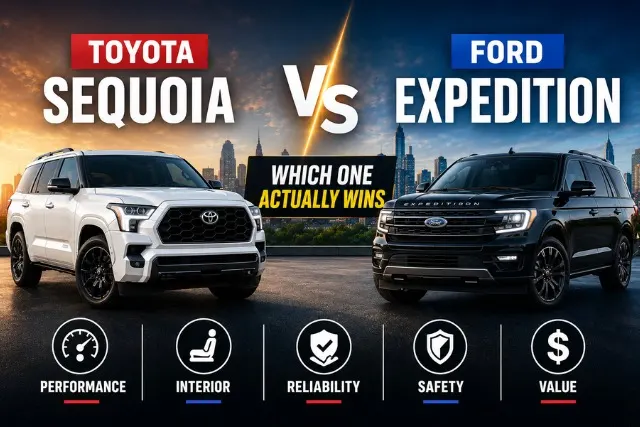
Quick Answer:
It’s hard to beat the Toyota Sequoia if you want a full-size SUV that offers the best fuel efficiency and technology. For maximum cargo versatility, an extended-body option or a more solid driving feel, try the Ford Expedition – particularly the Expedition MAX – which is the better all-rounder for big families.
All right, you’ve narrowed it down to two: the Toyota Sequoia and Ford Expedition. Both SUVs are full-size, three-row SUVs that can haul your whole family, tow your boat, and still look decent in a school parking lot. However, their paths differ significantly in the manner and way of accomplishing what they set out to do. Before choosing any used or new SUV, checking a vehicle history report can also help buyers understand past ownership, accidents, and maintenance details.
This doesn’t involve copying from a spec sheet. This detailed no-nonsense analysis of the Toyota Sequoia vs Ford Expedition comparison gives real buyers the answers they want to know.
Let’s explore the particulars.
Toyota Sequoia vs Ford Expedition: Specs at a Glance
The Toyota Sequoia is better for buyers who want hybrid fuel efficiency, reliability, strong resale value, and standard technology. The Ford Expedition is better for larger families needing maximum cargo space, third-row comfort, and Expedition MAX flexibility.
| Specification | Toyota Sequoia (2026) | Ford Expedition (2026) |
| Engine | 3.4L Twin-Turbo V6 Hybrid (i-FORCE MAX) | 3.5L EcoBoost Twin-Turbo V6 |
| Horsepower | 437 hp | 400 hp / Up to 440 hp |
| Torque | 583 lb-ft | 480 lb-ft / Up to 510 lb-ft |
| Fuel Economy (City/Hwy) | Up to 21 / 24 MPG | Up to 16 / 22 MPG |
| Max Towing Capacity | Up to 9,520 lbs | Up to 9,600 lbs |
| Starting MSRP | From $64,000+ | From $63,000+ |
| Max Cargo Space | Approx. 87 cu ft | Up to 123.1 cu ft (Expedition MAX) |
| Body Style Options | Single Length | Standard & Expedition MAX |
| Seating Capacity | Up to 8 | Up to 8 |
| Resale Value (5-Year) | Approximately 58.5% Retained | Approximately 43.0% Retained |
| Reliability Reputation | Excellent | Above Average |
Note: Specifications may vary by trim level and drivetrain configuration.
Engine & Performance: Hybrid Power vs. Displacement
When comparing their performance features, it becomes clear that the Toyota Sequoia and the Ford Expedition adopt different strategies, yet both vehicles offer sufficient power for a contemporary full-size SUV. Namely, the Toyota Sequoia is equipped with the i-FORCE MAX 3.4L Twin-Turbo V6 Hybrid Powertrain from Toyota, which produces up to 437 hp and delivers 583 lb-ft of torque. The hybrid engine helps to provide excellent low-end acceleration, allowing drivers to enjoy dynamic start-ups when merging onto highways and even towing trailers.
As for the Ford Expedition, it uses the traditional gasoline engine with 3.5L EcoBoost Twin-Turbo V6 engine, which produces up to 440 hp and 510 lb-ft of torque, depending on the selected trim level. In terms of the performance of the vehicle, its engine ensures smooth power delivery and confident performance. At the same time, the buyer may appreciate more classic performance of the engine. SUV buyers comparing drivetrain capabilities should also understand what is a transfer case in a car, especially when looking at off-road and 4WD features.
Despite the possibility to outperform the Toyota Sequoia in horsepower in certain trims, the higher torque of the latter vehicle and hybrid support help it to excel in performance. Thus, the Toyota Sequoia seems to be more attractive in terms of the balance between performance and efficiency.
Fuel Economy: Toyota Sequoia’s Clearest Win
One of the main distinctions between the two vehicles is the fuel economy of the Toyota Sequoia vs Ford Expedition. With its hybrid powertrain system being standard, the Sequoia boasts the estimated 21 MPG in the city and 24 MPG on the highway. Thus, it can be called one of the most economical vehicles in the segment of full-size SUVs.
If you compare Ford Expedition vs Toyota Sequoia fuel economy, the former will deliver 16 MPG city and 22 MPG highway. Although these numbers may be impressive for a conventional gasoline-powered SUV, they do not compare to the advantages of the Toyota vehicle when it comes to fuel economy.
Therefore, for those families who spend a lot of time driving their SUVs, make many road trips and even drive their cars daily to commute, choosing the Sequoia will mean a better fuel economy.
Official fuel economy estimates for different SUVs can also be verified using the EPA fuel economy comparison tool before making a buying decision.
Towing Capacity: Almost a Tie
The Ford Expedition vs Toyota Sequoia towing capacity matchup is essentially a dead heat at the top. The Ford Expedition offers a maximum towing capacity of up to 9,600 pounds, while the Toyota Sequoia can tow up to 9,520 pounds when properly equipped.
For most real-world use — boats, campers, utility trailers — both will get the job done without breaking a sweat.
Where they diverge is in consistency. Every Sequoia trim comes with the same hybrid powertrain and a minimum towing capacity of 9,120 lbs standard. The Expedition’s towing varies significantly by trim and powertrain, with base models rated around 6,000 lbs. If you want Expedition-level towing, you’ll need to pick the right trim — something the Sequoia doesn’t require you to worry about.
The Expedition does offer more factory towing aids across more trims, including Pro Trailer Backup Assist and BLIS with Trailer Coverage, which are genuinely useful tools if you’re regularly reversing a trailer into a tight spot.
Cargo Space & Interior: Ford Expedition Has More Room
This is where the Ford Expedition vs Toyota Sequoia size comparison tilts clearly in Ford’s favor. The standard Expedition offers 108.5 cubic feet of maximum cargo space — already significantly more than the Sequoia’s approximately 87 cubic feet. Then there’s the Expedition MAX, with up to 123.1 cubic feet behind the first row, a size class the Sequoia simply doesn’t have an answer to.
The Expedition also has more third-row legroom for adult passengers. The Sequoia’s third row is somewhat compromised by the hybrid battery packaging underneath the floor, which raises the cargo floor and creates an uneven surface when the seats are folded — a frustration some Sequoia owners only discover after purchase.
If you regularly need to fit eight adults comfortably — not just technically — the Expedition MAX is in a different league for rear-passenger space. Buyers exploring different SUVs often compare ownership value and reliability, similar to discussions around whether Kia Souls are good cars for long-term use.
That said, the Sequoia offers thoughtful cargo touches the Expedition doesn’t: an available under-floor storage compartment, a sliding third row, and a load-leveling rear suspension on upper trims that keeps the vehicle stable and level whether you’re empty or fully loaded.
Technology & Features: Sequoia Punches Above Its Base Price
The Toyota Sequoia vs Ford Expedition specs comparison in technology favors Toyota at lower price points. The Sequoia comes with more tech standard — Toyota’s Audio Multimedia system with wireless Apple CarPlay and Android Auto, a digital gauge cluster, multiple USB-C ports front and rear, and Toyota Safety Sense 3.0 (which includes pre-collision system, radar cruise control, lane departure alert, and blind spot monitoring) across all trims.
The Ford Expedition fights back with SYNC 4, a genuinely impressive infotainment platform, wireless smartphone integration, and FordPass Wi-Fi. On higher trims, the Expedition gains BlueCruise — Ford’s hands-free highway driving system, a feature the Sequoia doesn’t offer. If hands-free driving tech matters to you, this is a meaningful Expedition advantage at the top of the range.
Upper Sequoia trims (Platinum, 1794, Capstone) also offer a heads-up display that projects navigation and speed info into your sightline — the Expedition doesn’t offer this feature.
Safety & Driver Assistance
Both the Toyota Sequoia and Ford Expedition come equipped with a wide range of advanced safety technologies. The Sequoia includes Toyota Safety Sense 3.0, which bundles features such as adaptive cruise control, lane departure alert, automatic emergency braking, and blind-spot monitoring. The Expedition offers Ford Co-Pilot360 and available BlueCruise hands-free highway driving technology.
While both SUVs perform well in terms of safety, buyers interested in hands-free driving assistance may prefer the Expedition, while those seeking strong standard safety value will appreciate the Sequoia.
Buyers can also check official crash safety ratings and vehicle safety information through the NHTSA vehicle safety ratings database.
2026 Reliability: Toyota Sequoia vs Ford Expedition
When it comes to long-term ford expedition vs Toyota sequoia reliability , the Toyota Sequoia holds a clear advantage. Consumer Reports ranks Toyota among the most reliable automotive brands, while Ford typically ranks lower in overall reliability studies. J.D. Power’s Vehicle Dependability Study also places Toyota ahead of Ford in long-term ownership performance.
The Sequoia benefits from Toyota’s reputation for durability, lower maintenance costs, and strong owner satisfaction. The Expedition remains a capable and comfortable SUV, but it has historically reported more reliability concerns over time. Toyota buyers interested in older models can also explore details like how much a 2002 Toyota Sequoia 4×4 weighs to understand previous-generation specifications.
Resale value further strengthens Toyota’s case. The Sequoia retains approximately 58.5% of its value after five years, compared to roughly 43% for the Expedition. For buyers planning to keep their SUV for the long haul, that difference can translate into thousands of dollars in retained value.
Trim Variety: Sequoia Offers More Personality
One underrated edge for the Sequoia is trim variety. Six distinct configurations — including the rugged TRD Pro for off-road enthusiasts, the western-themed 1794 Edition, the ultra-luxurious Capstone, and the standard SR5, Limited, and Platinum — mean there’s a genuine Sequoia for nearly every buyer type.
Ford’s lineup includes trims such as Active, Tremor, King Ranch, and Platinum, offering buyers a range of comfort, luxury, and off-road-focused configurations. The Expedition’s lineup is solid, but it doesn’t match the Sequoia’s character range.
Toyota Sequoia vs Ford Expedition: Which One Wins?
The winner depends on your priorities. If fuel economy, reliability, resale value, and standard technology matter most, the Toyota Sequoia is the stronger overall package. Its hybrid powertrain delivers impressive efficiency without sacrificing power, making it one of the most well-rounded full-size SUVs on the market.
However, if cargo space, third-row comfort, and maximum flexibility are your top concerns, the Ford Expedition deserves serious consideration.
The availability of the Expedition MAX gives Ford an advantage that Toyota simply cannot match.
For most buyers, the Toyota Sequoia wins thanks to its superior efficiency, stronger long-term value, and excellent reliability reputation. Families needing every inch of cargo space, though, may find the Expedition to be the better fit.
Toyota Sequoia vs Ford Expedition: Who Should Buy Which?
Choose the Toyota Sequoia if…
You want better fuel economy, rock-solid reliability, strong standard towing across all trims, better long-term resale value, and more tech at every price point.
Choose the Ford Expedition if…
You need maximum cargo space (especially the MAX body), haul large groups in the third row, want BlueCruise hands-free driving, or need consistent towing power in cold climates.
Toyota Sequoia vs Ford Expedition: Quick Winner Summary
While both SUVs are strong choices, the winner depends on what matters most to you. Here is a quick Toyota Sequoia vs Ford Expedition comparison to help you decide which SUV performs better across fuel economy, reliability, towing, space, and overall ownership value.
| Category | Winner |
|---|---|
| Fuel Economy | Toyota Sequoia |
| Cargo Space | Ford Expedition |
| Reliability | Toyota Sequoia |
| Towing | Tie |
| Large Families | Ford Expedition |
| Resale Value | Toyota Sequoia |
Final Word
The Toyota Sequoia vs Ford Expedition debate doesn’t have a single universal winner — it depends on what matters to your family. The Sequoia wins on efficiency, reliability, resale value, and tech-for-money. The Expedition wins on sheer cargo volume, extended-body flexibility, and third-row adult comfort.
If you’re optimizing for long-term ownership costs and don’t need the absolute maximum in cargo, the Sequoia is the smarter buy. If your family is large, you haul lots of gear, and you want every cubic foot you can get, the Expedition MAX is genuinely hard to argue with.
Both SUVs are excellent. The one that’s right for you depends on whether you park at Costco or at a campsite — and honestly, the best families do both.
Frequently Asked Questions
Is the Toyota Sequoia bigger than the Ford Expedition?
In standard form, they’re similar in size. However, Ford offers the Expedition MAX, which is an extended-length body style with up to 123.1 cubic feet of cargo room — significantly larger than anything the Sequoia offers. The standard Expedition and standard Sequoia are comparable in overall dimensions.
Which has better towing — the Sequoia or the Expedition?
They’re nearly identical at maximum capacity. The Expedition Tremor is rated at approximately 9,600 lbs; the Sequoia maxes out around 9,520 lbs. But the Sequoia hits 9,120 lbs across all standard trims, while the Expedition’s towing varies widely (from 6,000 lbs at the base). If you want strong towing without upgrading trim, the Sequoia is the safer bet.
Is the Toyota Sequoia more reliable than the Ford Expedition?
According to Consumer Reports and J.D. Power data, yes — significantly so. Toyota ranks in the top 4 for overall reliability; Ford ranks 13th. The Sequoia also holds its resale value about 15 percentage points better than the Expedition over five years.
Does the Toyota Sequoia get better gas mileage than the Ford Expedition?
Yes. The Sequoia’s hybrid powertrain delivers 21 MPG city and 24 MPG highway, compared to the Expedition’s 16 city / 22 highway. That’s a meaningful difference over years of ownership.
Which is better for a large family — the Toyota Sequoia or Ford Expedition?
The Ford Expedition (especially the MAX) offers more usable third-row legroom and maximum cargo space, which makes it the better choice for families who regularly seat 7–8 people. The Sequoia is excellent for families too, but the third row is more comfortable for children than adults on long trips.
Reviewed by Automotive Research Team
This comparison has been reviewed by our automotive research team to ensure accurate specifications, reliability insights, and practical buying guidance for SUV shoppers.