


Written by the AutoMagToday Content Team | Reviewed by Rubi Chauhan, Insurance Advisor, AutoMagToday.com | Last updated: November 2026
Quick Answer
If you’re wondering how to switch car insurance, start by comparing quotes from multiple insurers and choosing a new policy that offers the coverage you need at a competitive price. Review your existing policy, compare coverage limits and deductibles, and select a start date for your new insurance before your current policy ends. Once the new policy is active, formally cancel your old coverage and check whether any cancellation fees or refunds apply. The key is to avoid a lapse in insurance coverage during the switch.
Whether your premiums have increased, you’ve found a cheaper policy or you aren’t happy with your current insurer, you’re not stuck with them until your policy ends. It’s generally possible to switch car insurance at any time, but the rules for cancelling and any fees involved vary by insurer and state.
The bright side is that switching car insurance is pretty easy. The trick is that you want to get your new policy first, avoid any lapse in coverage, and then transition to your new policy the right way.
Read on to learn about everything from how to switch car insurance companies to how to transfer your auto coverage to your new car and if you can switch insurance companies after a claim.
How Do You Switch Car Insurance?
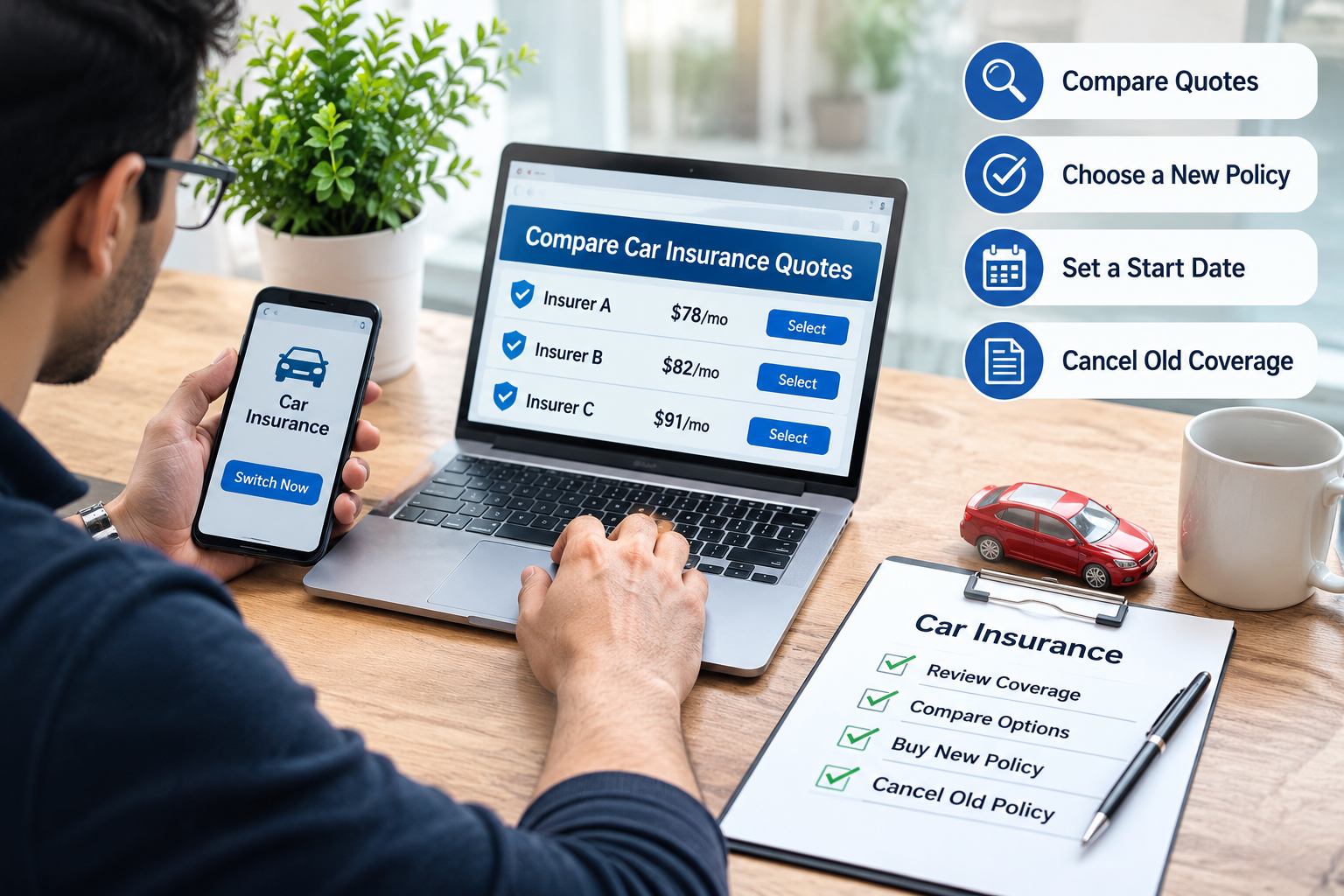
To transfer insurance on a car, compare and buy a new policy, select the new start date of coverage, verify your new coverage is in force and then cancel your old policy.
A simple process looks like this:
- Review your current policy.
- Get quotes from other insurers.
- Compare identical coverage limits and deductibles.
- Choose your new insurer.
- Set the new policy’s start date.
- Confirm the new policy is active.
- Cancel your old policy.
- Confirm the old policy has ended.
- Check whether you’re owed a refund.
The most important rule: Don’t cancel your existing policy before your replacement coverage is active. Even a short lapse can leave you uninsured and may create financial and legal problems.
When Should You Switch Car Insurance?
You can switch car insurance when you find a policy that better fits your needs or budget. You don’t necessarily have to wait for your current policy’s renewal date.
Some common reasons drivers switch include:
- Their premium increased.
- Another insurer offered a lower quote.
- They bought a new car.
- They moved to another state.
- Their driving habits changed.
- They qualify for new discounts.
- They’re dissatisfied with customer service.
- They want different coverage or deductibles.
- Their current policy no longer fits their needs.
Your renewal date can be a convenient time to compare rates, but it isn’t necessarily the only time you can switch.
Before making the change, check your current policy for cancellation requirements and ask your insurer whether any fees or refunds apply.
How to Switch Car Insurance Companies
If you’re ready to switch car insurance companies, follow these steps rather than simply canceling your existing policy and starting over.
1. Check Your Current Car Insurance Policy
Start by looking at your declarations page. This usually shows important information such as:
- Current premium
- Liability limits
- Comprehensive coverage
- Collision coverage
- Deductibles
- Uninsured/underinsured motorist coverage
- Policy expiration date
- Vehicles listed on the policy
Knowing your current coverage makes it easier to compare quotes accurately.
For example, if your current policy has a $500 comprehensive deductible and your new quote has a $1,500 deductible, the new policy may look cheaper partly because you’re taking on more out-of-pocket risk.
2. Shop Around for New Quotes
Get quotes from multiple insurance companies before deciding. You can also learn what is the cheapest car insurance and compare the factors that affect premiums before choosing a new provider.
When comparing car insurance switch options, provide the same information to each insurer and request comparable coverage.
Don’t compare only the monthly premium. Review the protection included in each policy, including whether car insurance covers hail damage and other weather-related risks.
- Liability limits
- Comprehensive and collision coverage
- Deductibles
- Uninsured motorist coverage
- Medical payments or personal injury protection, where applicable
- Rental car coverage
- Roadside assistance
- Discounts
- Policy fees
A lower price isn’t necessarily a better deal if the policy provides significantly less protection. Before switching, understand what is comprehensive car insurance and whether it offers the protection you need against non-collision damage.
3. Ask About Discounts
Before accepting a quote, ask the insurer which discounts you qualify for.
Depending on the insurer and your state, discounts may be available for things such as:
- Safe driving
- Multiple policies
- Multiple vehicles
- Good students
- Defensive-driving courses
- Low mileage
- Vehicle safety features
- Certain memberships or affiliations
- Usage-based insurance programs
Your circumstances may have changed since you bought your current policy, so it’s worth checking again.
4. Buy the New Policy Before Cancelling the Old One
This is the step you don’t want to get wrong.
Set the new policy to begin before your old policy ends. Ideally, the transition should be seamless, with no uninsured period.
For example:
Old policy ends: June 30 at 11:59 p.m.
New policy begins: July 1 at 12:01 a.m.
Ask your new insurer to confirm the effective date and that your policy is active.
Don’t rely solely on an online quote. Make sure you have confirmation that the policy has actually been issued.
5. Cancel Your Old Car Insurance
Once your new policy is active, contact your existing insurer and request cancellation.
Your insurer may allow you to cancel:
- Online
- By phone
- Through an agent
- In writing
Ask for written confirmation showing the cancellation date.
If you paid your premium in advance, ask whether you’re entitled to a refund for unused coverage.
6. Keep Your Insurance Documents
Save your:
- New insurance ID cards
- Policy declarations page
- Cancellation confirmation
- Refund information
- Payment receipts
Keeping these documents can make it easier to resolve questions about the transition later.
Do You Need to Cancel Car Insurance When Switching?
Yes. If you’re replacing your current policy with another insurer, you generally need to make sure the old policy is properly canceled.
Buying a new policy doesn’t necessarily mean your old insurer will automatically cancel your existing coverage.
If you simply stop paying the old insurer, the policy may eventually be canceled for nonpayment, but that’s not the cleanest way to switch.
Instead, contact the old insurer and specifically request cancellation.
Ask:
- What date will my policy cancel?
- Is there a cancellation fee?
- Am I entitled to a refund?
- Do you need written confirmation?
- Will you send me a cancellation confirmation?
This gives you a clear record of when the old policy ended.
Can You Switch Car Insurance at Any Time?
In many cases, yes. You can generally switch car insurance before your current policy’s renewal date.
However, cancellation terms can vary by insurer and state.
Depending on your policy, you could encounter:
- Cancellation fees
- Short-rate cancellation calculations
- Minimum policy periods
- Refund rules
- Notice requirements
Before switching, check the terms of your existing policy. For more guidance on changing insurance companies, understanding cancellation rules, and comparing coverage, read the National Association of Insurance Commissioners’ auto insurance shopping guide.
Can You Switch Car Insurance Before the Renewal Date?
Yes – you can change insurers before the policy renewal but make sure you consult the cancellation policy of your insurer first.
You are not obliged to keep the same insurer just because you are months away from renewing. But take the cancellation penalty into account before you jump ship now, for example.
Is It Easy to Switch Car Insurance?
For most drivers, switching car insurance is relatively simple. The process can often be completed in one sitting once you’ve gathered your vehicle and policy information.
The part that requires the most attention is comparing policies correctly.
A quote that is $50 cheaper per month isn’t necessarily a better deal if it has lower liability limits or less protection. Choosing adequate liability coverage matters because a serious accident can create financial risks beyond your policy limits. Learn whether you can lose your house due to an at-fault car accident.
- Lower liability limits
- Higher deductibles
- Fewer optional coverages
- Different uninsured motorist protection
Think of switching as a coverage comparison first and a price comparison second.
Does It Cost Money to Switch Car Insurance?
It can, but switching itself isn’t necessarily expensive.
Potential costs depend on your current insurer, state and policy terms.
You may need to consider:
- Early cancellation fees
- Short-rate penalties, if applicable
- Unused premium refunds
- New policy down payments
- Changes in installment fees
For example, suppose your current insurer charges a cancellation fee but your new policy saves you $40 per month. If you have several months remaining, the savings could still outweigh the cancellation cost.
Do the math before making the switch.
Can You Switch Car Insurance After an Accident or Claim?
You may be able to switch car insurance after an accident or claim, but timing matters.
If you already have an open claim, changing insurers does not normally erase your existing insurer’s responsibility for a covered loss that occurred while its policy was active.
The claim generally remains associated with the policy that covered you when the accident occurred.
However, a recent accident or claim can affect the price of a new policy because insurers may consider driving and claims history when determining premiums.
If you’re thinking about switching during an active claim, ask both insurers how the transition will work before making changes.
Most importantly, don’t cancel coverage in an attempt to avoid reporting an accident or claim.
How to Switch Car Insurance to a New Car
Buying a new vehicle is another common reason drivers search how to switch car insurance to a new car.
If you’re replacing your old car, contact your insurer before or immediately after purchasing the new vehicle and provide the new vehicle’s information.
If you’re changing insurers at the same time, the process is slightly different:
- Get quotes using the new vehicle’s information.
- Compare coverage.
- Purchase the new policy.
- Make sure it starts when needed.
- Confirm the vehicle is listed correctly.
- Cancel the old policy once the new policy is active.
Don’t assume your old vehicle’s coverage automatically transfers indefinitely to a new vehicle. Insurers and policies can have specific requirements and notification periods.
If you’re financing or leasing the new car, check the lender’s insurance requirements before selecting coverage. You can also review the car insurance requirements for financed vehicles to understand the coverage your lender may expect.
Can You Switch Insurance From One Car to Another?
You may be able to change the vehicle listed on your policy, but this is different from switching insurance companies.
If you sell one car and buy another, your insurer can generally update the policy to reflect the replacement vehicle, subject to its rules.
You may not need to cancel your policy at all.
Contact your insurer and provide details such as:
- Vehicle identification number (VIN)
- Year
- Make and model
- Purchase date
- Financing or lease information
- Expected annual mileage
Your premium may change because the replacement vehicle has different repair costs, safety features, theft risk or value.
How to Switch Car Insurance to Another State
Moving to another state is different from simply switching insurers.
Auto insurance requirements and rating rules vary by state. Your existing policy may not be designed to remain in force after you permanently relocate.
If you’re moving:
- Check your new state’s insurance requirements.
- Notify your current insurer about the move.
- Get quotes from insurers serving your new location.
- Compare the required coverage.
- Arrange the new policy before the old one ends.
- Update your vehicle registration and other required records.
- Cancel the old policy after confirming the new one is active.
Don’t assume that simply changing your address on an existing policy is enough when moving permanently to another state.
Should You Switch Car Insurance Often?
There’s no universal rule saying how frequently you should switch insurers.
Instead, review your coverage and price periodically, particularly when something changes.
Good times to compare include:
- Before policy renewal
- After moving
- After buying a vehicle
- After paying off a car loan
- After a major mileage change
- When your premium increases
- When you qualify for new discounts
- After significant changes to your household
You don’t need to switch every time you receive a slightly cheaper quote. Look at the overall policy, insurer, customer service, deductibles and coverage.
Common Mistakes to Avoid When Switching Car Insurance
A car insurance switch can go smoothly if you avoid these common mistakes.
Canceling before the new policy starts
This can create a coverage gap. Always confirm the replacement policy is active first.
Comparing different coverage levels
A cheaper quote isn’t meaningful if it provides substantially less protection.
Forgetting about deductibles
Check both comprehensive and collision deductibles.
Ignoring cancellation fees
Ask your current insurer about cancellation costs before making the change.
Failing to update your lender
If your vehicle is financed or leased, make sure the new insurer has the correct lender or leasing company information.
Letting the old policy lapse
Don’t simply stop making payments. Request a formal cancellation.
Focusing only on price
The cheapest policy may not provide the coverage you actually need.
Switching Car Insurance Checklist
Before completing your switch, run through this quick checklist:
- Reviewed my current policy
- Compared several quotes
- Matched coverage limits
- Compared deductibles
- Checked available discounts
- Selected my new insurer
- Confirmed the new policy’s effective date
- Received proof of insurance
- Confirmed my lender is listed, if applicable
- Canceled my old policy
- Received cancellation confirmation
- Checked whether I’m owed a refund
The Bottom Line
Changing your car insurance doesn’t need to be complicated. Get quotes, compare coverage, select your new policy, make sure it is active and cancel your existing car insurance.
You’re usually able to change car insurance by the renewal date, but it’s worth reading your cancellation policy first to see if there are any restrictions on when you can do this. If you’re buying a new car or moving to a new state, plan in advance to be certain that the new policy will be suitable for you and will satisfy the state.
Don’t select a policy just because it costs the least. When you’re switching car insurance companies, compare the coverage limits, deductibles and exclusions in addition to the premium. Spending an extra 10 minutes to compare coverage details can help you make a seamless car insurance switch without a surprise coverage gap or a bill.
Is it time for a change? Compare your present policy to a few new quotes based on the same coverage limits and deductibles.
Frequently Asked Questions
Can I switch my car insurance at any time?
In many cases, yes. You generally don’t have to wait for renewal, but your insurer may have cancellation rules or fees.
Do I need to cancel my car insurance before switching?
Don’t cancel your old policy until your replacement coverage is confirmed. Once the new policy is active, formally cancel the old one rather than allowing it to lapse.
Can you switch car insurance companies before renewal?
Yes, you may generally switch before your renewal date. Check your policy for any applicable cancellation fees or refund rules.
Can I switch car insurance after a claim?
You may be able to switch after filing a claim. Your existing insurer generally continues handling a covered claim arising from an incident that occurred while its policy was active.
Can I switch car insurance during a claim?
You may be able to purchase a new policy during an open claim, but the existing claim normally remains with the insurer that covered the incident. Ask your insurers about the specific circumstances.
Does it cost money to switch car insurance?
It can. Depending on your insurer and state, you may face a cancellation fee or other charges, although you may also receive a refund for unused premium.
Is it bad to keep switching car insurance?
Switching insurers isn’t inherently bad. However, constantly changing policies without comparing coverage carefully can create unnecessary administrative work. Focus on finding coverage that fits your needs and budget.
How long does it take to switch car insurance?
The actual purchase of a new policy can often be completed quickly, but the total process depends on how long it takes to compare quotes, provide information, activate the new policy and cancel the old one.
Can I switch insurance from one car to another?
You may be able to update your existing policy when replacing a vehicle. Contact your insurer with the new vehicle’s details rather than assuming the old policy automatically transfers.
Disclaimer
This article is for general informational and educational purposes only. Car insurance requirements, cancellation procedures, fees, refund policies, coverage options, and eligibility rules may vary by insurer and state. The information provided should not be considered legal or financial advice. Always review your existing policy, confirm the terms of your new coverage, and contact your insurance providers or state insurance department for guidance before switching car insurance.