


Written by the AutoMagToday Content Team | Reviewed by Anand Raj, Automotive Review Expert, AutoMagToday | Last updated: October 2026
Quick Answer
Ventilated seats are vehicle seats with small electric fans built into the cushion and backrest that move air through tiny perforations in the upholstery. Unlike a true cooled seat, most ventilated systems don’t generate cold air — they circulate cabin air to pull heat and moisture away from your body. The result is less sweat and a far more comfortable drive, particularly on leather in summer.
It’s 98°F, you’ve been parked in full sun for an hour, and sliding into a leather seat feels less like getting in a car and more like sitting on a griddle. The dealer mentioned “ventilated seats” on the higher trim. Are they actually worth the jump, or is it just another line on the options sheet? Along with seat ventilation, car window tinting may help reduce sunlight entering the cabin. Here’s a guide to how much it costs to tint car windows.
What Are Ventilated Seats?
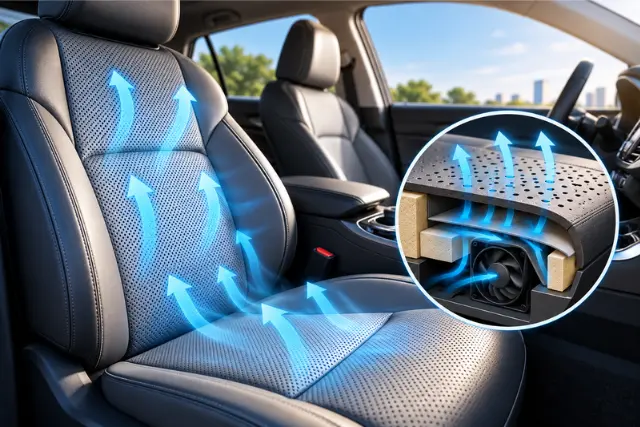
A ventilated seat is a seat with a ventilation system inside it. Beneath the visible upholstery sit one or more small fans, a layer of spacer material or air channels, and a perforated surface — those tiny holes you can see in the leather.
Switch the system on and the fans move air through those channels. Depending on the design, air is either pushed outward through the perforations toward you, or pulled inward away from you, drawing warm, humid air off your body and clothing.
That second design is more common than people realise, and it’s why some drivers say they can’t feel much airflow. The system may be working exactly as intended — it’s extracting rather than blowing.
Manufacturers introduced these because leather has an obvious weakness: it doesn’t breathe. Sit on it in summer and heat and moisture get trapped between you and the seat. Air conditioning cools the cabin but does very little for the part of you pressed against the upholstery.
[Image 1: Ventilated seat cutaway — Alt text: “Cutaway diagram showing ventilated car seat airflow through perforated leather”]
How Do Ventilated Seats Work?
Press the seat button
↓
Fans switch on
↓
Air moves through channels in the foam
↓
Air passes through perforated upholstery
↓
Heat and moisture carried away
↓
Cooler, drier contact surface
The components are simple:
- Fans – usually one to four small blowers per seat, mounted in the cushion base and seatback.
- Air channels or spacer fabric – a permeable layer inside the foam that lets air travel across the seat rather than getting stuck in one spot.
- Perforated upholstery – the holes are functional, not decorative. Without them, nothing gets through.
- Control module – connects to the seat button, usually with two or three intensity levels, and manages fan speed.
Most systems draw cabin air rather than air from a duct. That’s the key mechanical fact behind almost every question people have about them.
Ventilated vs Heated vs Cooled Seats
This is where the confusion lives, so let’s be precise.
| Feature | Ventilated | Heated | True Cooled |
| Uses fans | Yes | No | Yes |
| Produces cold air | No | No | Yes |
| Heating element | No | Yes | Sometimes |
| Best season | Summer | Winter | Hot climates |
| Needs perforated upholstery | Yes | No | Yes |
| Typically found on | Mid-range and up | Widely available | Premium trims |
| Relative cost | Moderate | Low | Highest |
Heated seats are the simplest of the three — a resistive heating element under the upholstery, essentially an electric blanket. No fans, no perforations needed.
Ventilated seats move ambient cabin air. If your cabin is 75°F, the air reaching you is roughly 75°F. The cooling sensation comes from evaporation and heat transfer, not from chilled air.
True cooled seats actively lower air temperature before it reaches you, typically using a thermoelectric (Peltier) device or by routing air from the climate system. These exist, but they’re less common than the marketing suggests.
The honest complication: manufacturers use these terms loosely. Plenty of vehicles advertised as having “cooled seats” are running a standard ventilation system. The badge on the button tells you less than the spec sheet does — and sometimes the spec sheet isn’t much clearer.
Do Ventilated Seats Blow Cold Air?
Usually not, and this is the single biggest misconception.
Most systems circulate whatever air is already in your cabin. Turn them on in a car that’s been baking all afternoon and the first few minutes will feel underwhelming, because the system is moving 120°F air around.
Run the AC for five minutes first, then switch on the ventilation, and the effect changes completely. Now cooled cabin air is being drawn through the seat, and the difference is immediate.
That’s the practical technique worth knowing: ventilated seats work with your air conditioning, not instead of it. If your cabin AC isn’t cooling properly, consider getting it checked by a professional offering automobile AC repair before judging how well the ventilated seats perform.
Do They Use Your Vehicle’s Air Conditioner?
Two designs exist, and which one you have matters.
Independent fan systems – the majority. Fans move cabin air with no direct connection to the HVAC system. Simpler, cheaper, and effective once the cabin has cooled.
HVAC-assisted systems – found on some premium vehicles. Air is drawn from the climate system, so it’s already conditioned before it reaches the seat. These deliver noticeably colder airflow and genuinely deserve the “cooled” label.
Terminology varies by brand too. BMW markets its system as Active Seat Ventilation. Others use “ventilated,” “cooled,” “climate,” or “air-conditioned” seats for functionally similar hardware. When you’re comparing trims, ignore the name and ask the dealer directly whether the system draws conditioned air or cabin air.
Benefits
- Less sweating – The main event, and the reason owners in hot states rate them so highly. Airflow prevents the trapped humidity that makes leather uncomfortable.
- No more scalding leather – Perforated seats with ventilation running shed heat far faster than solid upholstery after the car’s been parked.
- Genuinely better on long drives – Three hours on a hot interstate is where you notice the difference most — a dry back rather than a shirt stuck to the seat.
- Helps in humid climates as much as hot ones – Airflow aids evaporation, which is exactly what high humidity blocks.
- Modest energy draw – Small fans use far less power than cranking the AC harder, which matters more in an EV where climate control affects range.
- Pairs with heated seats – Most vehicles offering ventilation also offer heating in the same seat — genuinely useful year-round.
Drawbacks
- Higher purchase price – Usually bundled into a package or a higher trim, so you’re rarely buying the feature alone.
- Fan noise – Audible at the highest setting, particularly with music off and windows up.
- Limited on their own – They can’t cool a hot cabin. They complement the AC.
- Requires perforated upholstery – That means leather or leatherette in almost every case.
- Perforations can trap debris – Crumbs and dust find those holes, and spills go straight into the foam.
- More components to fail – Fans, wiring, and a module — none of which a plain seat has.
Are Ventilated Seats Worth It?
1. Do you live somewhere hot or humid?
- Yes: Go to Question 2.
- No: Go to Question 3.
2. Do you have leather or leatherette seats?
- Yes: Strong value
- No: Limited benefit
3. Do you take long summer road trips?**
- Yes: Worth it
- No: Probably skip it
Worth it if you:
- Live in Texas, Florida, Arizona, Nevada, or anywhere with long hot summers
- Have leather seats
- Commute daily, especially with street parking
- Take regular long drives
- Plan to keep the car several years — it’s a decent resale point
Probably skip if you:
- Live somewhere with mild summers
- Prefer cloth seats
- Only drive short distances
- If you would have to move up two trim levels just to get ventilated seats, compare the added cost with the comfort benefits before deciding. If you’re considering a new vehicle, reviewing current car lease deals in the USA may also help you compare your options.
Which Cars Have Ventilated Seats?
Availability has broadened significantly. Once exclusive to luxury cars, ventilated seats now appear across mainstream mid-size sedans, family SUVs, and full-size trucks — usually on mid-tier trims and above.
You’ll commonly find them on:
- Mainstream sedans and SUVs – higher trims from Hyundai, Kia, Toyota, Honda, Mazda, and Nissan
- Full-size trucks – upper trims from Ford, Ram, Chevrolet, and GMC
- Three-row family SUVs – increasingly standard on top trims
- Luxury vehicles – near-universal from BMW, Mercedes-Benz, Lexus, Genesis, and Cadillac
- EVs – increasingly common, since fans draw less energy than aggressive cabin cooling
Critical caveat: availability changes by model year, trim, and options package, and it’s frequently restricted to front seats only. A model that offers ventilated seats on its top trim may not offer them at all two trims down.
Always confirm on the specific vehicle’s window sticker, not the brochure — and if you’re buying used, sit in it and press the button.
Can You Add Ventilated Seats Later?
Yes, with real caveats.
Aftermarket: kits exist and typically include fans, wiring, a control switch, and spacer material. Installation requires removing the seat, stripping the upholstery, fitting the fans into the foam, and reassembling — several hours of skilled work.
The upholstery problem: if your seats aren’t perforated, air has nowhere to go. Many retrofits therefore require perforated covers as well, which changes the job from an install into a partial reupholster.
Seat swapping: sourcing factory ventilated seats from a donor vehicle — can work on some models, but wiring, connectors, airbag sensors, and seat-position memory modules all complicate it. On a car with side airbags in the seat, this becomes a safety-critical job
Realistically: buying a trim that includes ventilated seats from the factory is usually cheaper, cleaner, and better integrated than retrofitting them. Aftermarket installation makes the most sense if you’re keeping the vehicle long-term and your preferred trim wasn’t available. Similar considerations apply when researching other upgrades, such as whether you can add a sunroof to a car.
Common Problems
| Problem | Likely cause |
| Fans don’t run at all | Blown fuse or failed switch |
| Weak airflow | Clogged perforations or debris in channels |
| Works on one setting only | Failing control module or resistor |
| Noisy operation | Worn fan bearing or trapped debris |
| One seat works, other doesn’t | Wiring fault or individual fan failure |
| Intermittent operation | Loose connector under the seat |
Wiring faults under seats are more common than you’d think — connectors sit right where feet, luggage, and seat rails all meet.
Typical Repair Costs
| Repair | Indicative cost (US) |
| Fuse replacement | $10–30 |
| Fan motor | $150–400 |
| Seat control module | $250–800 |
| Wiring repair | $100–300 |
| Full seat system repair | $500–1,500 |
These are broad estimates and vary heavily by vehicle, parts availability, and labour rates. Luxury models with integrated seat modules sit at the top of every range. Because most of the cost is labour in accessing the components, fixing two faults in one visit is far cheaper than two separate visits.
Maintenance Tips
- Vacuum the perforations regularly with a soft brush attachment. Clogged holes can restrict airflow and reduce the effectiveness of ventilated seats. As part of your regular vehicle care routine, you can also learn how to get rid of water spots on a car.
- Clean up spills immediately. Liquid goes straight through the holes into the foam and fans.
- Use leather conditioner sparingly and never let it pool in perforations, where it dries and blocks airflow.
- Don’t run them on soaking-wet upholstery.
- Avoid seat covers. They block the entire system.
- Run them occasionally in winter — fans that never move can seize.
Myth vs Fact
| Myth | Reality |
| They blow ice-cold air | Most circulate cabin air; the cooling comes from airflow and evaporation |
| They can replace air conditioning | They complement AC — cool the cabin first for best results |
| Only luxury cars have them | Widely available on mainstream mid and upper trims |
| They hurt fuel economy meaningfully | Small fans draw minimal power |
| They’re high-maintenance | Occasional vacuuming is essentially the whole job |
| Cloth seats can be ventilated | Rare — the system needs perforated upholstery |
| Ventilated and cooled are the same | Different in principle, though brands often use the terms interchangeably |
Before You Pay Extra: Test Drive Checklist
- Run the AC for five minutes first, then test the seats
- Cycle through every fan level
- Listen for rattles, whining, or uneven noise
- Feel for airflow at your back AND under your thighs
- Check the perforations are clean and undamaged
- Confirm the trim actually includes ventilation (front and rear?)
- Ask whether it’s cabin air or HVAC-fed
- On used cars, verify remaining warranty on seat electronics
That first line matters most. Testing ventilated seats in a car that’s just come off a hot lot will make even a perfectly good system feel useless.
Key Takeaways
- Ventilated seats move air — they don’t manufacture cold
- Small fans push or pull air through perforated upholstery
- Different from heated seats and from true cooled seats
- Genuinely effective in hot, humid climates
- Need perforated leather or leatherette to work
- Available well below luxury price points now
- Repairs usually mean a fan motor or a fuse, not a whole seat
The Bottom Line
Ventilated seats aren’t miniature air conditioners built into your upholstery — and once you stop expecting that, they’re genuinely one of the better comfort features you can option.
They move air where your body meets the seat, which is exactly the spot your AC can’t reach. In a hot climate, on leather, over a long drive, that’s a meaningful upgrade rather than a gimmick.
Just remember the one thing that determines whether you love them or feel cheated: cool the cabin first, then let the seats do their job.
Sources:
- NHTSA
- SAE International
- Manufacturer owner’s manuals and equipment listings from Toyota, Honda, Ford, Hyundai, Kia, BMW, Mercedes-Benz, Lexus, General Motors, and Stellantis
Frequently Asked Questions
What are ventilated seats in a car?
Seats with built-in fans that move air through perforated upholstery, reducing heat and moisture between you and the seat.
Do ventilated seats actually cool you down?
Yes, though indirectly. They don’t produce cold air — they create airflow that carries heat and sweat away, which feels cooling. Effectiveness improves substantially once the AC has cooled the cabin.
What’s the difference between ventilated and cooled seats?
Ventilated seats circulate existing cabin air using fans. True cooled seats actively chill the air, usually via a thermoelectric element or the HVAC system. In practice, many vehicles labelled “cooled” use standard ventilation.
Which is better, cooled or ventilated?
Truly cooled seats feel more dramatic on a very hot day. Ventilated seats are simpler, more common, and effective enough for most drivers once the cabin is cool.
Do ventilated seats use the air conditioner?
Most don’t connect directly to it — but they circulate cabin air, so AC-cooled air makes them work far better. Some premium systems do draw conditioned air.
Can cloth seats be ventilated?
Rarely. The system needs perforations, which is why it’s almost always paired with leather or leatherette.
Can you install ventilated seats aftermarket?
Yes, using kits with fans and spacer material, but it requires seat disassembly and usually perforated upholstery. Factory-fitted is generally the better route.
Do they use much fuel or battery?
No. The fans draw minimal power — considerably less than increasing AC output, which is partly why they’re popular in EVs.
Why aren’t my ventilated seats working?
Most often a blown fuse, clogged perforations, a failed fan motor, or a loose connector beneath the seat. Start with the fuse and a thorough vacuum.
How long do the fans last?
Typically many years with normal use. Keeping perforations clear and avoiding spills is the best thing you can do for them.
Can ventilated and heated seats work together?
They’re usually the same seat with both systems fitted, but you operate one at a time — running both simultaneously would be self-defeating.
Are ventilated rear seats available?
On some vehicles, though, it’s far less common than front-only. Check the specific trim.