


Written by the AutoMagToday Content Team | Reviewed by Anand Raj, Automotive Review Expert, AutoMagToday | Last updated: September 2026
Quick Answer
The answer for What does it mean when the engine light blinks is – A blinking check engine light usually means your engine has a severe misfire that’s dumping unburned fuel into the exhaust. Continuing to drive can destroy your catalytic converter, a repair that often runs well over $1,000. Slow down, avoid hard acceleration, and stop driving as soon as it’s safe to do so. Get the vehicle diagnosed immediately.
That’s the short version. Now let’s cover what’s actually happening, whether you can limp home, what it’ll likely cost, and how to keep it from happening again.
If you’re wondering what does it mean when the engine light blinks, the warning generally indicates a more urgent problem than a solid check engine light. A flashing light can indicate a severe misfire that may increase the risk of catalytic-converter damage. If the light is blinking, reduce engine load and arrange for a diagnosis as soon as possible.
For a closer look at the warning and what it can indicate, read our guide on when your check engine light blinks.
What Does It Mean When the Engine Light Blinks? Explained
Your car’s computer, the ECM – constantly monitors how each cylinder fires. When it detects a misfire severe enough to damage emissions equipment, it doesn’t just log a code and light the lamp. It flashes it.
When the check engine light flashes, the vehicle’s diagnostic system has detected a fault that requires more urgent attention than a typical solid warning. A severe misfire is a common reason for a flashing light because unburned fuel can increase the risk of catalytic-converter damage. The exact warning strategy can vary by manufacturer, so check the owner’s manual for vehicle-specific instructions.
Here’s the chain reaction it’s warning you about:
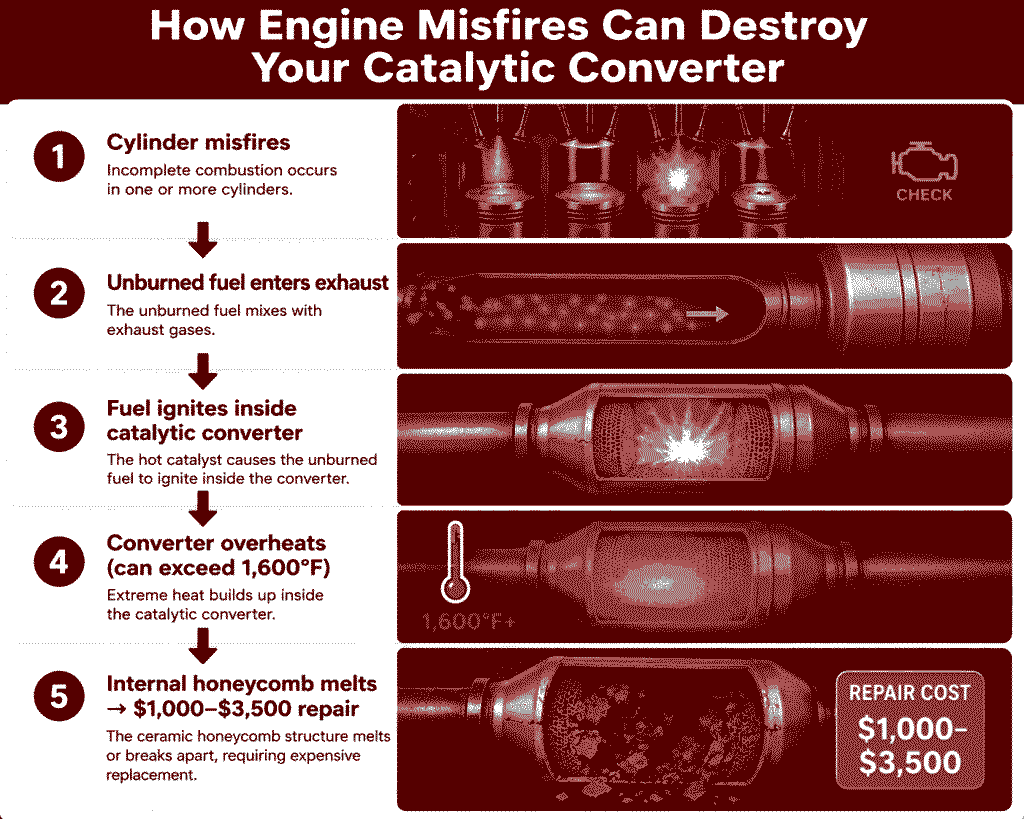
Under heavy load — highway speeds, towing, a steep hill — that damage can happen in minutes, not days. That’s the part most drivers don’t realize.
Blinking vs Solid Check Engine Light
| Feature | Blinking | Solid |
|---|---|---|
| Severity | High | Moderate |
| Safe to drive? | Usually no | Often, briefly |
| Engine damage risk | High | Low to medium |
| Catalytic converter risk | Very high | Low |
| Repair urgency | Immediately | Within days |
| Typical cause | Active misfire | Sensor, emissions, gas cap |
A solid light might be a loose gas cap or an aging oxygen sensor. A flashing one is almost never something that minor.
Is It Safe to Drive With a Blinking Engine Light?
Usually, a blinking check engine light means you should avoid driving unless you need to move the vehicle to a safe location. If you’re unsure about the difference between a flashing and solid warning, see our guide on can you drive a car with a check engine light on.
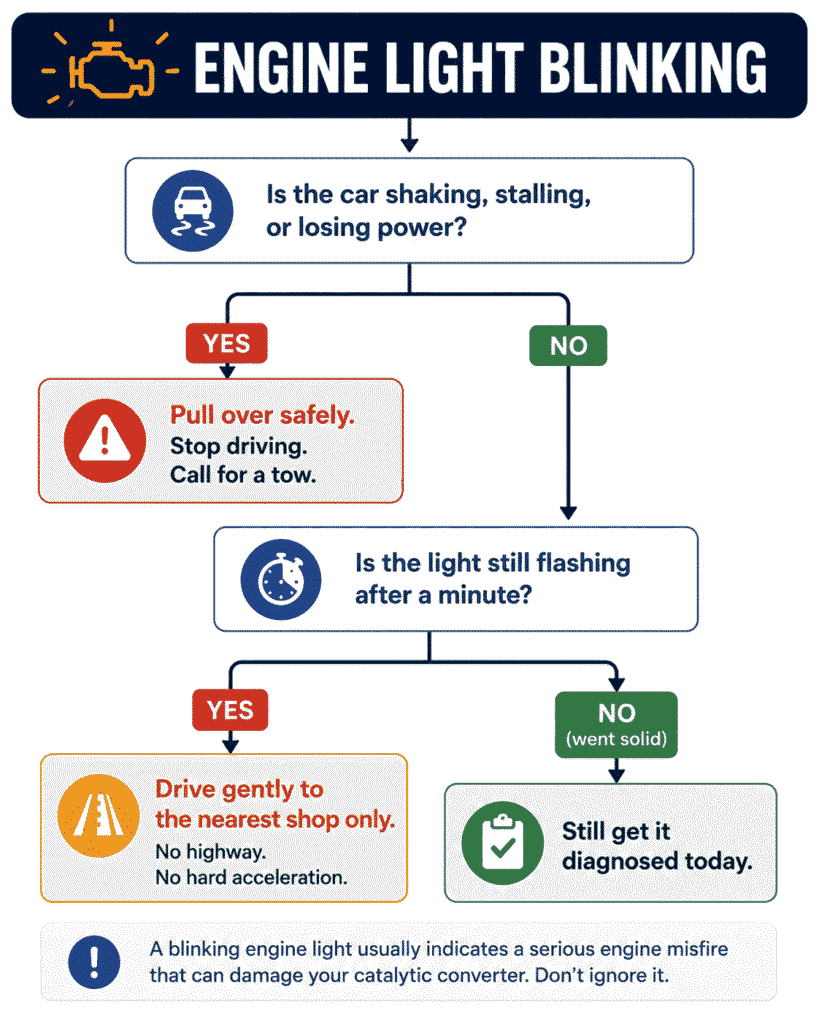
If you must move the car:
- Keep speeds low and steady
- Turn off the A/C to reduce engine load
- Avoid highways, hills, and heavy throttle
- Don’t tow anything
- Keep the trip under a few miles if you can
If the nearest shop is far, or the car is shaking badly, a tow is genuinely cheaper than a catalytic converter.
Most Common Causes
Engine misfire (by far the most common)
A misfire means a cylinder isn’t burning its fuel-air mixture properly. Usual suspects:
- Worn or fouled spark plugs – the most frequent cause, especially past 60,000–100,000 miles
- Failing ignition coils – increasingly common, and on many modern turbo engines coils fail before plugs do
- Bad plug wires on older vehicles
Fuel delivery problems
A clogged or failing fuel injector starves one cylinder. Low fuel pressure from a weak pump or restricted filter can cause misfires across several cylinders at once.
Vacuum leaks
A cracked hose or failed intake gasket lets unmetered air in, throwing off the mixture and triggering lean misfires.
Timing issues
A stretched timing chain or slipped belt throws valve timing off. Less common, but more serious.
Catalytic converter already failing
Sometimes the converter is the cause rather than the casualty — a clogged one creates backpressure that disrupts combustion.
| Cause | Severity | Typical U.S. Repair Cost |
| Spark plugs | Low | $100–$300 |
| Ignition coil | Medium | $150–$500 |
| Vacuum leak | Low–Medium | $100–$600 |
| Fuel injector | Medium | $400–$1,200 |
| Timing components | High | $1,000–$3,000+ |
| Catalytic converter | Very high | $1,500–$4,000+ |
Symptoms That Usually Come With It
A flashing light rarely arrives alone. Watch for:
- Rough or lumpy idle
- Noticeable shaking or vibration, especially at stops
- Loss of power and sluggish acceleration
- Hesitation or stumbling under throttle
- Raw fuel smell from the exhaust
- Black smoke
- Stalling
“Engine light blinking and car shaking” is one of the most searched combinations for a reason — the two go together almost every time. The shaking is the misfire, felt through the chassis.
What to Do Immediately
- Ease off the accelerator. Don’t panic-brake, just reduce load.
- Turn off the A/C and any heavy electrical draw.
- Find a safe place to pull over — parking lot, shoulder, side street.
- Let the engine idle briefly, then shut it off if the shaking is severe.
- Look for anything obvious — a disconnected hose, a visibly loose connector. Don’t touch anything hot.
- Scan the OBD-II codes if you have a reader. A basic one costs about $30 and tells you exactly which cylinder is at fault.
- Call a mechanic or roadside assistance.
What NOT to Do
- Don’t ignore it and keep driving. This is how a $200 job becomes a $2,500 one.
- Don’t rev the engine to “clear it out.” That accelerates converter damage.
- Don’t tow or haul anything.
- Don’t take it on a highway trip.
- Don’t just clear the code and hope. Resetting the light without fixing the fault only hides the problem — and the damage continues.
Can Low Oil Cause a Blinking Engine Light?
Usually not directly. Low oil normally triggers a dedicated oil pressure warning or low oil level light, not a flashing MIL.
That said, severely low oil can cause enough mechanical trouble — including valvetrain problems — to eventually produce misfire codes. So if you’re low on oil and the light is flashing, treat it as serious and stop driving.
Can a Loose Gas Cap Cause It?
Almost never a flashing light. A loose or failed gas cap creates an evaporative emissions fault, which produces a solid check engine light. If yours is blinking, look past the gas cap.
Common OBD-II Codes Behind a Flashing Light
OBD diagnostic communication between vehicles and test equipment is covered by the SAE J1979 diagnostic standard, which defines diagnostic test modes used for emissions-related OBD data.
| Code | Meaning |
| P0300 | Random or multiple cylinder misfire |
| P0301 | Cylinder 1 misfire |
| P0302 | Cylinder 2 misfire |
| P0303 | Cylinder 3 misfire |
| P0304 | Cylinder 4 misfire |
| P0171 | System too lean (Bank 1) |
| P0200 | Injector circuit malfunction |
| P0420 | Catalyst efficiency below threshold |
The cylinder-specific codes (P0301–P0308) are genuinely useful — they point a mechanic straight at the problem cylinder and cut diagnostic time.
Repair Costs in the U.S.
| Repair | Typical range |
| Spark plugs | $150–$350 |
| Ignition coil | $180–$500 |
| Vacuum hose / gasket | $150–$400 |
| Fuel injector | $300–$900 |
| Oxygen sensor | $200–$450 |
| Catalytic converter | $1,000–$3,500 |
| Major engine repair | $2,500+ |
These are broad averages. Actual cost swings hard on make, model, engine layout, and local labor rates — a coil on a four-cylinder Civic is a very different job from one buried in a V6 with the intake manifold in the way.
The math worth internalizing: fixing a misfire early usually costs a few hundred dollars. Driving on it until the converter melts multiplies that by five or ten.
How Mechanics Diagnose It
A competent shop works through roughly this sequence:
- Pull the OBD-II codes and freeze-frame data
- Inspect the ignition system — plugs, coils, wires
- Swap components between cylinders to see if the misfire follows
- Compression test to rule out mechanical damage
- Fuel pressure test
- Injector testing — electrical and flow
- Smoke test for vacuum leaks
- Live data analysis while running
If a shop wants to replace the catalytic converter without first identifying why it failed, get a second opinion. Replacing a converter without fixing the underlying misfire just ruins the new one.
Does It Vary by Manufacturer?
Ford, Chevrolet, Toyota, Honda, Nissan, Jeep — all of them use a flashing malfunction indicator lamp to signal a misfire severe enough to threaten emissions equipment. The meaning is consistent across brands.
What differs is diagnostic detail: how manufacturer-specific codes are prioritized, which live-data parameters are available, and known weak points. Some engines are notorious for coil failures; others for injector issues. A shop familiar with your brand will get there faster.
Nissan and some GM vehicles label it “Service Engine Soon” rather than “Check Engine” — same lamp, same meaning. A blinking service engine light is exactly as urgent.
Can You Reset a Blinking Check Engine Light?
Technically yes — a scanner clears codes, and disconnecting the battery often does too.
But you shouldn’t, and here’s why: resetting doesn’t repair anything. The misfire continues, the converter keeps cooking, and you’ve erased the diagnostic data a mechanic needs. You’ve also wiped the readiness monitors, which means you’ll likely fail an emissions test until the car completes a full drive cycle.
Fix first. Reset after.
Preventing Future Misfires
- Replace spark plugs at the interval in your owner’s manual — don’t stretch it
- Replace ignition coils as a set if one fails on a high-mileage engine
- Use fuel from reputable stations; the octane your manual specifies
- Address rough idle or hesitation early, before it escalates
- Keep up with air filter and fuel filter changes
- Scan codes when a solid light appears rather than waiting for it to flash
Expert Tips Most Drivers Don’t Know
- A flashing light under heavy load can ruin a converter in minutes. Time matters more than distance.
- Coils often fail before plugs on modern turbocharged engines. If you’ve replaced plugs recently and it’s still misfiring, look at coils.
- Some misfires only appear under acceleration and vanish at idle — which is why “it seems fine now” isn’t proof of a fix.
- Cheap aftermarket ignition parts cause repeat failures. This is one area where OEM or reputable brands genuinely pay for themselves.
- A $30 OBD-II scanner tells you which cylinder before you ever reach a shop, and makes you a much harder customer to upsell.
If the check engine light has appeared intermittently or you’re unsure what triggered it, our guide on why is my check engine light on explains some of the common causes behind a check engine warning.
The Bottom Line
A blinking check engine light is the one dashboard warning that rewards acting immediately. It nearly always means an active misfire, and every mile you drive on it risks turning an affordable repair into an expensive one.
Slow down, get off the road, scan the codes if you can, and get it diagnosed the same day. Fix the fault before clearing the light. Most of the time you’re looking at plugs or a coil — a few hundred dollars and an afternoon. The people who end up with four-figure bills are almost always the ones who keep driving.
Sources: U.S. Environmental Protection Agency (OBD-II standards) · SAE International · ASE (National Institute for Automotive Service Excellence) · Manufacturer owner’s manuals and service documentation.
Frequently Asked Questions
Why is my engine light blinking but the car still drives?
A misfire doesn’t always disable the car. It still causes damage. Driveable isn’t the same as safe to drive.
Can I drive 10 miles with a blinking check engine light?
Ideally no. If you have no choice, drive gently at low speed and avoid highways. A tow is cheaper than a converter.
Will a blinking engine light turn off by itself?
It may go solid if the misfire stops under lighter load. The fault is still stored, and it will come back.
Is a flashing engine light always a misfire?
Not literally always, but the overwhelming majority are. Scanning the codes confirms it.
Can bad spark plugs cause it?
Yes — worn or fouled plugs are the single most common cause.
Does premium fuel fix it?
No. Higher octane won’t cure a mechanical or ignition fault.
Can low coolant cause it?
Not directly. Overheating triggers its own warning, though severe overheating can eventually cause misfires.
How much does it cost to fix?
Anywhere from about $150 for plugs to $3,500+ if the catalytic converter is destroyed. Early action keeps you at the low end.
How long before damage occurs?
Under heavy load, converter damage can begin within minutes. There’s no safe window worth gambling on.
Should I tow my car?
If it’s shaking, stalling, losing power, or the shop is more than a few miles away — yes.
Can a bad catalytic converter make the light flash?
It can contribute, since a clogged converter disrupts combustion. More often the converter is the victim.
Can rain or water trigger it?
Occasionally. Moisture on ignition components can cause a temporary misfire that clears once things dry. If it recurs, something’s failing.
Disclaimer: This article is for general informational purposes only and is not a substitute for professional automotive diagnosis or repair advice. Check engine light behavior, diagnostic codes, repair requirements, and costs can vary by vehicle make, model, engine, location, and the underlying fault. Always consult your vehicle’s owner’s manual or a qualified automotive professional before making repair or driving decisions.