


Written by the AutoMagToday Content Team | Reviewed by Nitish Ranjan, Automotive Review Expert, automagtoday.com | Last updated: September 2026
Quick Answer:
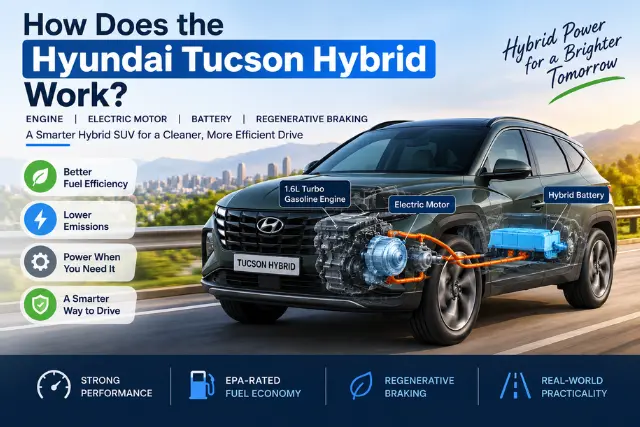
The Hyundai Tucson Hybrid works by combining a turbocharged 1.6-liter gasoline engine, an electric motor, a lithium-ion battery, and a 6-speed automatic transmission. The system automatically blends gas power, electric power, or both to improve efficiency and performance. The battery recharges itself through regenerative braking and the engine, so it never needs to be plugged in.
Hybrid SUVs have gone from niche to mainstream in just a few years, and the Hyundai Tucson Hybrid is one of the big reasons why. If you’re comparing Hyundai’s electrified SUVs, you may also want to see whether the Hyundai Palisade comes in a hybrid and how its system differs.
It looks and drives like a normal compact SUV, but underneath it quietly juggles two power sources to squeeze out better mileage. If you’ve ever wondered how does the Hyundai Tucson Hybrid works, this guide explains how its gasoline engine, electric motor, battery, and regenerative braking system work together.
The short version: the Tucson Hybrid pairs a small turbocharged gas engine with an electric motor and battery, and a computer decides how much power to draw from each at any given moment. You just drive. The car handles the rest.
What is the Hyundai Tucson Hybrid?
The Tucson Hybrid is a full hybrid (also called an HEV). That means it can move on electric power alone at low speeds, on gas power, or on a blend of the two — all without any input from you. It’s different from a mild hybrid, which only uses its electric side to assist the engine and can’t drive on electricity by itself. It’s also different from a plug-in hybrid, which has a much bigger battery you charge from a wall outlet.
Full hybrid (HEV): A vehicle with both a gas engine and an electric motor that can each drive the wheels. It charges its own battery and never needs to be plugged in — unlike a plug-in hybrid (PHEV), which has a larger battery and a charging port.
How Does the Hyundai Tucson Hybrid Work? Step by Step
The Hyundai Tucson Hybrid works by automatically combining gasoline and electric power based on speed, acceleration, battery charge, and driving conditions. Its 1.6-liter turbocharged engine, electric motor, and lithium-ion battery work together to deliver power while regenerative braking and the engine recharge the battery.
Here’s the actual sequence the car runs through on a typical drive.
1. You start the vehicle – Unlike many gasoline vehicles, the engine may remain off at startup if conditions allow electric-only operation.
2. Low-speed pull-away – Creeping out of a parking spot or crawling in traffic, the electric motor usually does the work — smooth, quiet, and using no gas.
3. The gas engine joins in – As speed or power demand increases, the turbocharged 1.6-liter gasoline engine joins the electric motor to deliver additional performance. This type of powertrain is one reason many buyers are also looking at the Hyundai Kona as a compact SUV option.
4. Combined power – Under hard acceleration or highway merging, the engine and motor work together for a combined 231 horsepower.
5. Battery recharging – When you lift off or brake, the motor flips into generator mode and feeds energy back into the battery, ready for the next electric stint.
Here’s a key point most explanations get wrong: the system doesn’t make sharp “switches” between engine and motor. Rather than making noticeable switches, the hybrid control unit continuously adjusts how much power comes from the gasoline engine, the electric motor, or both, based on speed, throttle input, battery charge, and driving conditions. It all happens in fractions of a second.
Components of the Hyundai Tucson Hybrid System
Hyundai’s official 2026 Tucson Hybrid specifications provide the detailed powertrain, battery, transmission, drivetrain, and towing information.
| Component | Purpose | Location |
| 1.6L Turbocharged Engine | Primary power source | Front engine bay |
| Electric Motor (~64 hp) | Assists and drives at low speed | Integrated with transmission |
| 1.49 kWh Lithium-ion Battery | Stores electricity | Under the rear seats |
| Hybrid Starter Generator | Starts the engine, generates power | Engine bay |
| Power Control Unit | Manages the flow of power | Vehicle electronics |
| 6-Speed Automatic Transmission | Sends power to the wheels | Front drivetrain |
One detail enthusiasts appreciate: Hyundai uses a conventional 6-speed automatic instead of the droning CVT found in many rivals. It makes the Tucson Hybrid feel more like a normal SUV when you press the accelerator.
How Power Flows Through the Hybrid System
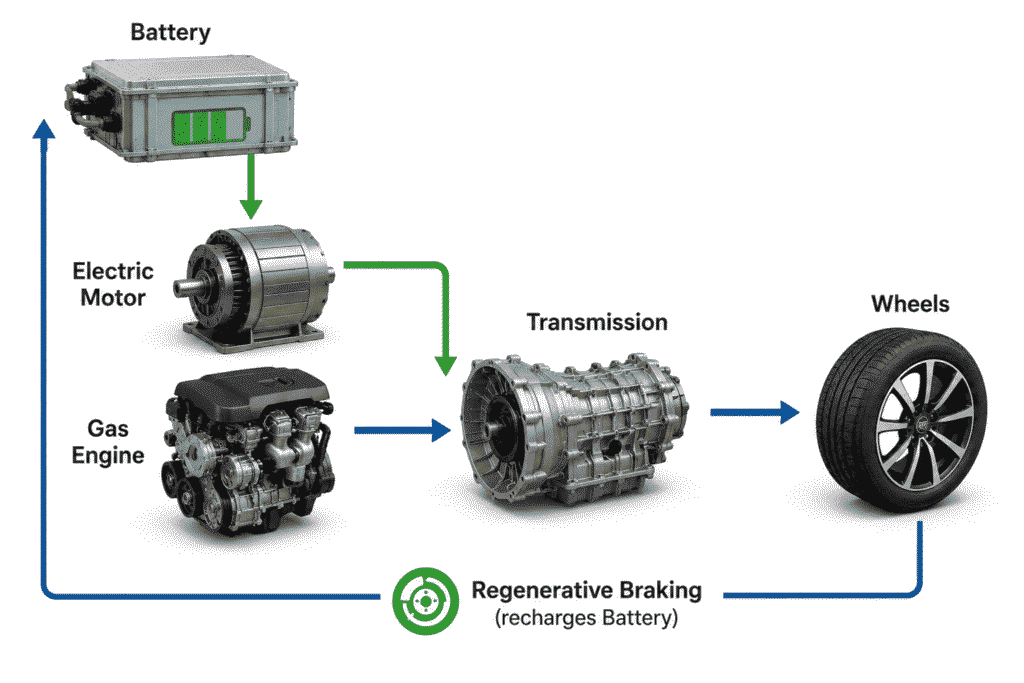
The engine and electric motor both route power to the transmission, which drives the wheels. The battery and motor constantly trade energy — the motor pulls from the battery to help drive, and returns energy to it whenever you coast or brake.
Energy flow:
When Does the Tucson Hybrid Use Electric Power?
Electric driving shines in the situations that waste the most gas in a conventional car:
- Starting and pulling away from a stop.
- Crawling through parking lots.
- Stop-and-go traffic jams.
- Gentle, low-speed city driving.
- Light acceleration on flat roads.
Depending on battery charge, temperature, and driving conditions, the Tucson may pull away using electric power alone — exactly the scenario where a gas-only SUV burns the most fuel.
When Does the Gasoline Engine Turn On?
The turbocharged engine takes a bigger share of the load whenever more muscle or sustained speed is needed:
- Highway cruising and higher speeds.
- Hard acceleration or quick merges.
- Climbing steep hills.
- When the battery charge runs low.
- Cold starts, when the engine needs to warm up.
How Regenerative Braking Works
In a normal car, braking turns your speed into wasted heat. The Tucson Hybrid recovers it instead. When you lift off the accelerator or press the brake, the electric motor reverses its role and becomes a generator, converting the car’s momentum back into electricity and storing it in the battery.
Say you’re slowing from 40 mph for a traffic light. Instead of throwing that energy away as brake heat, the system captures a chunk of it and tops up the battery — energy you’ll spend again the moment you pull away. On the 2026 model you can even dial in how aggressive this feels using the steering-wheel paddles. If you’re interested in how paddle-shift systems work, see our guide to the best Dodge paddle-shift transmission.
How the Battery Charges Itself
This is the part that confuses most first-time hybrid buyers. The Tucson Hybrid’s battery charges two ways: through regenerative braking, and directly from the gas engine when there’s spare capacity. It’s all automatic and continuous. You never handle a cable.
Common misconception – Hybrid ≠ Plug-in Hybrid: A standard Tucson Hybrid has no charging port and cannot be plugged in. Only the separate Tucson Plug-in Hybrid (PHEV) has a bigger battery and a charging port for longer electric-only range.
What Happens When the Hybrid Battery Is Fully Charged?
Another common question. When the battery reaches the top of its usable range, the vehicle automatically relies more on the gasoline engine and eases off regeneration until the battery has room to accept energy again. Nothing is wasted or damaged — the system simply rebalances.
It’s also worth knowing that the hybrid battery normally operates within a controlled charge range rather than staying completely full or completely empty. This buffer helps protect the cells and extend battery life over the years.
Hyundai Tucson Hybrid Driving Modes
You still get to influence how the car behaves. Eco leans on the electric motor and softens the throttle for maximum mileage. Smart reads your driving and adapts automatically. Sport sharpens the response and holds the engine on for a peppier feel. Whatever mode you pick, the automatic gas-electric blending keeps working underneath.
Real-World Fuel Economy
The Tucson Hybrid is EPA-rated between roughly 36 and 38 mpg combined depending on trim, with the efficiency-focused Blue SE hitting about 38 across the board. HTRAC AWD is standard on higher Tucson Hybrid trims, while FWD is available on the SE and SEL.
| Driving Condition | Roughly what to expect |
| City | Strong efficiency, especially in stop-and-go driving |
| Highway | Generally lower than city-focused hybrid driving |
| Combined (EPA) | Up to 38 mpg, depending on trim and drivetrain |
| Winter / cold starts | Fuel economy can decrease |
| Heavy traffic | Electric assistance can help efficiency |
Your real numbers depend on temperature, terrain, and how heavy your right foot is. Interestingly, hybrids like this one often beat their EPA figure around town and fall a little short on long highway runs — the opposite of a gas car.
Does the Hybrid Make the Tucson Faster?
Yes, noticeably. The electric motor delivers instant torque the moment you press the pedal, so low-speed acceleration feels quicker and smoother than the gas-only Tucson. The combined 231 horsepower makes the hybrid one of the stronger performers in its class — and it takes strain off the engine, since the motor covers the gaps.
Hyundai Tucson Hybrid vs Gas Model
| Feature | Hybrid | Gas (2.5L) |
| Fuel economy | ~36–38 mpg combined | ~28 mpg combined |
| Horsepower | 231 hp combined | 187 hp |
| Torque | 271 lb-ft | Lower |
| Drivetrain | AWD standard | FWD standard, AWD optional |
| Upfront price | Higher | Lower |
| Long-term fuel savings | Meaningful | Minimal |
The hybrid costs a few thousand more up front but returns roughly 10 extra mpg and more power. Over years of ownership, the fuel savings often close much of that gap.
How the Tucson Hybrid Compares to Rivals
| SUV | MPG (approx.) | Horsepower | Transmission | Warranty |
| Tucson Hybrid | ~36–38 | 231 hp | 6-speed automatic | Hyundai warranty |
| Toyota RAV4 Hybrid | Varies by year | ~219 hp | eCVT | Toyota warranty |
| Honda CR-V Hybrid | Varies by year | ~204 hp | eCVT | Honda warranty |
| Kia Sportage Hybrid | Varies by year | ~227 hp | 6-speed automatic | Kia warranty |
Figures are approximate and vary by model year and trim. The takeaway: The Tucson Hybrid offers 231 combined horsepower and uses a 6-speed automatic transmission, while the RAV4 Hybrid and CR-V Hybrid use different hybrid powertrain configurations. The RAV4 and CR-V are also established options in the hybrid SUV segment. For another SUV comparison on AutoMagToday, see our GMC Yukon vs Toyota Sequoia comparison.
Common Hybrid Myths, Debunked
- “Hybrid batteries die in five years.” Modern hybrid batteries routinely last well over a decade, and Hyundai backs the system with a long warranty.
- “Hybrids are slow.” Not this one — 231 hp and instant electric torque make it quick off the line.
- “Hybrid maintenance is expensive.” Routine upkeep is similar to a gas car, and regenerative braking actually reduces brake wear.
- “You have to plug it in.” The standard hybrid never needs charging. That’s the PHEV.
- “The battery can’t be replaced.” It can, though most owners never need to within normal ownership.
Battery Life & Warranty
The lithium-ion battery is designed to last the life of the vehicle for most owners. In the U.S., Hyundai provides a 10-year/100,000-mile powertrain limited warranty for the original owner, and hybrid battery coverage is subject to Hyundai’s warranty terms. Coverage may vary by country and model year, so verify the details in your owner’s warranty booklet. Battery health holds up best when the car is driven regularly and not left sitting for long stretches.
Does a Hybrid Cost More to Maintain?
Not really — this is where hesitant buyers can relax. Oil changes are still required on the gas engine, roughly on the same schedule as a conventional Tucson. Brake pads often last longer thanks to regenerative braking, which does much of the slowing before the physical brakes engage. There are no charging costs since you never plug in. And battery replacement is uncommon during normal ownership. Day to day, running costs land close to a gas SUV’s — minus a chunk of the fuel bill.
Is the Hyundai Tucson Hybrid Worth Buying?
Here’s a quick way to see where you fit:
| Driver Type | Tucson Hybrid? |
| City commuter | Excellent |
| Highway commuter | Good |
| Towing | Check limits (~2,000 lbs) |
| Long-distance traveler | Good |
| First-time hybrid owner | Excellent |
Choose the Hybrid if: you do a lot of city driving, fuel prices sting, you commute daily, or you plan to keep the car for years. That’s where the efficiency and standard AWD pay off fastest.
Choose the gas model if: you’re mostly on the highway, you want the lowest upfront price, or you drive relatively few miles a year. If you’re also considering a smaller Kia SUV, our guide explains whether Kia Souls are good cars and what to consider before buying one.
Tip from Nitish: Test-drive in both city and highway conditions before deciding, compare insurance quotes for each version, and check whether any hybrid tax incentives apply in your area. Also weigh trim differences — the fuel-economy leader (Blue SE) isn’t always the trim buyers gravitate to.
The Bottom Line
So, how does the Hyundai Tucson Hybrid work? It automatically combines a 1.6-liter turbocharged gasoline engine, electric motor, and lithium-ion battery based on driving conditions. Regenerative braking and the engine recharge the battery while you drive, so the standard hybrid does not need external charging. The result is a hybrid SUV that delivers 231 combined horsepower and EPA-rated fuel economy of up to 38 mpg combined, depending on trim and drivetrain.
How we verified this guide: Specifications were reviewed using Hyundai technical specifications, owner documentation, and EPA fuel-economy information for applicable U.S. model years. Features and ratings may vary by trim level and market, so always confirm on the window sticker or with a Hyundai dealer before purchase.
Frequently Asked Questions
How Does the Hyundai Tucson Hybrid Work Without Being Plugged In?
The Hyundai Tucson Hybrid uses a gasoline engine and electric motor together. Its battery is recharged through regenerative braking and energy generated by the engine, so the standard hybrid does not require an external charging station.
Does the Hyundai Tucson Hybrid charge while driving?
Yes. The battery recharges continuously through regenerative braking and the gas engine, so it stays topped up automatically as you drive.
Can the Tucson Hybrid run on electricity only?
For short stretches, yes — mainly at low speeds, in traffic, and when pulling away. It’s not designed for long electric-only trips; that’s the plug-in model.
Does it need a charging station?
No. The standard Tucson Hybrid is self-charging and has no charging port. Only the Tucson Plug-in Hybrid uses a charger.
How long does the hybrid battery last?
Typically well over a decade for most owners, and it’s covered under Hyundai’s warranty terms.
What happens if the battery runs out?
The gas engine simply takes over and recharges the battery as you go. You won’t be stranded — it behaves like a regular car.
Is the Hyundai Tucson Hybrid reliable?
It has a solid reputation, and the strong warranty reflects Hyundai’s confidence. Routine maintenance keeps it in good shape like any vehicle.
Does regenerative braking wear out the brakes?
Quite the opposite — it reduces wear, because the motor does much of the slowing before the physical brakes engage.
Is the Tucson Hybrid good for highway driving?
Yes. It cruises comfortably and returns strong mileage, though hybrids gain their biggest efficiency edge in city driving.
Can you tow with the Tucson Hybrid?
It’s rated to tow up to about 2,000 pounds when properly equipped — fine for a small trailer, jet ski, or lightweight camper.
Is the hybrid worth the extra cost?
For city commuters and long-term owners, usually yes. The fuel savings, added power, and standard AWD often justify the higher sticker.
Disclaimer: This article is for general informational purposes only. Vehicle specifications, features, fuel-economy ratings, warranty coverage, and hybrid-system details may vary by model year, trim, drivetrain, and market. Always verify current information with Hyundai’s official specifications, owner’s documentation, or an authorized Hyundai dealer before making a purchase or maintenance decision.