


Written by the AutoMagToday Content Team | Reviewed by Anand Raj, Automotive Review Expert, AutoMagToday | Last updated: September 2026
Quick Answer:
A blinking check engine light usually means your engine has a severe misfire. Unburned fuel can overheat and destroy the catalytic converter, one of the most expensive emissions parts on your car. Reduce speed immediately, avoid hard acceleration, and stop driving if the light keeps flashing. Get the vehicle diagnosed as soon as possible.
You’re merging onto the interstate, doing sixty, coffee in the cupholder, and out of nowhere the check engine light starts flashing at you like a tiny orange strobe. Your stomach drops. Is the engine about to blow? Can you make it home? Is this a $200 problem or a $3,000 one?
Take it seriously but don’t panic. The right response in the next few minutes can prevent a much more expensive repair. Because if you’ve been wondering what does it mean when the engine light blinks, the short version is: your car is telling you something is actively going wrong, right now, not eventually. A flashing light almost always means a severe engine misfire, and every minute you keep driving hard, raw fuel is pouring into a catalytic converter that was never designed to burn it.
Let’s walk through exactly what’s happening, why, and what to do. If the problem turns out to be related to an ignition coil, our guide to ignition coil replacement cost can help you understand the possible repair expense.
What Does a Blinking Check Engine Light Mean?
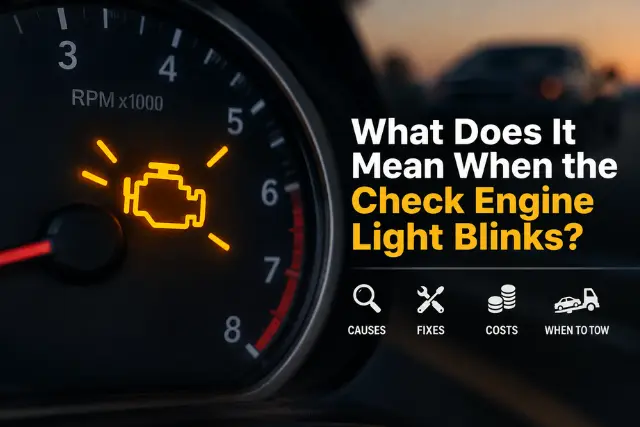
Here’s the plain-English version of what does it mean when your check engine light blinks: one or more of your engine’s cylinders is failing to fire properly, and it’s happening badly enough that your car’s computer has moved from “make a note of it” to “sound the alarm.”
When a cylinder misfires, the fuel injected into it doesn’t burn. That raw gasoline gets pushed out with the exhaust and lands inside your catalytic converter, which runs at over 1,000°F on a normal day. Dump unburned fuel in there and it ignites, sending temperatures soaring past what the converter’s internal honeycomb can survive. The material literally melts. And once a converter melts, there’s no cleaning it, no reset, no cheap fix. Only replacement.
That’s why automakers made this specific warning blink. A solid light means “get this checked soon.” A flashing one means “you are causing damage as we speak.”
Blinking vs. Solid Check Engine Light
People mix these up constantly, and the difference matters enormously. Same bulb, completely different message.
| Feature | Blinking Check Engine Light | Solid Check Engine Light |
| Typical meaning | Severe misfire or urgent engine/emissions problem | Fault detected that needs diagnosis |
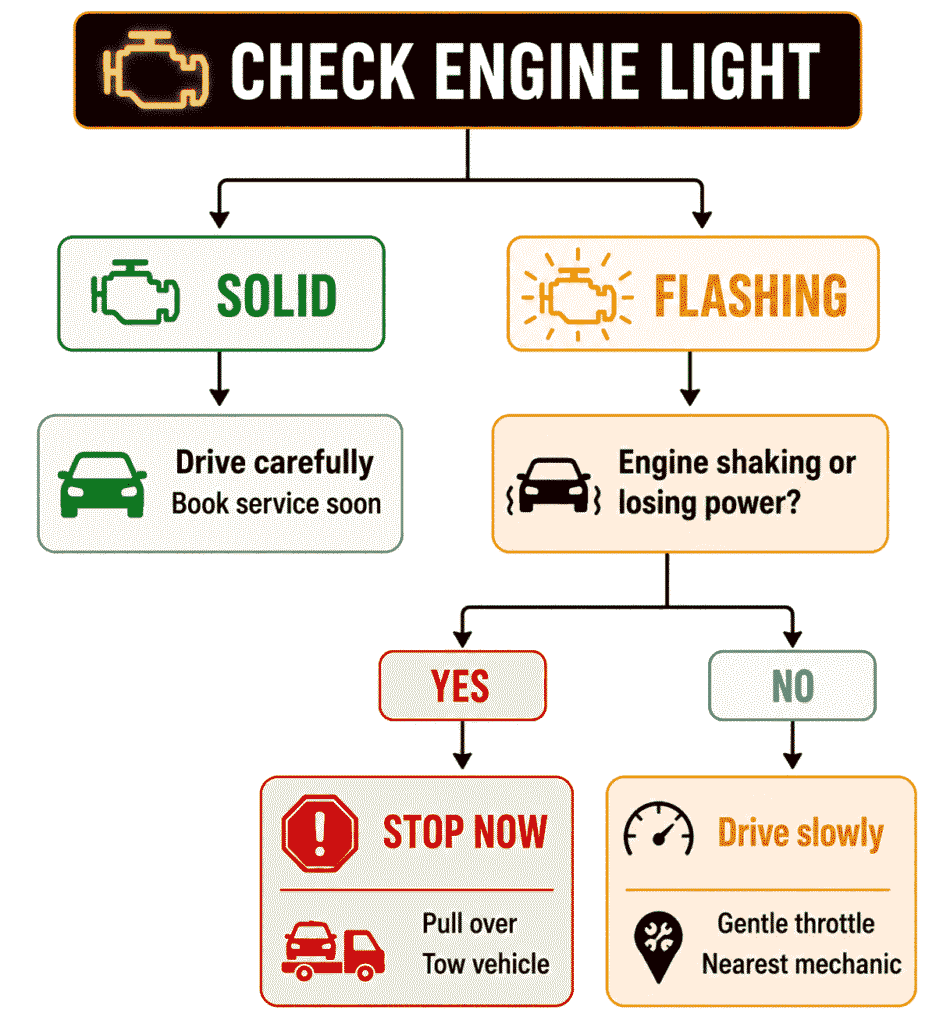
| Driving advice | Reduce speed and stop safely if it continues | Drive cautiously only if the vehicle runs normally |
| Main risk | Catalytic-converter or engine damage | Damage depends on the underlying fault |
| Recommended action | Prompt diagnosis, possibly towing | Schedule diagnosis as soon as possible |
A solid light could be anything from a loose gas cap to a lazy oxygen sensor. Annoying, yes. An emergency, usually not. A blinking light skips the pleasantries entirely.
Quick Decision Tree: Drive, Stop, or Tow?
Why Does the Check Engine Light Blink?
Nearly every gasoline vehicle sold in the US since 1996 and most diesel vehicles since 2008 runs an OBD-II system, a network of sensors feeding your engine control unit, largely thanks to EPA emissions rules. Among its jobs: counting misfires. The ECU watches the crankshaft’s rotation with remarkable precision, and every time a cylinder fails to fire, the crankshaft hesitates for a fraction of a second. The computer catches it.
A stray misfire here or there? Logged quietly, maybe a solid light eventually. But when misfires pile up fast enough to threaten the catalytic converter, typically a set percentage within a couple hundred engine revolutions, the ECU flips the light to flashing mode. So if you’ve ever asked what does it mean when your engine light is blinking, understand it’s not a glitch or a random panic. It’s a calculated alarm your car was engineered to raise at exactly this threshold.
The U.S. Environmental Protection Agency explains how onboard diagnostics monitor emissions-related systems and alert drivers when a malfunction is detected. See the official EPA explanation of OBD systems for more background.
10 Most Common Causes of a Blinking Check Engine Light
1. Bad Spark Plugs
The number one culprit, hands down. Worn or fouled plugs can’t reliably light the fuel mixture, and misfires follow. Symptoms include rough idle, hesitation, and worse gas mileage in the weeks before the light. The cheapest fix in this entire article $150–$400 for a set, and often the whole problem.
2. Faulty Ignition Coil
Modern engines give each cylinder its own coil, and coils die one at a time. When one goes, that cylinder simply stops firing, and the light starts flashing almost immediately. You’ll usually feel a distinct shudder. Very common on higher-mileage vehicles.
3. Fuel Injector Problems
A clogged or leaking injector starves or floods its cylinder. Either way, combustion fails. Sometimes a fuel system cleaning solves it; sometimes the injector needs replacing. Understanding how many fuel injectors a car has can also help explain why one faulty injector may affect engine performance.
4. Vacuum Leak
A cracked hose or leaking intake gasket lets unmeasured air sneak into the engine, throwing off the fuel mixture badly enough to misfire, often worst at idle. Cheap part, but finding the leak is the real work.
5. Low Fuel Pressure
A weak fuel pump or clogged filter can’t deliver enough fuel under load. The engine runs lean, misfires under acceleration, and the light flashes right when you’re passing someone on the highway. Terrible timing, every time.
6. Faulty Mass Air Flow Sensor
The MAF sensor tells the computer how much air is entering the engine. When it lies, the fuel math goes wrong and misfires can follow. Sometimes a careful cleaning fixes it; sometimes it’s a replacement.
7. Failing Catalytic Converter
Cruel irony: a converter that’s already partially clogged creates backpressure that causes misfires, which then finish the converter off. This is why catching the problem early matters so much. You can also learn more about how to know if your catalytic converter is bad before approving an expensive replacement.
8. Engine Timing Problems
A stretched timing chain or slipped belt means valves and pistons fall out of sync. Misfires are the early warning; catastrophic engine damage is the late one. Do not sit on this.
9. Low Compression
Worn piston rings, a burned valve, or a failing head gasket means a cylinder can’t build the pressure combustion needs. This is the diagnosis nobody wants, because the repairs get serious.
10. ECU or Sensor Failure
Rare, but real. A faulty crankshaft position sensor or a computer fault can produce misfires, or false readings of them. This is diagnostic-work territory, not guess-and-replace territory.
Symptoms by Cause: Quick Reference
What you’re feeling in the driver’s seat usually points somewhere specific:
| Symptom | Likely Cause |
| Rough idle | Spark plugs |
| Loss of power | Ignition coil |
| Sulfur / rotten egg smell | Catalytic converter |
| Stalling | Fuel injector |
| Engine shaking | Severe misfire |
| Worst at idle, better at speed | Vacuum leak |
| Misfires only under acceleration | Low fuel pressure |
| Rattling from under the car | Damaged converter internals |
This won’t replace a diagnosis, but it tells you which repair-cost row to brace for.
What Should You Do Immediately?
The light is flashing right now? Here’s your checklist, in order:
- Ease off the gas. Load is the enemy. Slow down smoothly.
- Avoid hard acceleration. No passing, no hills at full throttle, no towing.
- Watch the temperature gauge. If the engine is overheating, turn off the A/C and turn the heater on full it pulls heat away from the engine. If the coolant level is low, review our guide on how to put radiator fluid in a car before attempting any maintenance.
- Pull over somewhere safe. A parking lot beats a shoulder; a shoulder beats a travel lane.
- Do a quick sanity check. Did this start right after a gas station fill-up? Any smoke, smells, or leaks visible?
- Skip the road trip. Whatever long drive you had planned is now cancelled or postponed.
- Call for help if it’s bad. Continuous flashing plus rough running equals roadside assistance, not wishful thinking.
Never ignore a flashing light. A solid check engine light gives you a grace period. A blinking one doesn’t. The difference between stopping now and “finishing your errands first” can literally be a $2,000 catalytic converter.
Should You Restart the Engine?
A very common instinct and a fair question. Sometimes turning the car off and back on temporarily stops the flashing light, because the restart clears the immediate misfire event.
But understand what actually happened: nothing got fixed. The failing plug, coil, or injector is still failing. If the light returns immediately after restart, or the engine runs rough, treat it exactly as before, avoid driving and have the vehicle inspected. A restart that “fixes” it is a snooze button, not a repair. The alarm will go off again, usually at a worse moment.
Is It Safe to Drive With a Blinking Check Engine Light?
The question everyone actually types after what does it mean when check engine light is blinking is really “can I keep going?” Here’s the honest framework. For comparison, our guide on whether you can drive with a check engine light on explains why a solid warning light requires a different response from a flashing one.
- You’re probably okay to limp along only if all three are true: the flashing stopped quickly on its own, the car is running smoothly with no shaking or power loss, and a repair shop is a very short, gentle drive away.
- Stop driving if any of these apply: the light keeps flashing continuously, the engine is shaking or idling rough, you’ve lost power, you smell anything burning or sulfur-like (rotten eggs), or you see smoke. Any one of those means the misfire is active and the damage clock is running.
When in doubt, the tow truck is always the cheaper mistake.
How Long Can You Drive With a Flashing Light?
| Distance | Recommendation |
| 1 mile | Only if running smoothly |
| 5 miles | Risky gentle throttle only |
| 20 miles | Not recommended |
| Highway driving | Avoid sustained load is the killer |
| Towing / hauling | Absolutely not |
| Calling a tow truck | Best option |
The pattern is simple: distance matters less than load. One mile uphill with a trailer does more converter damage than five flat, gentle miles. When the light flashes, your right foot sets the repair bill.
What Happens If You Ignore It?
Here’s the timeline nobody wants to test personally:
| Time Ignored | What’s Likely Happening |
| Minutes | Catalytic converter overheating; internal honeycomb begins degrading |
| Hours | Misfire worsens; converter damage becomes probable, oil dilution begins |
| Days | Converter partially melted or clogged; engine running worse; secondary damage spreads |
| Weeks | Converter replacement plus original repair plus possible engine damage — the full expensive package |
The math is brutal. A $250 ignition coil ignored for two weeks routinely becomes a $2,500 combined repair. The misfire never gets cheaper by waiting. Not once, in the history of cars.
Repair Costs in the USA (2026)
Real-world ranges, parts and labor:
| Repair | Estimated Cost |
| Spark plugs (set) | $150 – $400 |
| Ignition coil | $200 – $600 |
| Fuel injector | $300 – $1,200 |
| MAF sensor | $250 – $600 |
| Vacuum leak repair | $150 – $500 |
| Catalytic converter | $1,200 – $3,500+ |
| Internal engine repair | $2,000 – $8,000+ |
Costs vary by vehicle make, model, engine type, labor rates, and location. A Toyota Camry sits at the low end of these ranges; a European turbo V6 does not.
Notice the cliff between the first five rows and the last two. Everything above the converter line is a maintenance-level expense. Everything below it is a “how attached am I to this car” conversation. Acting fast keeps you above the line.
Does It Mean the Same Thing on Ford, Toyota, Honda, Chevrolet, Nissan, Hyundai, and Jeep?
Yes. Whether you drive a Toyota Camry, Honda Civic, Ford F-150, Chevy Silverado, Nissan Altima, Hyundai Elantra, or Jeep Wrangler on virtually every OBD-II vehicle, a flashing check engine light indicates a severe engine misfire that can damage the catalytic converter.
The warning is federally standardized, which is genuinely good news: you don’t need a brand-specific manual to know what to do. A blinking light in an F-150 towing a boat and a blinking light in a Civic on a grocery run mean the same thing though the F-150 under load is doing damage much faster. The differences between brands show up in which parts fail most often (coil packs on some, plugs on others) and what the repair costs (truck converters and V8 plug jobs cost more than compact-car equivalents). The meaning of the light itself? Identical across the parking lot.
How Mechanics Diagnose a Blinking Check Engine Light
A good shop follows a sequence, and knowing it helps you understand your bill. First, the OBD-II scan pulls the stored codes and the freeze frame a snapshot of exactly what the engine was doing the moment the misfire was logged (speed, load, temperature). That freeze frame is gold; it tells the tech whether the misfire happens cold, hot, at idle, or under load.
From there: live sensor data while the engine runs, swapping coils between cylinders to see if the misfire follows the part, a compression test if a mechanical cause is suspected, a fuel pressure test for delivery problems, and a smoke test to expose vacuum leaks. The scan is thirty minutes; the detective work is where the diagnostic fee earns itself.
Common OBD-II Codes for Engine Misfires
| Code | Meaning |
| P0300 | Random / multiple cylinder misfire |
| P0301 | Cylinder 1 misfire |
| P0302 | Cylinder 2 misfire |
| P0303 | Cylinder 3 misfire |
| P0304 | Cylinder 4 misfire |
| P0351 | Ignition coil “A” circuit malfunction |
| P0171 | System too lean (Bank 1) |
Quick decoder: a single-cylinder code (P0301–P0304) points toward that cylinder’s plug, coil, or injector. P0300, the random misfire, suggests something affecting all cylinders — fuel pressure, a vacuum leak, bad gas, or timing. P0171 alongside misfire codes screams vacuum leak or fuel delivery.
Can You Fix It Yourself?
Reasonable DIY territory: scanning codes with a $25 Bluetooth OBD-II reader, replacing spark plugs on most engines (a Saturday-morning job with basic tools), swapping an ignition coil once you’ve identified the bad one, and replacing an air filter. If the light is solid rather than flashing, tightening the gas cap is the classic freebie.
Leave to a professional: compression testing, fuel injector replacement, anything timing-related, catalytic converter work, and any diagnosis that’s gone past “swap the obvious part.” The line is simple: if the fix requires interpreting data rather than following steps, or if getting it wrong risks the engine, pay the professional. It’s cheaper than being wrong.
Can AutoZone or O’Reilly Read the Codes?
Yes, and it’s one of the genuinely useful free things left in car ownership. Walk in, they plug in a scanner, and you leave with a printout of your codes. For a solid light, that’s often enough to point you at a fix.
But understand the limitation: a code identifies a symptom, not a broken part. P0302 means cylinder 2 is misfiring; it doesn’t say whether the plug, coil, injector, or a valve is responsible. Parts-store employees will helpfully sell you the most common fix, and sometimes that works. When it doesn’t, you’ve bought parts you didn’t need. Also worth knowing: with a light actively flashing, driving to the parts store for a free scan is itself risky. Priorities.
Will Insurance or Warranty Cover the Repair?
Car insurance: no. Misfires and worn components are mechanical failures, not accidents, and standard policies don’t touch them.
Warranties are the better hope. A manufacturer bumper-to-bumper warranty (typically 3 years/36,000 miles) covers misfire causes. Powertrain warranties (often 5 years/60,000 miles or longer) cover internal engine failures like low compression, though usually not plugs, which are maintenance items. Extended warranties vary wildly by contract — read yours. And here’s an underused fact: federal law requires emissions warranties of 8 years/80,000 miles on catalytic converters. If your converter failed within that window, the manufacturer may owe you a very expensive part for free. Ask before you pay.
How to Prevent a Blinking Check Engine Light
- Replace spark plugs on schedule check your manual; intervals range from 30k to 100k miles depending on plug type
- Use quality fuel from busy stations (fresh gas, maintained tanks)
- Keep up with regular maintenance instead of batching it “someday”
- Replace the engine air filter yearly it’s a $20 part protecting a $20,000 engine
- Fix small problems early; today’s rough idle is next month’s flashing light
- Never ignore new vibrations, hesitation, or a drop in gas mileage those are misfires introducing themselves politely
Common Myths, Busted
- “It’s just the gas cap.” A loose cap can trigger a solid light. It does not cause misfires and will not make the light flash. Different problem entirely.
- “It’ll fix itself.” The light might turn off if the misfire pauses. The failing part underneath does not heal. Coils and plugs only travel in one direction.
- “I can drive all week and deal with it Saturday.” This myth has personally funded thousands of catalytic converter replacements. The damage timeline is measured in minutes of hard driving, not days of ownership.
- “The code reader tells you exactly what’s broken.” It tells you where to look. The looking is the actual diagnosis.
Expert Tips Most Drivers Don’t Know
Converter damage accelerates dramatically under load. A flashing light while towing, climbing, or flooring it does in minutes what gentle city driving does in hours. If it flashes, your right foot becomes the most expensive pedal in the car.
Misfires caught at the “occasional stumble” stage cost a fraction of misfires caught at the “flashing light” stage same part, wildly different bill, because the converter is still healthy.
Write down (or photograph) when the flashing happens: cold start? Under acceleration? In the rain? That pattern shortens diagnosis time, and diagnostic time is billed by the hour.
A misfiring engine also dumps fuel into the oil, thinning it. After any extended misfire, an oil change is cheap insurance.
When Should You Call a Tow Truck?
Skip the internal debate and call if any of these are true:
- The light is flashing continuously and won’t stop
- The engine is visibly shaking or the whole car vibrates at idle
- You see smoke any color, any amount
- You smell burning or rotten eggs (that’s the converter cooking)
- You’ve lost noticeable power
- The temperature gauge is climbing
A tow across town runs $75–$150. Every item on that list can cost twenty times that if you drive through it. This is the easiest math in the article.
Key Takeaways
- A blinking check engine light almost always signals a severe engine misfire requiring immediate attention.
- Continued driving can destroy the catalytic converter, turning a $200 fix into a $1,200–$3,500+ repair.
- Most common causes: worn spark plugs, failed ignition coils, injector trouble, vacuum leaks, and low compression.
- The meaning is the same on Ford, Toyota, Honda, Chevy, Nissan, Hyundai, and Jeep — the flash is federally standardized.
- If it keeps flashing and the engine runs rough: reduce speed, pull over, and arrange diagnosis or a tow.
- A free OBD-II scan is the starting point but a code names the symptom, not the broken part.
Conclusion
So, what does it mean when the check engine light blinks? Your engine is misfiring severely, raw fuel is heading for a catalytic converter that can’t survive it, and your car is asking you as urgently as a dashboard can to slow down and stop.
A blinking check engine light usually signals a serious engine misfire that can damage the catalytic converter within a short time. Reduce speed, avoid hard acceleration, and pull over if the light continues flashing or the engine runs rough. A diagnostic scan can help identify the affected system, but the code alone does not confirm which part has failed. Have the vehicle inspected promptly, and consider towing it if there is shaking, power loss, smoke, overheating, or a burning smell. Acting early can prevent a relatively small repair from becoming a much larger engine or catalytic-converter bill.
For a broader explanation of possible warning-light causes, read our guide on why your check engine light is on.
Frequently Asked Questions
Can low oil cause a blinking check engine light?
Rarely on its own low oil triggers the oil pressure light. But severely low oil can contribute to timing and overheating problems that lead to misfires, so check it anyway. Thirty seconds, zero dollars.
Can bad gas cause it?
Absolutely. A tank of contaminated fuel can misfire an engine badly enough to flash the light. If it started right after a fill-up, that’s your prime suspect. It may clear with fresh, quality gas but get the codes read regardless.
Will it reset itself?
The light can turn off after enough clean drive cycles if the misfire stops. The broken part underneath won’t repair itself, and intermittent misfires return usually at the worst moment.
Can I drive 5 miles with it flashing?
If it’s actively flashing and running rough, even 5 miles gambles the converter. If you truly must move it, low speed, feather-light throttle, straight to the shop. Towing is smarter.
Can AutoZone fix it?
They can read the codes free and sell you parts. Diagnosis and repair are separate steps that happen elsewhere — your driveway or a shop.
Does a flashing light always mean misfire?
Almost always. Automakers reserve the flash specifically for converter-threatening misfires. Nearly everything else gets a solid light.
Can a bad battery cause it?
Occasionally, indirectly. Very low voltage can scramble sensor readings and mimic misfires. Uncommon, but worth a battery test if the behavior is erratic.
Can cold weather trigger it?
Cold doesn’t create problems; it exposes them. Marginal plugs, tired coils, and small leaks all fail first on freezing mornings.
Is it safe on the highway?
No. Highway speed means sustained load, and load is what converts misfires into melted converters. Exit safely, slow down, get help.
Can overdue maintenance cause this?
It’s the most common backstory there is. Most flashing-light emergencies began life as a skipped spark plug interval.
What about a blinking service engine light?
If you’re searching what does it mean when a service engine light blinks on most vehicles it’s the same warning as the check engine light with different wording, and the same rule applies. Solid means soon. Flashing means now.
How fast can the catalytic converter actually be damaged?
Under heavy load with a serious misfire? Minutes. Under gentle driving, longer but “longer” is measured in a drive or two, not weeks. There is no safe amount of flashing-light driving.
Disclaimer: This article is based on information researched and compiled from reputable automotive, safety, and industry sources. Repair costs, diagnostic times, and warranty details are general US estimates and may vary depending on the vehicle’s make, model year, condition, location, repair facility, and warranty terms. Always consult your vehicle’s owner’s manual and a qualified automotive technician before making repair or driving decisions.