


Written by the AutoMagToday Content Team | Reviewed by Anand Raj, Automotive Review Expert, AutoMagToday | Last updated: July 2026
Quick Answer:
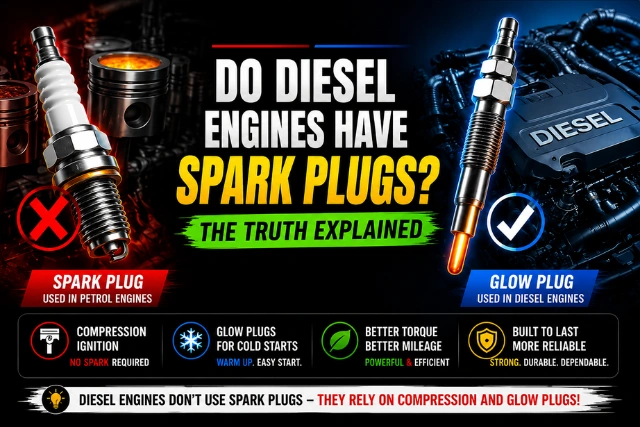
No. Diesel engines do not have spark plugs. None. Diesel engines are not designed to use spark plugs. Instead, diesel engines rely on compression ignition. The air inside the cylinder gets compressed so intensely that it heats up enough to ignite the diesel fuel on its own. A spark is simply not part of the equation.
What diesel engines do have are glow plugs, Heating elements that warm the combustion chamber during cold starts. But they are not the same thing as spark plugs, and they work in a completely different way.
One of the most common questions diesel owners ask is, “Do diesel engines have spark plugs?” Whether they’ve just opened the hood or visited a service center, the confusion usually comes from seeing glow plugs instead of spark plugs. It’s one of the most frequently searched questions about diesel engines because many people assume every engine needs spark plugs.
In this guide, we break down exactly why diesel engines don’t need spark plugs, what they use instead, how glow plugs actually work, and why all of this matters for your engine’s performance and longevity. If you’re learning more about how modern vehicle systems work, our guide on what does TPMS mean on a car? is another useful read.
How Does a Diesel Engine Start Without a Spark Plug?
The answer lies in how diesel engines ignite fuel. A petrol (gasoline) engine needs a spark to ignite its fuel-air mixture. The spark plug fires, creates an arc, and boom, combustion happens. A diesel engine works differently at a fundamental level.
Diesel engines use what’s called compression ignition. Here’s the process, step by step:
- The piston moves down, drawing in air (just air, no fuel yet).
- The piston moves back up, compressing that air to an extreme degree.
- At peak compression, diesel fuel is injected directly into the cylinder as a fine atomised mist.
- The compressed air is hot enough (around 700–900°C) to ignite that mist spontaneously.
- The explosion pushes the piston back down, generating power.
That’s the complete ignition process. Unlike petrol engines, diesel engines rely entirely on high compression to ignite the fuel.
Key Fact: A well-tuned petrol engine typically generates around 130 psi of compression. A diesel engine? Around 425 psi. That’s over three times the pressure and this high compression generates enough heat to ignite diesel fuel naturally, eliminating the need for spark plugs.
So How Many Spark Plugs Does a Diesel Engine Have?
Zero. Diesel engines don’t have any spark plugs at all. If somebody says you need to replace the sparkplugs on your diesel, they should be directing you to a qualified diesel technician.
This also answers another common question: does a diesel have spark plugs if it’s a newer model? No. Modern common-rail diesel engines, Euro 6 compliant diesels, new diesel trucks – none of them have spark plugs. The combustion principle hasn’t changed.
What Does a Diesel Engine Have Instead of Spark Plugs? Glow Plugs Explained
This is where many people get confused. Diesel engines don’t have spark plugs, but they do have glow plugs one per cylinder, just like spark plugs in a petrol engine. They look somewhat similar too. Apart from their appearance, glow plugs and spark plugs perform completely different functions.
A glow plug is a heating element. Its job isn’t to ignite the fuel directly, it’s to preheat the air inside the combustion chamber, especially when the engine is cold. Diesel compression ignition works brilliantly when the engine is up to temperature. But on a cold winter morning, a cold engine means cooler air, which means the compression alone might not generate enough heat to reliably ignite the fuel. The glow plug solves this.
What Happens When You Turn the Key on a Diesel?
If you’ve driven a diesel vehicle, you’ve probably noticed a short delay before the engine starts on a cold morning. During this time, the glow plugs heat the combustion chamber to make ignition easier. That’s the work of the glow plugs, they preheat themselves for just a few seconds, reaching over 1,000°C at the tip, to ensure that the combustion chamber is hot enough for a clean start. In normal running the glow plugs mostly switch themselves off.
| Feature | Spark Plug (Petrol) | Glow Plug (Diesel) |
| Function | Creates an electrical arc to ignite fuel-air mixture | Heats the combustion chamber to assist cold starts |
| Ignition Method | Spark (electrical arc) | Heat (resistance element) |
| Pre-heating Required | No | Yes – a few seconds before cranking |
| Active During Normal Running | Yes – fires every combustion cycle | Mostly no – mainly used during cold start |
| Typical Lifespan | 30,000–100,000 km depending on type | Up to 100,000 miles / ~160,000 km |
| Engine Type | Petrol / Gasoline engines | Diesel engines |
Why Does a Diesel Engine Not Have Spark Plugs? (The Technical Reasons)
There are three main reasons diesel engines don’t use spark plugs, It comes down to how diesel engines operate differently from petrol (gasoline) engines.
1. Diesel Fuel Ignites Under Compression, Not Spark
Petrol evaporates easily and can be ignited by a small electrical spark at relatively low compression. Diesel fuel is denser and doesn’t ignite from a simple spark. It needs to be atomised into a fine mist under high heat and pressure to combust. That naturally makes the compression ignition method the right fit and eliminates any need for a spark.
2. The Engine Architecture Is Built Around Compression
Diesel engine components – the pistons, cylinder walls, connecting rods, and crankshaft are all built heavier and stronger than their petrol counterparts. They’re engineered specifically to handle the extreme pressure of compression ignition (425 psi versus ~130 psi in petrol). Adding a spark plug system would be engineering a workaround into a system that doesn’t need one.
3. Compression Ignition Is More Thermally Efficient
The more you compress air and fuel inside the cylinders, the more efficiently your engine can draw energy from a unit of diesel. This is one of the key reasons diesel engines produce higher torque and better fuel efficiency.
Pros and Cons of Glow Plugs in Diesel Engines
Pros
- Ensures reliable cold-weather starting
- Improves fuel vaporisation → better combustion efficiency
- Reduces white smoke and rough idle when cold
- Long service life (up to 100,000 miles)
- Lower emissions thanks to cleaner combustion. Maintaining your cooling system is equally important for engine health, so here’s how to put radiator fluid in a car correctly.
Cons
- Must reach ~1,000°C within ~5 seconds to work properly
- Worn glow plugs cause hard starts and rough running
- Can fail earlier on engines with high carbon buildup
- Extreme cold can overwhelm aged or worn glow plugs
- Failure is sometimes confused with other starting issues
Do All Diesel Engines Have Glow Plugs?
Almost all of them, yes. Most modern diesel cars, trucks, and vans come equipped with glow plugs (one per cylinder). A 4-cylinder diesel will have 4 glow plugs; a 6-cylinder will have 6.
There are some large industrial diesel engines used in generators, marine vessels, or very warm climates that can sometimes start without glow plugs due to their size (larger displacement means more heat generated during compression). But for the diesels you’ll encounter on Indian or international roads your Mahindra, Tata, Ford EcoSport TDCi, Toyota Fortuner, glow plugs are standard.
What Happens If the Glow Plugs Fail?
If one or more glow plugs fail on your diesel, you’ll likely notice:
| Symptom | Possible Cause |
|---|---|
| Hard starting | Worn glow plugs |
| White smoke | Cold combustion |
| Rough idle | Poor cylinder heating |
| Glow plug warning light | Faulty glow plug |
| Slow cold starts | Weak glow plug performance |
- Hard starting, especially on cold mornings. If the engine warning light also appears, read our guide on drive a car with the check engine light on? to understand the possible risks.
- Rough idle for the first few minutes after startup
- White or grey smoke from the exhaust at startup (unburnt fuel)
- Increased fuel consumption in the short term
- A glow plug warning light on the dashboard (on modern cars)
The good news? Glow plugs are relatively inexpensive to replace compared to most engine components. If you’re seeing any of these symptoms, get them tested and replaced promptly, running a diesel consistently on failed glow plugs in cold conditions puts additional strain on the starter motor and battery. You can also review manufacturer-recommended diesel maintenance schedules on the Bosch Automotive website.
Diesel engines tend to accumulate more carbon than petrol engines, a problem you must beware of. Carbon buildup around your glow plug can weaken its performance and it might even have a shorter lifespan with enough accumulation of the carbon. A good diesel fuel additive can help your glow plugs stay working well, as can getting the engine professionally cleaned on a frequent basis.
Diesel vs Petrol Ignition: A Side-By-Side Summary
Here’s a quick comparison between diesel and petrol engines:
| Aspect | Diesel Engine | Petrol Engine |
| Has Spark Plugs? | No | Yes |
| Has Glow Plugs? | Yes | No |
| Ignition Method | Compression ignition | Spark ignition |
| Compression Ratio | ~14:1 to 25:1 (≈425 psi) | ~8:1 to 12:1 (≈130 psi) |
| Fuel Injection | Direct injection into hot compressed air | Port or direct injection into air-fuel mix |
| Torque Output | Higher – better for towing and heavy loads | Lower torque, higher revving |
| Fuel Economy (Loaded) | Significantly better under load | Can use up to 5x more fuel for same work |
The Bottom Line
The key takeaway is simple: diesel engines do not use spark plugs because they rely entirely on compression ignition. The compression ignition system is more thermally efficient, produces more torque, and burns fuel in a fundamentally different way that makes spark plugs completely redundant.
What diesel engines do have and what you should pay attention to, are glow plugs. They’re the unsung heroes of cold diesel starts, and keeping them in good condition is an important part of diesel engine maintenance.
Whether you’re a diesel owner troubleshooting a hard-start problem, a car enthusiast curious about engine differences, or just someone who had a mechanic mention “plugs” and wanted to know what they meant. Understanding this difference can help you diagnose common diesel issues and maintain your engine more effectively.
Key Takeaways
- Diesel engines never use spark plugs.
- Compression ignition powers every combustion cycle.
- Glow plugs assist only during cold starts.
- One glow plug is typically installed per cylinder.
- Faulty glow plugs can cause hard starts, rough idling, and white exhaust smoke.
- Modern diesel engines continue to rely on the same ignition principle despite advances in fuel injection technology.
Frequently Asked Questions (FAQs)
Does a diesel engine have a spark plug?
In contrast, diesel engines do not have spark plugs at all. Instead, they have compression ignition. What this effectively means is they put an incredible (really) amount of pressure on to the air in the cylinders which in turn makes it incredibly hot and it burns by itself as it meets the diesel. This is quite an important factor as far as petrol vs diesel engine comparison is concerned.
How many spark plugs does a diesel engine have?
Zero. A diesel engine whether it has 4, 6, or 8 cylinders has no spark plugs at all. Each cylinder has a glow plug instead, but that serves a completely different purpose.
What does a diesel engine have instead of spark plugs?
Glow plugs function instead of the spark plugs used by gasoline engines. They’re used to provide additional warmth for the combustion chamber because they’re a type of heating element and assist with the beginning of cold starts. They’re used as opposed to the spark plugs which ignite repeatedly as you’re running.
Why does a diesel engine not have spark plugs?
Because diesel fuel doesn’t ignite from a spark. It needs to be atomised under high heat and pressure to combust. Diesel engines achieve this through compression ignition compressing air to around 425 psi, generating enough heat to spontaneously ignite the diesel mist. A spark plug would serve no purpose in this system.
Do all diesel engines have glow plugs?
Most do, yes. Virtually all passenger and commercial diesel vehicles have glow plugs (one per cylinder). Some large industrial or marine diesels in very warm climates may not strictly need them due to heat generated by high displacement, but glow plugs are standard on every diesel car and truck you’ll encounter in everyday use.
Do diesel trucks have spark plugs?
No. Diesel trucks whether light, medium or heavy duty, do not have spark plugs. In other words, be it a Tata Xenon light duty pick-up, a Mahindra Bolero Camper light duty truck, a medium duty Ashok Leyland Ecomet, a heavy duty Eicher Pro and so on, the diesel engine uses glow plugs and compression ignition.
Can a Diesel Engine Run Without Glow Plugs?
A diesel engine may still run without working glow plugs in warm weather, but cold starts become difficult. Faulty glow plugs can lead to rough idling, white exhaust smoke, and increased strain on the battery and starter motor.
Are Glow Plugs Expensive to Replace?
Glow plugs are generally affordable compared to most engine components. Replacement costs vary by vehicle, but changing faulty glow plugs early helps prevent starting problems and unnecessary wear on the battery and starter.