


Quick Answer:
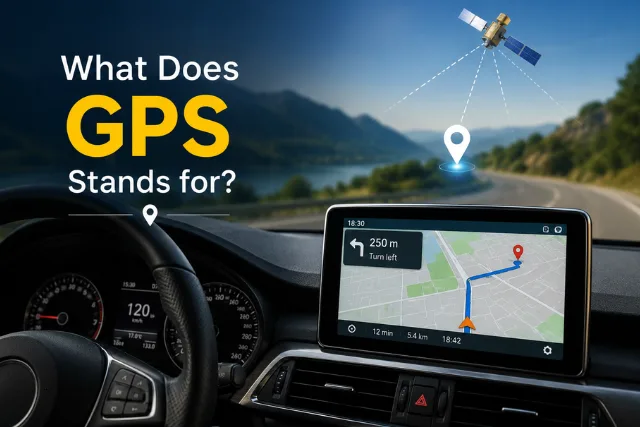
Do you know what GPS is, and what does GPS stands for? Global Positioning System. That’s what it stands for. GPS is a satellite-based navigation system that is owned and operated by the U.S. Government. It consists of an orbiting satellite system that enables any GPS device equipped with a receiver to get accurate location, speed, and time readings at any place on Earth and at any time, with no service fee required.
If you have ever needed directions from your cell phone, tracked a package, or tried to navigate to avoid traffic, then you have used GPS. So what does GPS stand for, and what is it used for? Everyone pretty much uses it every day; it’s just that no one even knows the technology that it is based on. Modern vehicles also rely heavily on navigation technology, which is why many drivers wonder whether the Toyota Sienna uses Google Maps for navigation.
We will look into it in the most basic way!
What does GPS stands for?
GPS stands for Global Positioning System, a satellite-based navigation system operated by the United States Government. It uses a network of satellites orbiting Earth to provide accurate location, speed, and timing information to GPS-enabled devices worldwide.
GPS stands for the Global Positioning System – which basically just sums it up perfectly!
- Global – The signal can reach anywhere on Earth, any day, any weather, and at any time of the day or night.
- Positioning – It provides you with exact coordinates: latitude, longitude, and height.
- System – It isn’t a single item; it is the combined work of many satellites.
The actual phrase is the Global Positioning System GPS. Originally, it was for the military. In the 1980s, the United States Department of Defence made it available to everybody, so it is now a vital part of daily life.
How Does GPS Work? (Explained Simply)
Here’s where it gets cool. The GPS satellite network doesn’t send you a “you are here” signal. Instead, it does something more clever.
The Basic Idea: Trilateration
When using a GPS (it could be a phone, in a car, on a watch, or even a standalone unit), several satellites send out signals simultaneously to you. Your receiver works out how far away each satellite is from you by measuring the amount of time it takes for the signal to get from the satellite to your unit. Once it has 3-4 satellites to work with orbiting the Earth, it will work out your position
Think of it like this: if you’re blindfolded in a city and three friends call out your name from different directions, you could figure out roughly where you are just by the direction and volume of their voices. GPS does that — but with satellites and the speed of light.
The Role of the Atomic Clock
So how exactly does GPS manage to be so precise? It’s due to each GPS satellite carrying a clock on board – a precise atomic clock accurate to within nanoseconds. Because GPS is an accurate positioning system based on measuring travel times, a slight inaccuracy would put you many miles off. However, because each atomic clock is so accurate, modern GPS is accurate to a few meters and in some cases far fewer.
The GPS Satellite Network – So how many satellites are there?
Today the GPS is made up of 31 working satellites which are operated by the U.S. Space Force. GPS satellites orbit the Earth in medium Earth orbit 20,200 km above the Earth. This is lower than a geostationary satellite but still high enough to provide worldwide coverage.
At any one time, between 6 and 12 satellites will be visible to your GPS device – you only need 4 to get a stable 3D fix for your position (the fourth satellite calculates altitude).
Here’s a simple breakdown:
| Layer | Detail |
| Number of satellites | 31 satellites actively operational |
| Orbit type | Medium Earth orbit (~20,200 km up) |
| Orbit period | ~12 hours (each satellite circles the Earth twice per day) |
| Ground control | Operated by the United States Space Force |
| Civilian access | Free, global, always-on |
What Does GPS Actually Do? (Real-World Uses)
Knowing the name: GPS stands for Global Positioning System, is all good; however, the practical implications for the technology in your day-to-day life are much more fascinating.
1. Navigation on cars and phones
Every navigation application, such as Google Maps, Apple Maps, Waze, or in-car navigation systems, relies on GPS receivers for real-time positioning. Many modern vehicle systems also integrate GPS with other technologies, including tyre pressure monitoring systems (TPMS).
2. Package and fleet tracking
Every courier service uses a tracking system for tracking parcels and vehicles in real-time. When looking at the moving dots of delivery trucks on a map, that’s real-time data transmission from GPS systems.
3. Emergency services
Being able to find people is vital for the emergency services. When a call is made from a mobile phone to 911, the position of the caller can be transferred to search and rescue workers, and, in large, remote areas, rescue teams use GPS devices to search for their targets.
4. Aviation and Maritime navigation
Pilots and ship captains use GPS systems as their navigation system constantly, from modern-day aircraft carrying passengers across oceans to massive ships carrying freight worldwide without visual landmarks to aid navigation; this technology is constantly in use.
5. Agriculture
“Precision farming”, the act of using GPS systems to guide tractors precisely along paths at optimal locations. This saves on fuel and seeds and minimizes overlap; there are some GPS-powered agricultural devices which work almost completely autonomously.
6. Fitness and sports tracking
The distance you cover in your morning run, speed while cycling, or the course of your hike is recorded using a GPS within your running watch, bike computer, or fitness tracker. The GPS within your smart watch is surprisingly accurate.
7. Scientific Research and Surveying
Measuring land movement and mapping terrain for purposes of geology or environmental science require extremely high precision, sometimes to the order of millimetres, and that is where scientific GPS receivers come into use to map tectonic plates, volcanic activity, and much more.
GPS vs GNSS – What’s the Difference?
You might have heard the term Global Navigation Satellite Systems GNSS — and wondered how it relates to GPS.
Here’s the simple answer: GPS is American. GNSS is the umbrella term for all satellite navigation systems.
| System | Country | Full Name |
| GPS | USA | Global Positioning System |
| GLONASS | Russia | Global Navigation Satellite System |
| Galileo | European Union | Galileo |
| BeiDou | China | BeiDou Navigation Satellite System |
Nowadays, all smartphones are designed to make use of Global Navigation Satellite Systems (GNSS) – which simply is when the phone receives signals from more than one satellite constellation at once (like GPS, Galileo and GLONASS) so that you get a more accurate fix of your position quickly.
A Brief History of GPS
When was GPS invented? The story goes back further than most people realize.
- 1960s – The US Navy begins experimenting with satellite navigation systems for submarines
- 1973 – The US Department of Defence officially begins developing the Global Positioning System GPS as a military project
- 1978 – First GPS satellite launched into medium Earth orbit
- 1983 – After Korean Air Flight 007 was shot down after going off course, President Reagan announced GPS would be made available for civilian use
- 1995 – GPS declared fully operational with a complete constellation of GPS satellites
- 2000 – “Selective Availability” turned off — civilian GPS accuracy improved from ~100 meters to ~10 meters overnight
2010s–present – New generation of GPS satellites launched, improving accuracy, coverage, and reliability dramatically
Today, the latest generation of GPS satellites (GPS Block III) offers significantly improved signal strength, better accuracy, and longer operational lifespans.
How Accurate Is GPS?
Standard civilian GPS is accurate to within 3–5 meters under good conditions. Factors that affect accuracy include:
- Satellite geometry – More GPS satellites visible = better accuracy
- Atmospheric effects – Satellite signals are delayed slightly when passing through the ionosphere
- Signal blockage – Tunnels, dense forest, tall buildings, etc can block the satellite signals
- Device quality – Device quality matters because dedicated GPS equipment often performs better than smartphones in challenging environments. Similar precision is required when learning how tyre pressure monitoring systems work in modern vehicles.
Centimetre accuracy can be obtained with specialist high-precision GPS receivers used in scientific/survey applications using correctional data.
The Bottom Line
But what is GPS and what does it do? It is called the Global Positioning System, and what it does is truly amazing. It allows any individual, anywhere in the world, with just a mobile phone in their pocket, to tell them where they are, where they want to go, and how to get there using the 31 satellites circling thousands of kilometres above them quietly. These satellites use atomic clocks that are accurate enough to tell the time better than the most accurate wristwatch.
Next time your navigational app guides you out of traffic in a couple of seconds, remember the men who took a project which began as a military experiment during the Cold War and made it one of the most useful tools invented.
Frequently Asked Questions (FAQs)
What does GPS stand for?
GPS stands for Global Positioning System. A satellite-based navigation system owned and operated by the United States Government.
What does GPS stand for and how does it operate in a car?
The GPS, or Global Positioning System, connects you and your car (or cell phone) to a constellation of satellites circling Earth to give you an accurate indication of your current position on the map in real time, as well as to run your car’s navigation system, providing you with directions.
How many satellites does GPS use?
Today, 31 GPS satellites are orbiting Earth in a medium Earth orbit. Your 3D position can be pinpointed in real time accurately with a signal from at least 4 satellites.
What’s the difference between GPS and GNSS?
GPS refers to the United States’ Global Positioning System. Global Navigation Satellite System (GNSS) is a collective name given to all satellite-based navigation systems, including the US’s GPS, Russia’s GLONASS, Europe’s Galileo, and China’s BeiDou.
Is GPS free to use?
It’s free of cost. The United States government operates the GPS as a public utility; anyone with a GPS receiver, such as a cell phone, watch, or car navigation, can use signals emitted from GPS satellites without charge.
What is a GPS satellite?
A GPS satellite is a man-made object launched into medium Earth orbit that constantly transmits accurate timing signals. A GPS receiver such as a cell phone or watch picks up the signals from several GPS satellites simultaneously and uses a method known as trilateration to determine the user’s position.
How can GPS operate without the internet?
GPS operates without any internet connection, as the GPS unit communicates directly with the satellite signals that are travelling from space. Applications such as Google Maps will, however, require a data connection to download map data, but a standalone navigation unit will operate solely off satellite signals.
Does GPS work without mobile data?
Yes. GPS receives signals directly from satellites and does not require mobile data or Wi-Fi to determine your location. However, navigation apps may need an internet connection to download maps and traffic information.
How accurate is GPS on a smartphone?
Under normal conditions, smartphone GPS is typically accurate within 3–10 meters. Accuracy can vary depending on signal strength, surrounding buildings, weather conditions, and the device being used.
Reviewed by the Vehicle Technology Research Team
This content has been reviewed to ensure accurate information about GPS technology, vehicle navigation systems, and satellite-based positioning.