


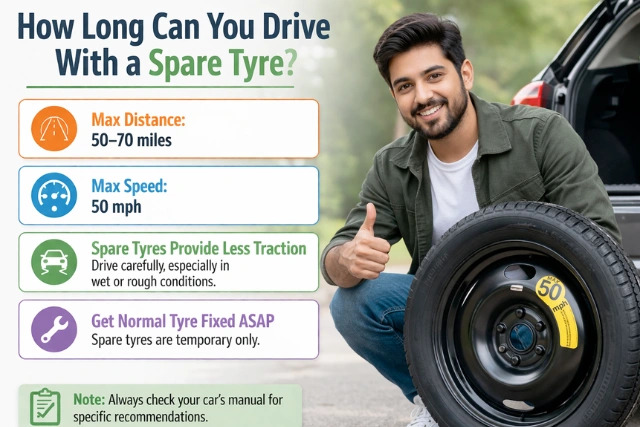
For drivers, when to change a spare tyre generally comes down to two factors: How long can you drive with a spare tyre and how far away you’re from home. While it varies from car to car, all spares should be treated as temporary solutions, not permanent repairs. As a result, if you continue to operate your vehicle for long distances using a spare tyre, it could jeopardise both your own safety and also create additional damage on your vehicle than if you were to replace the spare tyre with a regular size tyre sooner.
Driving with a spare tyre will vary greatly in the amount of time you can do so safely and will be determined by a number of different factors, like: type of spare, your vehicle speed while driving; and even weather conditions on the roads.To help you save money during the time that you have the damaged tire and until you replace or repair your damaged tire by using an appropriate size reference (the proper size tire), you should familiarize yourself with the limitations of these products to remain safe while doing so.
How Long Can You Drive With a Spare Tyre in Normal Conditions
Unlike standard tires, spare ones are manufactured in a different way. They tend to be thinner, lighter, and manufactured using a stiffer type of rubber. Because of the way spare tires were designed, they do take up less room and provide better fuel economy, but they don’t provide the same level of durability and traction as a standard tire.
When you drive on a spare tire normally, you are placing additional stress on all of your suspension, brake, and differential systems. Because of this, manufacturers have severe restrictions regarding how far you can drive on the spare tire.
How Long Can You Drive With a Spare Tyre? (Distance & Time)
The exact answer to how long can you drive with a spare tyre depends on the spare type installed in your vehicle.
Spare Tyre Distance Comparison
| Spare Tyre Type | Maximum Distance | Recommended Speed |
| Full-size spare | 80–100 miles | Normal speed |
| Temporary (donut) spare | 50–70 miles | Up to 50 mph |
| Run-flat tyre (after puncture) | 50 miles | Up to 50 mph |
A temporary spare should be used only until you can arrive at the nearest service station; if it appears fine, using the tire longer is hazardous.
How Far Can You Drive With a Spare Tyre Safely
Driving at highway speed builds excess heat and wear on the spare tyre. Highway surfaces are much smoother, but you should put a 50-mile limit on the use of a temporary spare.
City driving involves frequent stops and turns. This adds uneven stress to the spare, reducing its lifespan even faster.
Potholes, uneven surfaces, and poor weather conditions can negatively impact the durability of the spare tyre. In such conditions, keep driving to the bare minimum distance needed for repair.
Speed Limits While Driving on a Spare Tyre
Most of the manufacturers of vehicle tyres recommend that a person should not drive over an indicated speed of 50 mph (80 km/h) with a temporary spare. Driving above this speed will reduce stability and will lengthen the stopping or braking distance of your vehicle.
Although driving faster than this may not cause the temporary spare to fail immediately, it greatly increases the chances of a blow-out.
Signs You Should Stop Driving Immediately
You should stop driving your vehicle and get a mechanic for the following reasons:
- If vibrations/wobbling occur, these could cause further damage.
- Pulling to one side
- Unusual noises
- Visible damage to the spare tyre
Ignoring these signs can lead to loss of control.
Does the Position of the Spare Tyre Matter?
Yes, placement matters. Spare wheels should always be fitted to the back wheels, but sometimes a mechanic will take an old rear wheel and put it on the front of the vehicle when there is no spare wheel available and use their spare as the new back wheel for improved steering.
To use as a spare, the temporary tire should be put on an axle. The way a car handles is affected by this.A damaged tire’s location has greater impact on handling than a spare tire’s location’s impact on the way the vehicle handles. For example, if you change the rear axle to be farther ahead than it is currently located and add a steering tire in front of it, putting the spare tire on the rear axle will have a significant effect on handling.
Tips to Extend Spare Tyre Safety
- Keep tyre pressure checked regularly
- Avoid sudden braking or sharp turns
- Remove extra vehicle load
- Replace the damaged tyre as soon as possible
These steps won’t extend mileage dramatically but will reduce immediate risks. Keep tyre pressure checked regularly by learning how to read a tyre air pressure gauge properly.
Driving Style and Spare Tyres
How you drive can make an enormous impact on the life of a spare tyre. If you accelerate quickly, brake abruptly, or turn sharply, all these driving behaviours will place additional strain on a spare tyre that doesn’t have the same level of strength as regular tyres.
Driving smoothly, using moderate steering actions, and braking gradually are all things you can do to lessen the likelihood of having your spare tyre fail while you are driving on it.
Vehicle Weight and Spare Tyre Safety
Excess weight increases the amount of pressure put on the spare tyre. In the event that you have an excessive load on your car, extra weight will put added stress on the tire’s sidewall, therefore as you drive over bumps or rough ground this will cause more wear and tear to your tires than if there were no additional weight.
If at all possible, you should remove as many of the things as you can from the vehicle and do not carry anything heavy until you have replaced the damaged tire.
Common Myths About Spare Tyres
While many people believe they can drive for long distances to get somewhere on a spare tire as long as it looks new; this too is incorrect.Just like people, tires can become aged or “worn out”, so while the way that a tire looks is not as significant as the date that it was manufactured, the aging process for a tire with no miles or use is still unavoidable.
Be sure to check your spare tire on a regular basis, and do not wait until you are driving before you take the spare up to a retailer for assistance.
Conclusion
To prevent damaging your car and driving safely, it is important to know how long can you drive with a spare tyre that you can use. A full-size tire (or donut) has a similar tone to the spare tire, and same principles apply: do so cautiously (immediately) and basically within a relatively short distance of where you are possible in regards to going and changing to your original tire as soon as you are able.
Frequently Asked Questions (FAQs)
1. How long can you drive with a spare tyre without damage?
Temporary spare tyres can usually be driven for 50–70 miles although the vehicle should be driven at a low speed.
2. How far can you drive with a spare tyre before replacing it?
It is always best to replace or repair the original tyre as soon as possible (usually within 1 day).
3. Can you drive long distances with a spare tyre?
Only full-size spares allow longer distances. Temporary spares are not meant for long trips.
4. Is it safe to travel on a temporary tire in the dark?
Yes. However, since night gives you less light and you won’t be able to avoid traffic quickly in emergencies, it will become more dangerous. Therefore, proceed with caution.
5. Use a spare tyre for day to day driving ,is it safe ?
No ,spare tyres are only to be used as emergency tools not to replace regular tyres.
6. If you have to use a spare tyre will the fuel efficiency be impacted?
Yes ,the size and tread that differ slightly will affect fuel efficiency.

