


Written by the AutoMagToday Content Team | Reviewed by Anand Raj, Automotive Review Expert, AutoMagToday | Last updated: February 2026
Quick Answer
You’ve probably asked yourself at least once, “How does a tyre pressure monitoring system work?” A tyre pressure monitoring system (TPMS) monitors tyre pressure and alerts the driver when pressure is too low or when the system detects a fault. Direct TPMS uses pressure sensors inside the wheels, while indirect TPMS uses wheel-speed data from the ABS system to identify possible pressure loss.
With the addition of smart technologies, modern vehicles now have many different safety features that keep you informed at all times—and TPMS is one of these technologies.
Understanding how a tyre pressure monitoring system (TPMS) works will help you achieve safe driving and conserve gasoline, while also increasing the total mileage on your tires. If you’re new to this system, you can also understand what TPMS means on a car to get a clearer basic idea. A Tire Pressure Monitoring System (TPMS) monitors your tires’ air pressure and warns when there is something wrong. We will discuss what a TPMS does and how it works in detail.
Complete Guide: How Does Tyre Pressure Monitoring System Work
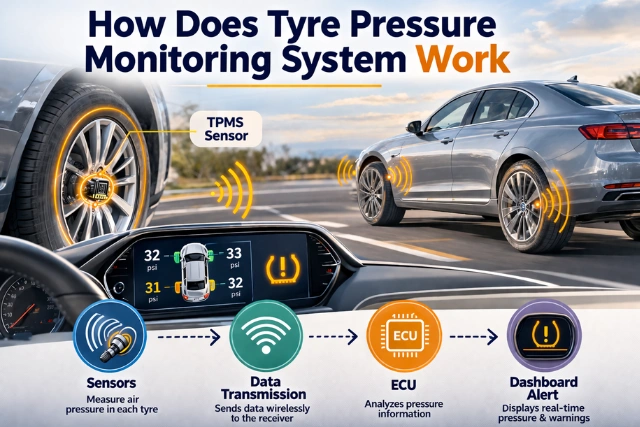
To understand how a tyre pressure monitoring system works, you should first bone up on its basic characteristics: This system consists of several sensors that measure tyre air pressure and transmit that information to the vehicle’s computer, which assists the driver by triggering a warning light on the dashboard whenever tyre pressure drops below the acceptable range. Some models provide a numeric readout on the vehicle display for each corner tyre.
There are two major types of tyre pressure monitoring systems:
| Feature | Direct TPMS | Indirect TPMS |
| Uses physical sensors | Yes | No |
| Measures actual pressure | Yes | No (estimates) |
| Accuracy level | High | Moderate |
| Maintenance cost | Slightly higher | Lower |
Both systems help answer the question: how does a tyre pressure monitoring system work in real-life driving situations?
How Does a Tyre Pressure Monitoring System Work in Direct TPMS?
The direct TPMS has internal sensors, which enable measurement. More accurately, rather than estimating, this system has sensors in each wheel that are capable of reading the actual tyre pressure. The sensors communicate this level of pressure wirelessly to the vehicle control module.
- When there is low tire pressure, the dashboard indicator will show an indicator message.
- This method of measuring tyre pressure is very accurate, and therefore direct TPMS is one of the more popular types of TPMS found on newer cars.
Many people ask “how does a tyre pressure monitoring system work, to which they usually refer to the direct TPMS described above.
How Does a Tyre Pressure Monitoring System Work in Indirect TPMS?
An Indirect TPMS utilizes the Anti-lock Braking System (ABS) already in place on the vehicle to function; however, it does not provide an actual measurement of air pressure.
When air is lost from one of the tires, it decreases in size and will rotate with a greater speed than the remaining tires. The change in tire speed is what causes the system to identify an issue and send an alert.
Although indirect TPMS is less expensive, it does not provide exact pressure numbers. Still, it plays an important role in explaining how the tyre pressure monitoring system works in older or budget-friendly models.
Main Components of a TPMS
To better understand how a tyre pressure monitoring system works, let’s look at its key components:
| Component | Function |
| Pressure Sensors | Measure tyre air pressure |
| Control Module | Receives and processes data |
| Dashboard Indicator | Alerts driver of low pressure |
| ABS Sensors (Indirect) | Monitor wheel speed |
Each component works together to ensure your tyres remain properly inflated.
Why TPMS Is Important
Knowing how the tyre pressure monitoring system works is useful, but understanding why it matters is even more important.
1. Improves Road Safety
Blowouts and accidents happen at a higher frequency due to low tyre pressure. In serious situations, you should also know can I drive with a punctured tyre to avoid further damage or risk. TPMS alerts you before it becomes dangerous.
2. Better Fuel Efficiency
Fuel consumption is increased by rolling resistance due to low tyre inflation (under-inflated tyres). This means that an automobile will consume more gasoline per mile travelled.
3. Longer Tyre Life
Uneven wear is caused by improper inflation of tyres, which can shorten the service life of a tyre.
4. Environmental Benefits
Properly inflated tyres will reduce the amount of carbon dioxide generated from automobiles by improving the fuel efficiency of the automobile.
In most parts of the world, the implementation of TPMS was made mandatory by law following the establishment of safety regulations concerning vehicles. According to the National Highway Traffic Safety Administration (NHTSA), TPMS plays a key role in improving vehicle safety by alerting drivers about under-inflated tyres.
TPMS Warning Light: What It Means
When you understand how the tyre pressure monitoring system works, the warning light becomes less confusing.
There are two common warning signs:
- Steady light: One or more tyres have low pressure.
- Malfunction indicator light: May indicate a malfunction within the system.
If the indicator is illuminated, perform a manual tyre pressure check and inflate the tyre(s) to the correct PSI value as indicated on the driver’s door. You can follow a step-by-step guide on how to check tyre air pressure to ensure accuracy.
Common Problems With TPMS
Even though TPMS is reliable, it can sometimes face issues:
- Dead sensor battery
- Sensor damage during tyre replacement
- Cold weather causing temporary pressure drops
- System needing recalibration
These problems don’t mean the system is faulty — just that it needs maintenance. Regular tyre checks and proper care are important, so you should also know how long you can drive with a spare tyre in case of emergencies.
Direct vs Indirect TPMS: Quick Comparison
| Aspect | Direct TPMS | Indirect TPMS |
| Real-time data | Yes | No |
| Shows individual tyre pressure | Yes | Usually No |
| Needs sensor battery | Yes | No |
| Recalibration required | Rarely | Often |
Understanding these differences makes it easier to explain how a tyre pressure monitoring system works in different vehicles.
Conclusion
By learning about how the tyre pressure monitoring system works, you can see why they are important. It doesn’t matter if your vehicle has an indirect or direct system; they both help to keep you safe while operating your vehicle. Having knowledge about the functioning of the TPMS gives you an option in handling warning signals and provides you with a comfort level of safe and comfortable driving by maintaining proper air pressure in your tires.
Continued support from the TPMS will depend on the operator performing routine tire maintenance and responding appropriately to any warning lights illuminated on the dashboard.
Frequently Asked Questions (FAQs)
1. How does a tyre pressure monitoring system work in simple words?
It uses sensors or wheel speed data to detect low tyre pressure and shows a warning on your dashboard.
2. How does a tyre pressure monitoring system work when a tyre loses air?
The system detects pressure changes (direct TPMS) or changes in wheel rotation speed (indirect TPMS) and alerts the driver.
3. Can I drive with the TPMS light on?
You can drive for a short distance, but you should know how to read a tyre pressure gauge immediately to avoid safety risks.
4. Will my TPMS replace Manual checks of my tyres?
While a TPMS provides information about your tyre’s air pressure, there are still advantages of completing a manual air pressure check of your tyre at least once each month.
5. How long do TPMS sensors last?
Most direct TPMS sensors last 5–10 years, depending on battery life and usage.
Disclaimer
This article is for general informational purposes only. TPMS operation, warning thresholds, sensor design, calibration procedures, and maintenance requirements can vary by vehicle make, model, and model year. Always follow the vehicle owner’s manual and manufacturer recommendations for tyre pressure and TPMS servicing.